

Table of Contents
Written by
 Mike Waters
Edited by
 Matthew Scott
What is Baccarat?
Baccarat is a casino card game where you’re betting on which hand will get closest to a total of nine – the Player hand or the Banker hand. The biggest misconception is that you’re the ‘Player’ and you’re playing ‘against the Banker’. That’s not true. You’re not actually the ‘Player’ in the round – you just bet on it. You can bet on the ‘Banker’ too, or even bet on a tie.
Now, I know that this might sound confusing, and it’s the opposite of what you know about any casino game out there. You’re probably wondering: how can I be the ‘Banker’? Am I expected to pay the bets of other players, too?
The answer is no, you are not expected to pay the bets of other players (at least not in the standard baccarat game you’ll find at casinos these days). The hands are called ‘Player’ and ‘Banker’ (or Punto and Banco in Spanish), but the dealer deals the cards for both hands, and you just bet on the hand that you think will win.
Unlike games like poker or blackjack, you’re not playing against other people at the table or trying to beat the dealer. Instead, you’re just placing your bet on the outcome of the two hands that are dealt. There are several specific rules, like how many cards each side is dealt, but the goal is the same: to be closer to 9. The site that’s closer to 9 wins.
An interesting fact about baccarat is that 10s and face cards have a value of 0, so I’ve heard many people also call it “the zero game”.
Note from Australian Gamblers: Keep in mind that while baccarat has several variations (like Punto Banco, Chemin de Fer, Super8, and Baccarat Banque), the standard version you’ll find at most Australian land-based and online casinos is Punto Banco, or just ‘Baccarat.’ I’ll briefly introduce you to the other variants too, but this guide will be focusing on standard baccarat.
All the Bets in Baccarat
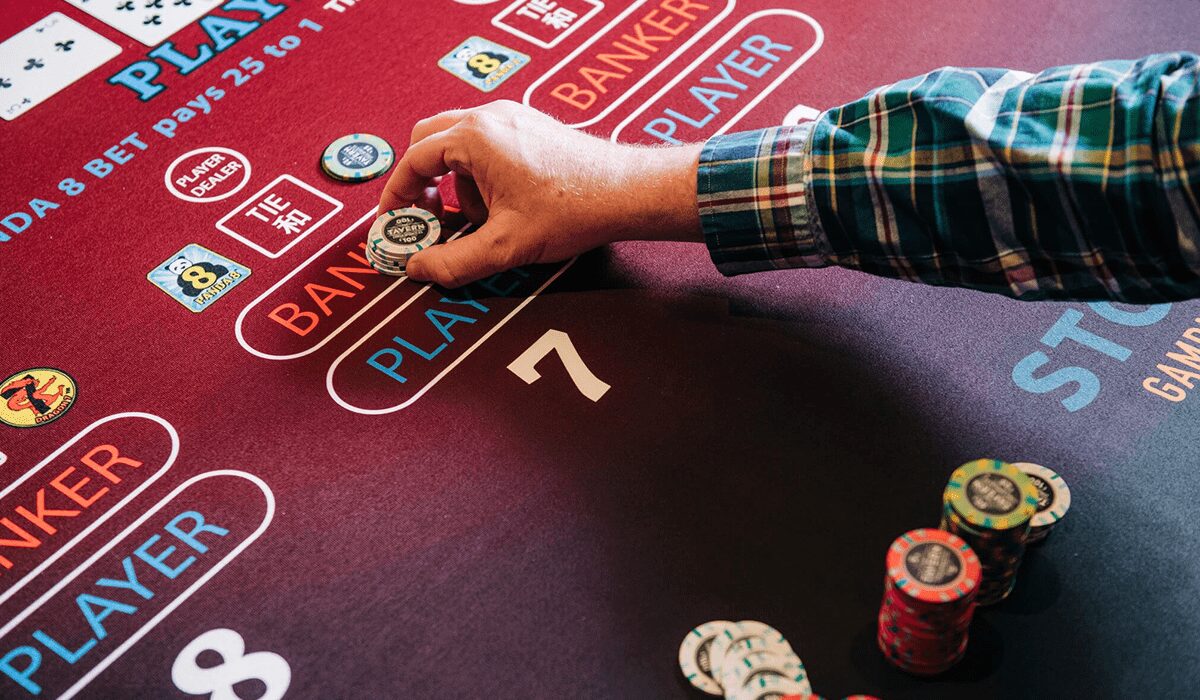
Baccarat keeps things very simple. There are really only three main bets: Player, Banker, or Tie. From there, casinos have added some side bets and variations like Pairs or Bonus bets, but the essence of the game is the three main bets.
That’s actually why baccarat is so popular with both beginners and high rollers. I have a theory that when you first start playing in casinos, you prefer simplicity because you’re still learning.
When you get some experience, you start experimenting with different games and strategies, but when you get to the ‘high roller’ or ‘whale’ level, you get back to the basics – stick with games with limited betting decisions and high RTP. And that’s where baccarat shines, offering an RTP of almost 99%.
I’ll break down every bet you’ll find in standardised baccarat, but first, I’ll explain the scoring system and how much each card is worth.
I’ve noticed that most newbies don’t have a problem with the rules of baccarat, but with the scoring system. If you have played card games like blackjack, your brain is ‘wired’ to see the value of face cards as 10. In baccarat, cards don’t carry their ‘normal’ values. Here, the aim is to get as close to 9 as possible, and this is what each card is worth:
- Aces always count as 1
- Number cards from 2 to 9 are worth their face value
- 10s, Jacks, Queens, and Kings count as 0
A hand of a Jack and an 8 is worth 8, not 18. Now, if your hand is worth 10 or over, the first digit is dropped. For example, if you get a 7 and an 8, the added total is 15, but it counts as 5. If the other hand has a 7 and a 2, they win.
The highest possible hand in baccarat is a ‘natural 9,’ followed by a ‘natural 8,’ so if either the Player or Banker hand gets a natural 8 or 9 on the initial deal, that hand wins and the round ends without drawing additional cards. I’ll explain the drawing rules for the Player and Banker below, but for now, you need to remember that baccarat is a comparing game where the two hands are compared, and the one closest to 9 wins.
The Player bet means backing the Player hand to finish closer to 9 than the Banker hand. It’s considered the simplest bet in baccarat, but I don’t see it any simpler than the Banker bet. If you win, the payout is 1:1. There’s no commission on this bet, which means that the payout is 100% yours. If you were to place a A$100 bet on Player, and the hand wins, you win A$200. That’s why many consider it ‘cleaner’ compared to the Banker bet, where the casino takes a 5% cut.
In practice, here’s what happens: the Player hand is dealt two cards. If those two cards total 6 or 7, the Player stands and no more cards are drawn. If they total 0-5, the Player automatically gets a third card. And if the Player’s first two cards make an 8 or 9, that’s called a natural. In the case of a natural on any side (Player or Banker), the round stops immediately, no one draws, and the higher total wins. If both hands have the same score, it’s a Tie.
Statistically, the Player bet is a bit weaker than the Banker bet. The house edge is 1.24%, which is much smaller than many other games in the casino (like roulette, for example), but slightly worse than the Banker’s 1.06%. Still, many players stick to the Player bet because they see it as a simpler one; the third card rule is straightforward, and it doesn’t involve paying commission.
The big misconception is that if you bet on Player, you’re somehow the Player yourself. Remember, the hand in baccarat is just a label, as both hands are dealt automatically by the dealer, and you’re only betting on the outcome.
The Banker bet is statistically the strongest bet in baccarat, and I always recommend it if you’re playing the standard version. With this bet, you back the Banker hand to come closer to 9 than the Player hand. If it wins, the payout is 1:1, but unlike the Player bet, there’s a 5% commission taken from your winnings, so if you were to bet A$100 on the Banker and win, you’ll win A$195. The commission is paid because the Banker is the mathematically stronger side, but even with it, the Banker is still the stronger side.
So, why does the Banker bet have the edge? It’s all about the third-card drawing rule, which favours the Banker hand. At the start of every round, both the Player and Banker hands get two cards, and if either side has a natural 8 or 9, it wins immediately. But if there’s no natural, things get more complicated.
If the Player has a score of 0 to 5, they always draw a third card first, and the card they draw affects what the Banker does (which is where the advantage comes in). This is the third card rule for the Banker:
- If the Banker has a 0-2, they always draw a third card regardless of what the Player draws.
- If the Banker has 3, they draw a card unless the Player’s third card was an 8.
- If the Banker has 4, they draw a card if the Player’s card was 2-7.
- If the Banker has 5, they draw if the Player’s third card was 4-7.
- If the Banker has 6, they only draw if the Player’s third card was 6 or 7.
- If the banker has 7, they always stand.
I know that this sounds very complicated, but what these rules mean is that the Banker doesn’t follow a fixed formula like ‘draw on 0-5, stand on 6 and 7’, but it reacts to what the Player’s third card was.
Let’s say that the Banker has a total of 4. Hypothetically, if the Player stood, the Banker wouldn’t draw because the chance of improving is low.
However, if the Player draws a third card 5, the Banker’s conditional rule says that they must ‘draw’ on 4 when the Player’s third card is 2-7. It’s important to point out that the Banker doesn’t choose whether to draw. The drawing rules are fixed for the Banker bet, too.
Essentially, the Banker has an extra piece of information (that the Player’s third card was a 5), which changes the expected value of drawing enough to justify taking a card. If the Player’s third card was an 8, the Banker would stand on a total because the Player’s third card makes a Banker draw less desirable. It’s not much, but these small adjustments in many different scenarios tilt the advantage slightly toward the banker.
Tip from Australian Gamblers: Despite the 5% commission, I suggest you always take the Banker bet. Statistically, the Banker hand wins ~45.86% of rounds, the Player hand wins ~44.62% of rounds, and ~9.52% of rounds end in a Tie, so despite the 5% commission, the Banker bet has the better odds of winning and a house edge of just 1.06%.
The Tie bet in baccarat happens when the Player and Banker hands finish with the same total, whether after two or three cards. In other words, it doesn’t matter if the Tie happens after a natural 8 or 9, or after a third card has been drawn according to the drawing rules.
Expectedly, the Tie is the least common outcome in baccarat, so the payout for this bet is 8:1. However, although the payout looks good, this is the worst main bet you can take.
The house edge is extremely high at around 14.36%, which is far, far worse than the Player or Banker bets. This is because the payout doesn’t reflect the true odds, and Ties are not very common in practice.
Statistically, if you were to bet on Tie ten times in a row, you would win only about 1 in 10, which means that your wins won’t cover for your losses. Most players generally avoid the Tie bet entirely because mathematically, it’s a trap.
Side bets are fairly common in baccarat, especially in online casino baccarat tables. They’re a modern casino invention to make the game ‘more exciting,’ but in reality, they’re a way for the casino to make more money. While they can be fun for a bet or two, they come with a much higher house edge, which means they’re a terrible choice in the long run.
Some popular baccarat side bets are:
- Pairs – It’s a side bet that the first two cards dealt to either the Player or Banker will be a pair, like two 7s or two Kings. The payout is usually 11:1, but it still has a house edge of over 10%.
- Player/Banker Bonus – With this side bet, you’re betting that the Player or Banker will win with a margin of 4 points or more (like 9 vs 5, for example). It usually pays 7:1 or 8:1, but the house edge is from 4% to 6%, so it’s not really a good bet.
- Perfect Pairs – This is a popular side bet which requires that both cards be identical in rank and suited (like, two As of Spades, for example). The payout is 25:1, but the odds are extremely low, so they’re more of a gamble than a bet you want to be making long term.
How to Play Baccarat?
Baccarat is genuinely easy to play, especially if you stick to the two main bets, Player and Banker. So, let’s go through how a standard round of baccarat plays out:
1
Choose your chip size, and place it on the Player, Banker, Tie, or any of the side bets. The bets are usually very clearly displayed, regardless of whether you play live dealer online baccarat, RNG baccarat, or you are in a casino.
2
Once every player on the table has placed bets (a standard baccarat table has 14 seats, but Midi and Mini tables with fewer seats exist too), the dealer will close the bets and deal two cards to both the Player and Banker face up.
3
After the initial deal, if any hand has a ‘natural’ (a score of 8 or 9), the higher total wins, and the round ends. All players on the table are paid out.
4
If neither hand has a natural, the dealer follows the third card rule for the Player first. Once the Player receives their third card, the Banker hand follows its more complicated third card rules.
5
There’s no option to draw a fourth or fifth card. The game ends after the third card is dealt. The totals are compared, and the dealer declares the winning hand.
The sequence is the same for every standard baccarat game, be it with a real dealer, RNG game, online, or at a casino venue. There are some baccarat variations that play out differently, and I’ll explain some of them below.
Different Types of Baccarat
There are 30+ known baccarat variations, and contrary to games like roulette or craps, where the rules are largely the same, with baccarat, the rules can be very different.
Punto Banco is just a synonym for standard Baccarat. It’s the most popular variant where you can bet on Punto (Player), Banker (Banco), or Tie (Egalite).
Chemmy is the actual variant that James Bond plays in Casino Royale. It’s one of the oldest baccarat versions, and it’s hard to find at online casinos. Here, the Players actually play in the game against the Banker, and the third card is drawn face down. If you’re the Banker in Chemin de Fer baccarat, you do need to pay out the other players.
Dragon Tiger is a very popular live casino variant. It’s not really baccarat, but it’s a card comparison game, so people often consider it to be a variant of baccarat. The Dragon and the Tiger get one card each, and the side with the higher card wins.
EZ Baccarat is also known as ‘no commission baccarat’ because it doesn’t charge the usual 5% commission on Banker wins. Instead, there’s a special rule where the Banker wins with a three-card 7, which results in a push rather than a standard payout. What’s important for you is that the RTP is a bit higher at almost 99%.
Super 6 is probably the second most common variant (after Punto Banco) you’ll find at Australian online casinos. It follows the standard Punto Banco rules, but there’s no 5% commission on Banker wins.
Instead, the Banker bet pays half if the Banker has a total score of 6. However, the RTP is largely the same, so it doesn’t really matter if you choose Punto Banco or Super 6. The only real difference is that Super 6 adds a ‘Super 6’ optional side bet that pays out 12:1 (if one side has a 6).
This variant is only available in some land-based casinos in Asia or as a live casino game. The idea is that the ‘squeeze’ adds suspense to the game.
The rules are exactly the same as standard baccarat, but the cards are first dealt face down, and the dealer takes around 5-6 seconds to turn them up. My tip would be to avoid this variant because if you’re anything like me, you’ll be cringing out on the ‘squeeze’, and it’s super-frustrating to wait so long to get the result.
Where to Start Playing Baccarat Online
Baccarat is a popular game, so it’s widely available at almost every Australian casino. There are usually several available variations, like Punto Banco or Super 6, so you’ll easily find a table with a betting range that suits you.
These are the steps to follow to get started:
1
Pick a reputable online casino from our website or do your own research.
2
Complete the registration and verification process, which usually takes a few minutes.
3
Place a deposit. First, choose a preferred method, be it cards, e-wallet, or crypto, and top up your account.
4
Check for welcome bonuses, because the majority of casinos on our website offer them (but always read the T&Cs first).
5
Find a baccarat variant. RNG baccarat games are usually located in the Table Games section, while live dealer variants are placed in the Live Casino.
6
Select your preferred table based on the betting range. Then, choose a chip denomination and place a bet.
Basic Baccarat Tips & Strategies
My first and most important tip about baccarat is to stick to the basics. Choose a standard game, either Punto Banco or EZ Baccarat, and play the basic Player or Banker bets. I prefer the Banker bet because it has the lowest house edge, but the difference between the two is rather small, so the Player bet makes sense too.
As with any other casino game, baccarat is a game of chance, and that’s even more emphasised here because you don’t participate in the game – you just place bets and observe. However, there are still ways to play smartly:
- Avoid the Tie bet: The Tie bet is just a bad bet. It has a house edge of 14%, so it makes no sense to play it.
- Avoid ‘exotic’ side bets: I would avoid all side bets altogether, but if you really want to take a side bet, it’s better to bet on Player/Banker Bonus that comes with 4-5% house edge than some ‘exotic’ side bet like Perfect Pairs, where the house edge is often higher than 15%.
- Stick with Banker bets when possible: You can’t beat maths, and statistically, the Banker bet wins slightly more often. It’s the better bet even with 5% commission, but if you can find a baccarat variant without commission, even better!
- Manage your bankroll: Except for Squeeze Baccarat, the standard game moves rather quickly, so I suggest you set a budget before you start and choose a bet size that allows you to play multiple rounds. Try to bet up to 2% of your total bankroll per round and don’t get greedy if you hit a winning streak, or desperate if you hit a losing streak.
Before You Hit the Baccarat Tables
The standardised version of baccarat (Punto Banco) is really simple. Leave Chemin de Fer and the other complex variants to the pros, and stick to the basics. The game is quick, so the bankroll moves quickly, which means you need to pay attention to what’s happening on the table.
But since there are just three bets (out of which only two are actually good, Player and Banker), this is a much simpler game than blackjack, craps, or even roulette. If you follow my advice and stick to the Banker bet, you only decide on your bet size. And that’s a good choice, because the Banker bet is one of the bets with the best odds in the casino.
The standard game is played with 8 decks, so you can’t realistically count the cards, and even if you could, card counting is useless because the outcome in each round is independent of the previous round. And sure, the side bets sometimes look tempting, but I guarantee that they’ll eat into your bankroll if you use them often, so my advice is to just keep it simple and enjoy the rhythm of the game.
Latest Articles


Disclaimer: Gambling in Australia is strictly for individuals aged 18+. Our editorial team adheres to a strict policy to ensure that our reviews, recommendations, and content remain objective and free from external influence. We strongly encourage responsible gambling at all times. If you or someone you know is struggling with gambling addiction, visit the following gambling resources:
- https://responsiblewagering.com.au/
- https://www.gamblinghelponline.org.au/
- https://gamblershelp.com.au/get-help/