



As the name suggests, you play with three cards, and there’s no flop, turn, or river. The whole game feels more like a combination of blackjack and baccarat than poker, which is why you’ll often find it as an RNG and live dealer game in online casinos.
In this guide, I’ll go through everything you need to know about how Three Card Poker works, including the rules, payouts, and different versions. I’ll also share a few tips on how to do well in Three Card Poker and my own findings from my 200-hand test with this game.
What Is Three Card Poker
Three Card Poker was created by British poker pro Derek Webb in 1994. So, even though it’s an ‘old’ game by online casino standards, it’s relatively new as a poker game. His idea was to design a poker-style game that can be played faster than traditional Texas Hold’em and Omaha, and works better in a casino setting.
The goal was to create a game that’s simple enough for casual players, but still built around real poker hands. So, after a few years of testing it and “fine-tuning” the concept, he revealed the game in Las Vegas.
We poker players are notorious for being sceptical about changes, so expectedly, the game wasn’t very well accepted in poker circles. Surprisingly (or not), it was very well received by casual players, so it quickly spread through land-based casinos around the world, including those in Australia.
Is it a real poker game? Well, it depends on who you ask. Purists will tell you it’s not “proper” poker because there’s no bluffing, betting rounds, playing against other players… You know, the things that make poker the game it is.
But as a former professional poker player, I’d still say it’s poker. Okay, maybe semi-poker? You’re still using the same hand rankings, you’re still comparing cards, but instead of playing against other players, you play against the dealer.
Today, you’ll find Three Card Poker at just about every Australian online poker site, both as a standard RNG version and in live dealer format. The rules are the same in both cases, and the only difference is whether you’re playing with a computerised dealer or a real one streamed live.
The key thing to understand is that this isn’t a traditional poker game. You’re not competing against other players at the table – it’s just you vs the dealer, similar to blackjack. You’re dealt three cards, the dealer gets three cards, and the goal is simply to make a better hand. You can’t “bluff” the dealer because all the cards are dealt pre-showdown, so it’s largely a game of luck.
Before the cards are dealt, two main bets: the Ante bet, which is your main wager against the dealer, and the optional Pair Plus bet, which pays out if you have a pair regardless of the end result.
Some casinos also include an extra 6-Card Bonus side bet, but the basic structure always revolves around those first two.
How to Play Three Card Poker
I’m guessing you’re used to standard poker like Texas Hold’em, so Three Card Poker will seem a bit weird at first. But I guarantee you’ll learn how it works in no more than a few minutes.
That’s why I’m here to help, after all, so check out how to play Three Card Poker step by step:
1. Place the Ante Bet
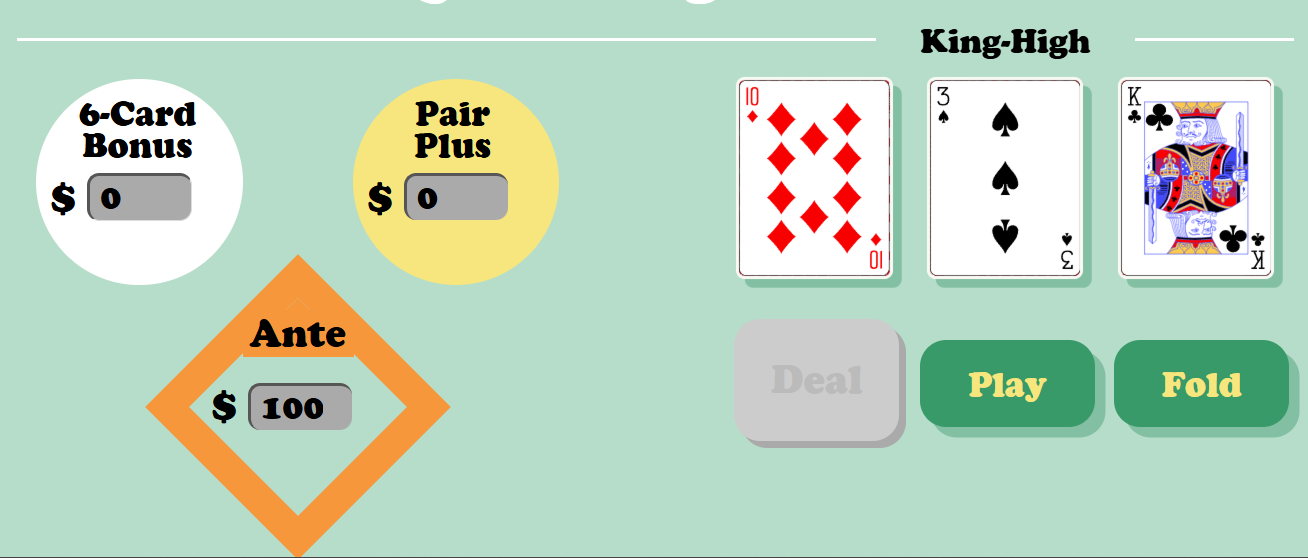
The Ante in Three Card Poker is the main bet to start playing a hand, and it’s a bet against the dealer. If you want to start playing, you put the chips in the Ante circle, and you’ll receive three cards.
So, the ante here is very different from the ante in traditional (Texas Hold’em) poker, where it works as a forced bet to seed the pot (in later stages of tournaments).
Now, this is how the ante bet works: you place your chips, and both you and the dealer receive three cards each. You get to see your three cards, and based on them, you have a decision to make – forfeit the ante or make the Play bet, which indicates that you do want to play against the dealer (with the cards you have been dealt). I’ll explain why this is important.
2. The Optional Play Bet
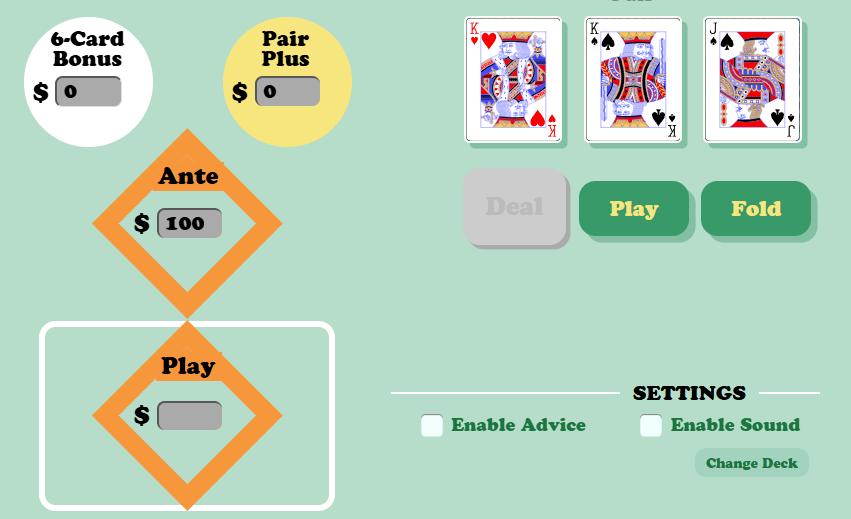
If you do decide to play after the ante bet, it means that it’s showdown time. The dealer turns their cards, and if they have a Q-high or higher, the Play bet continues. If they don’t, the Play bet pushes, and you either win or lose the ante, depending on the outcome. Note that the Play bet’s value is determined by the Ante bet, so you can’t bet more or less after you see the cards.
Note how I said that you get to decide whether to play after the ante bet. That’s because the Play bet is optional. Based on the quality of your hand, you decide whether you want to play against the dealer or not. If you don’t, you lose only the ante. If you decide to play, you compare your hand to the dealer’s.
Let’s take a quick example of a standard Three Card Poker hand:
Scenario 1
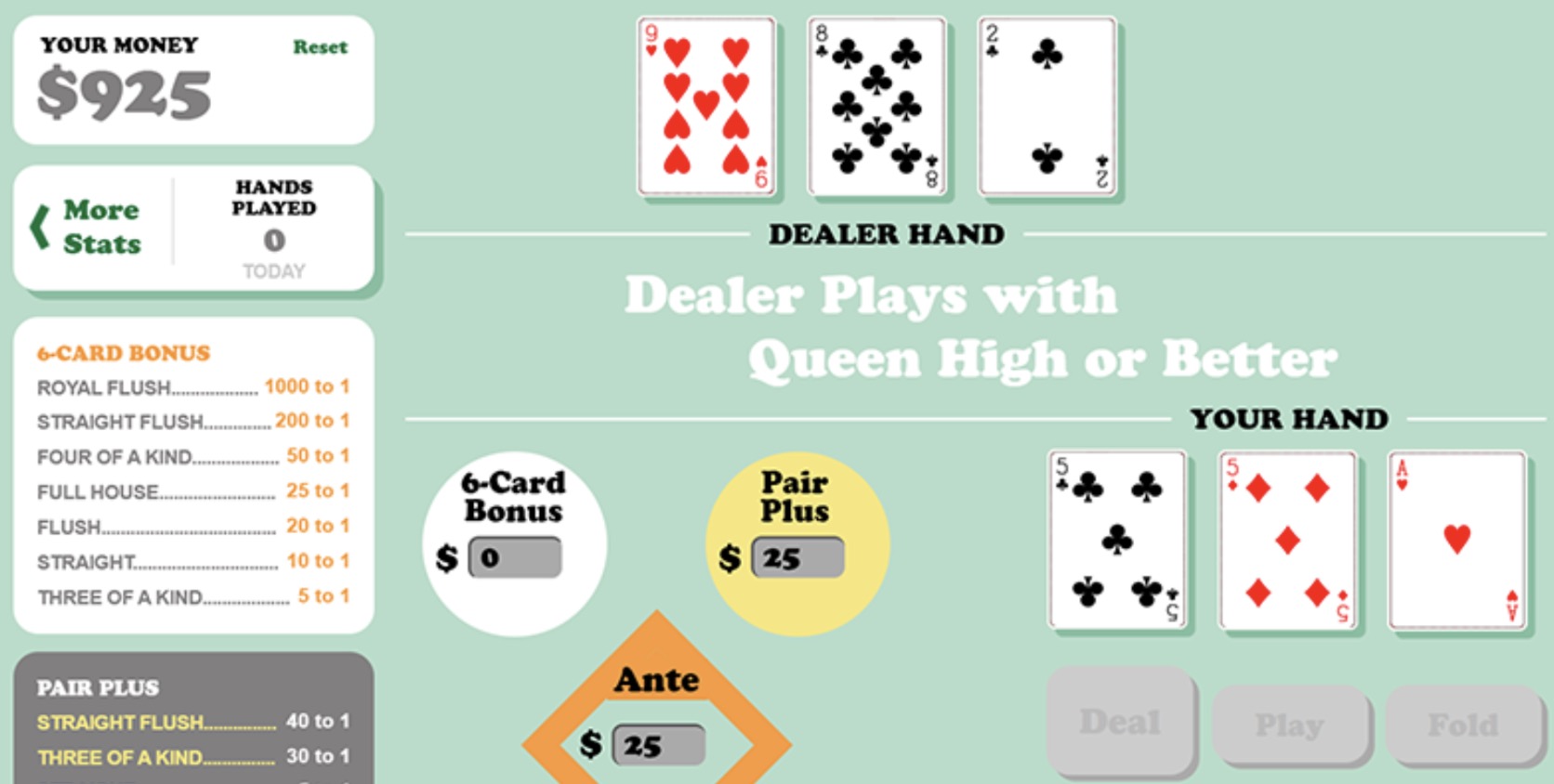
- You place a A$10 Ante bet.
- Your hand is 5 Clubs, 5 Diamonds, and an Ace of Hearts. You’ve got a small pair and a high kicker, so you like your hand. You decide to Play bet.
- The dealer gets a 9 of Hearts, 8 of Clubs, and 2 of Clubs. They don’t qualify, so you win the A$10 you wagered and +A$10 for the Ante bet, which means the payout for the ante bet is 1:1.
Scenario 2
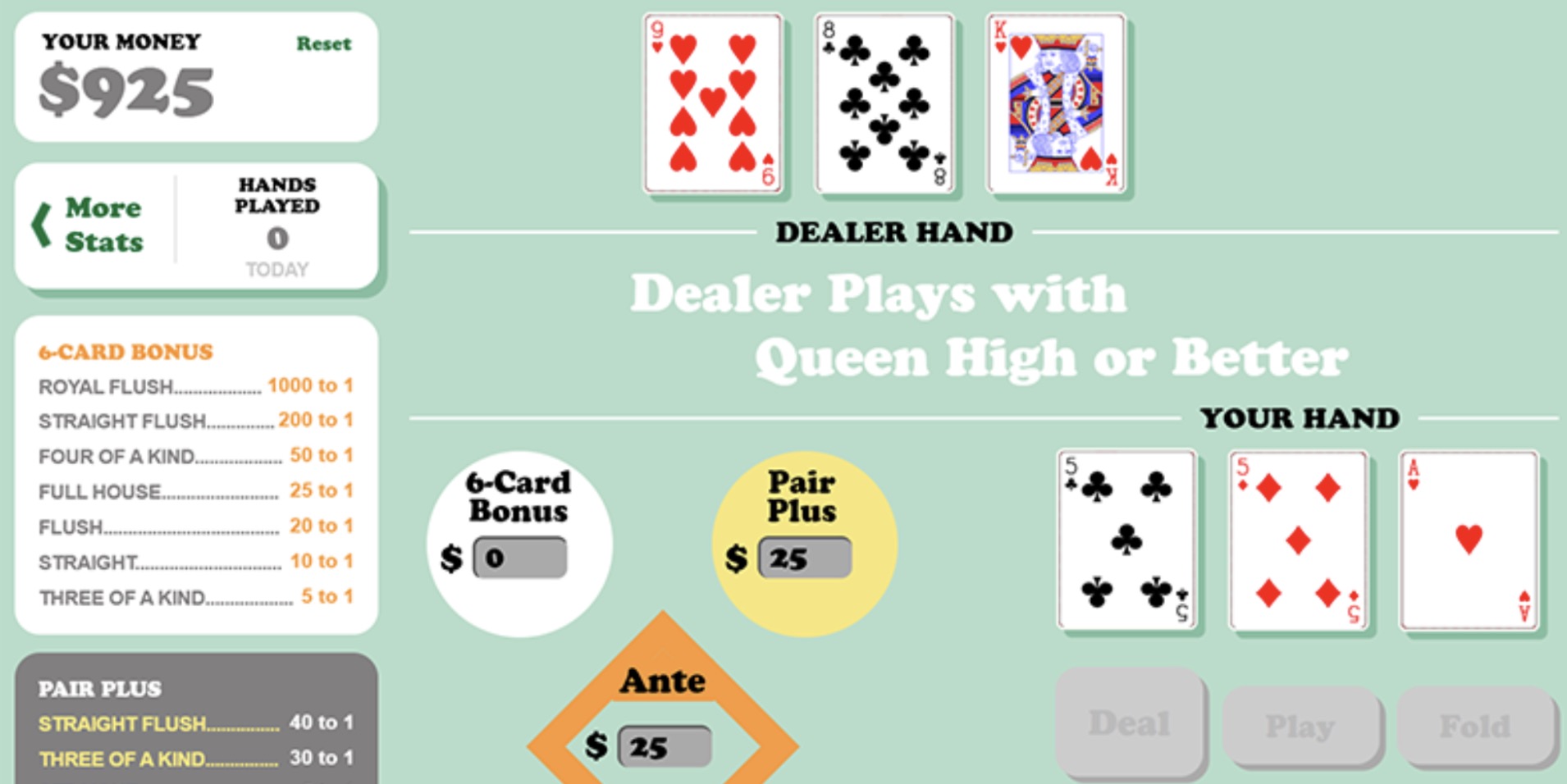
- You place a A$10 Ante bet.
- Your hand is the same 5 Clubs, 5 Diamonds, A hearts – so you’ve got a 5-pair with a strong kicker.
- The dealer gets K Hearts, 9 Hearts, and 8 Clubs. Their hand is a K-high, but this time, they do qualify for the Play bet; however, their hand is weaker, so they lose. You win A$30 in total, +A$10 for the ante bet, and +A$10 for the Play bet.
Scenario 3
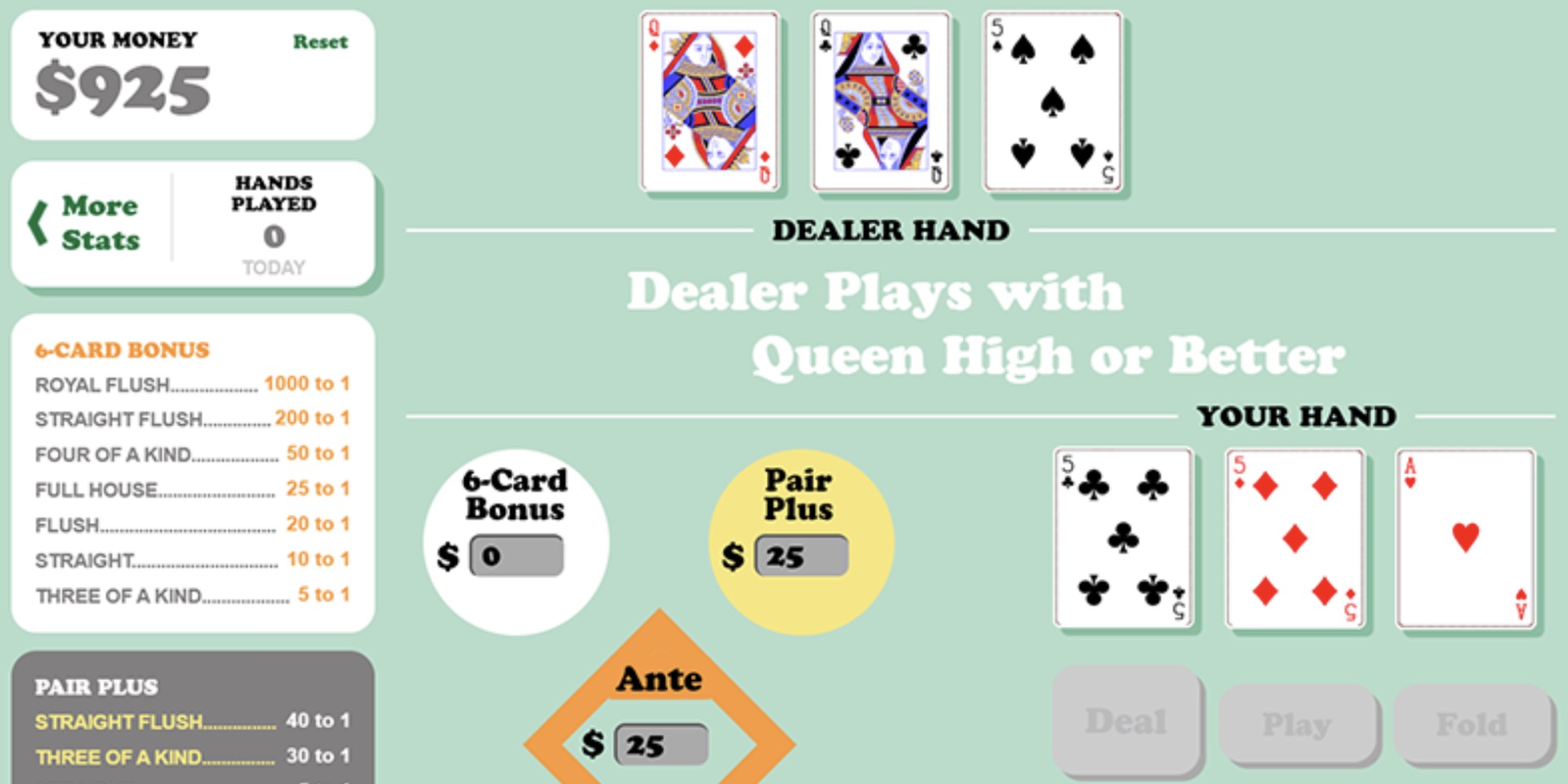
- You place a A$10 Ante bet.
- Your hand is the same 5 clubs, 5 diamonds, A hearts, so your hand is a 5-pair and A-kicker.
- The dealer gets Q Clubs, Q Diamonds, 5 Spades. They have a stronger hand, so they win.
- You lose your A$10 ante and your A$10 play bet, so you lose A$20 in total.
Scenario 4
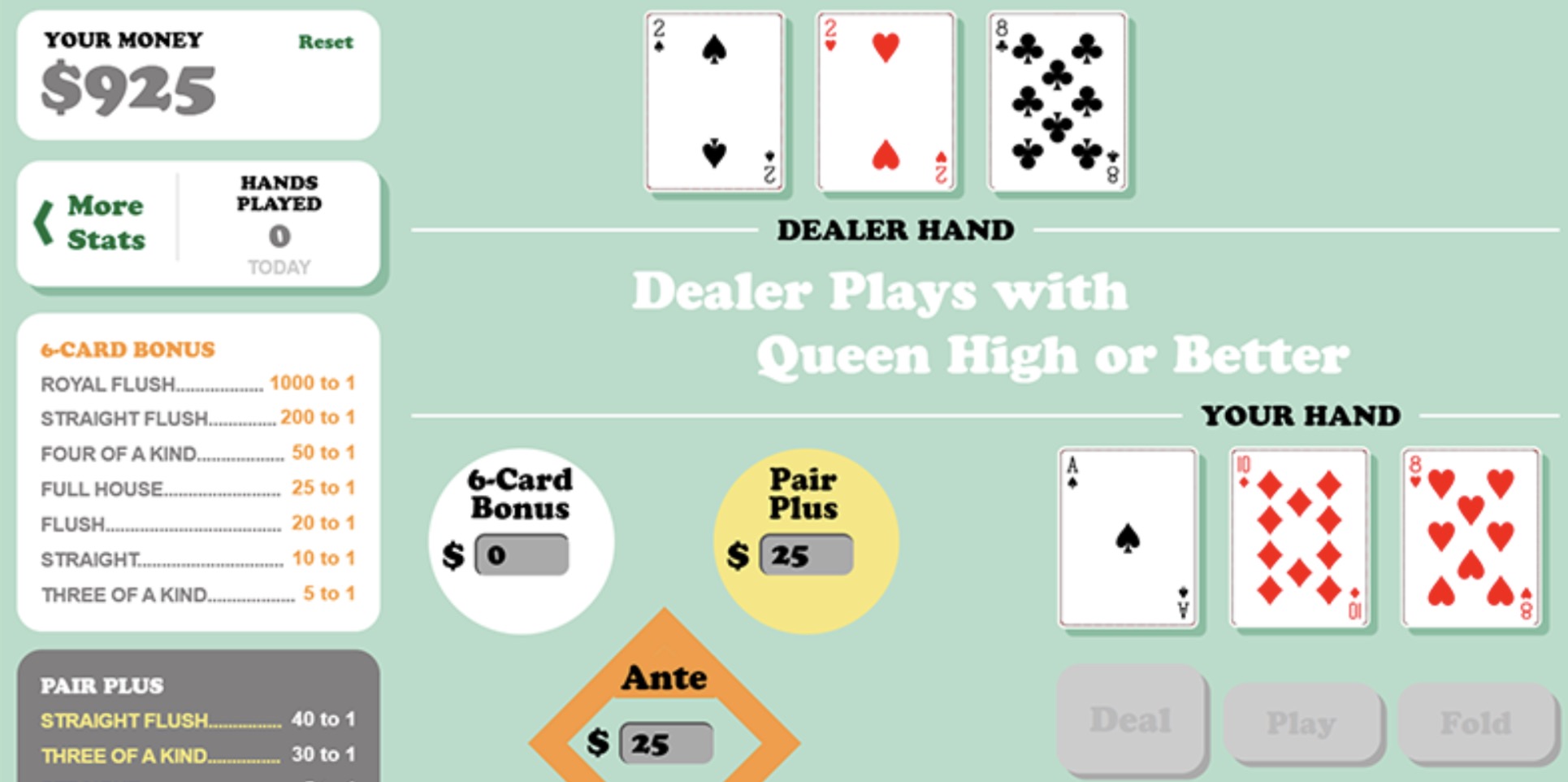
- You place a A$10 ante bet.
- Your hand is A Spades, 10 Diamonds, and 8 Hearts, so you decide to play with an Ace-high hand.
- The dealer gets 2 Spades, 2 Hearts, 8 Clubs. Their hand is stronger because they have a pair, so they win the ante bet. However, since they don’t qualify for the Play bet (they don’t have a Q-high or higher), you only lose your Ante bet, but your money on the Play bet is returned.
3. The Ante Bonus
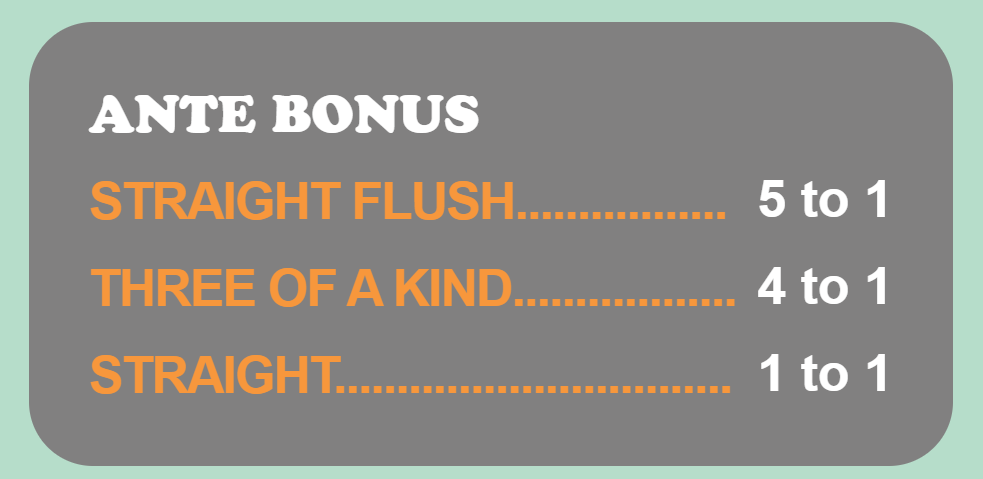
Many Three Card Poker games have an Ante bonus, which is a bonus to the ante bet if you win with a special hand, like a Straight, Three of a Kind, or Straight Flush.
Typically, the bonus for a Straight-bet win is 1:1 (on top of the Ante bet win), the bonus for Three of a Kind is 4:1, and the bonus for a Straight Flush is 5:1.
4. The Optional Pair Plus Bet
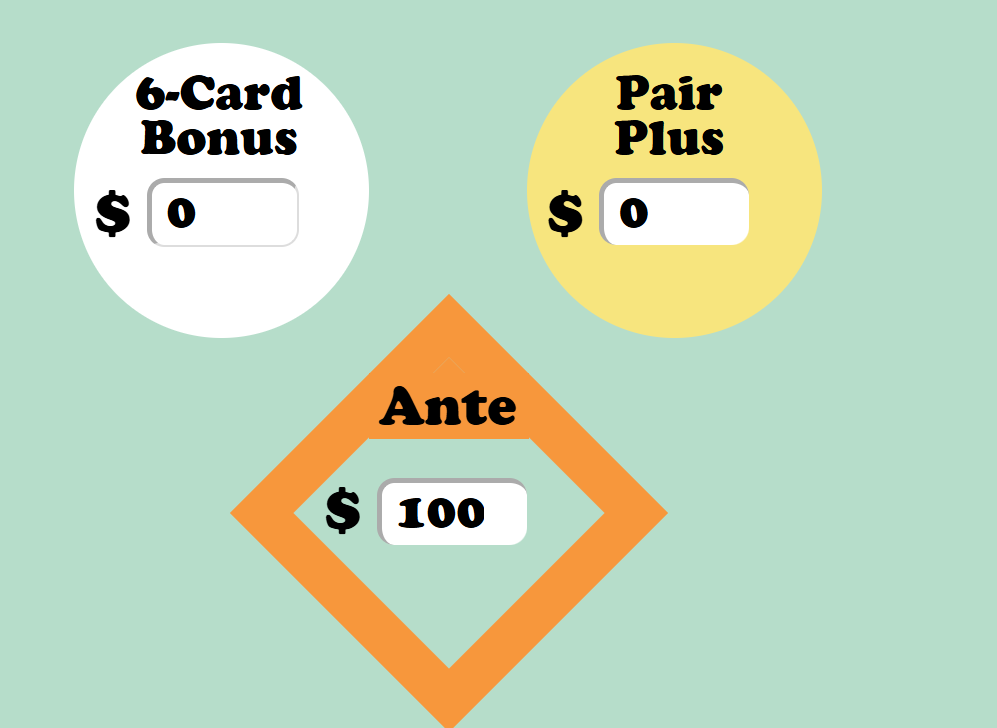
All of the bets I’ve been explaining so far are a part of the standard game. The Pair Plus bet is a completely separate side bet in Three Card Poker. It has nothing to do with the dealer or whether they qualify – it’s all about your own three cards. You’re betting that your hand will form at least a pair or better, and the higher your hand, the bigger the payout.
You can place this bet by putting chips in the Pair Plus circle that’s usually next to the Ante bet, and if you qualify for a payout, you will be paid out once the round ends.
Here’s a table with the typical payouts for the Pair Plus side bet in Three Card Poker:
| Hand | Typical Payout |
|---|---|
| Straight Flush | 40:1 |
| Three of a Kind | 30:1 |
| Straight | 6:1 |
| Flush | 3:1 |
| Pair | 1:1 |
Note from Australian Gamblers: I always advise against side bets in games like blackjack and baccarat, and Three Card Poker is no exception. The RTP for the Pair Plus side bet is 95.51%, which is slightly lower than the base RTP of Three Card Poker of 96.63% (with standard rules), so I don’t recommend you play this side bet.
5. The Optional 6-Card Bonus Bet
The 6-Card Bonus is another optional bet in Three Card Poker. This one looks at both your and the dealer’s three cards (hence the name), and together they form the best possible five-card poker hand. It doesn’t matter if you play the Play bet or whether the dealer qualifies, since this bet is a standalone one.
You place it at the same time you place your Ante bet (alongside it), and the best five-card hand made from any combination of your three plus the dealer’s three cards is evaluated for the bonus. If that five-card hand qualifies for a bonus (like Three of a Kind or a Flush), you’ll get paid out according to the paytable. Importantly, it doesn’t matter if you decide to Fold or Play in the main game.
Here’s the paytable for the 6-Card Bonus Bet:
| Hand (5-Card best out of 6) | Payout |
|---|---|
| Royal Flush | 1,000 :1 |
| Straight Flush | 200 :1 |
| Four of a Kind | 50 :1 |
| Full House | 25 :1 |
| Flush | 20 :1 |
| Straight | 10 :1 |
| Three of a Kind | 8 :1 |
Note from Australian Gamblers: The RTP of the 6-Card Bonus Bet is even worse at 91.44%, so I don’t recommend playing this bet either.
Hand Rankings and Payouts in Three Card Poker
Hand rankings in Three Card Poker are similar to standard poker, but not identical – mainly because you’re only working with three cards instead of five. Straights beat flushes here, which often surprises new players. The game uses simple odds and straightforward payouts, making it one of the easiest casino poker games to learn once you know the hierarchy.
Hand rankings in Three Card Poker are very similar to standard poker, but they’re not identical!
The differences are mainly due to the fact that you’re playing with three cards instead of five, but an important change is that straight beats a flush here. That took me out at first, but I realised that the odds of hitting a straight with 3 cards are lower than hitting a flush, hence the change.
Otherwise, the hand rankings are standard, and the payouts are 1:1 for the standard bets, so in the table below, I have listed the hand rankings from highest to lowest ranked and the ante and pair bonuses that are paid for each:
| Hand | Description | Ante Bonus | Pair Plus |
|---|---|---|---|
| Straight Flush | Three consecutive suited cards | 5:1 | 40:1 |
| Three of a Kind | Three cards of the same rank | 4:1 | 30:1 |
| Straight | Three consecutive cards | 1:1 | 6:1 |
| Flush | Three suited cards | / | 3:1 |
| Pair | Two cards of the same rank | / | 1:1 |
| High Card | Highest single card | / | / |
Note from Australian Gamblers: Since you’re only playing with three cards, the most common hand will be High Card, both for you and the dealer. So, what would be a weak pair in standard poker, like 5-5, is actually a strong hand in Three Card Poker.
Dealer Qualification Explained
I already touched on this earlier, but it’s worth repeating because this is the single most important rule in Three Card Poker. The dealer doesn’t actually “play” in the traditional poker sense – you make all the decisions. Once you’ve placed your Ante and decided whether to Play or Fold, you have decided whether the dealer will show their cards or not, and that’s where the “Queen High or Better” rule comes in.
To put it simply, the dealer can only qualify to play the Play bet if their three cards contain at least a Queen-high, so the highest card in their hand must be a Queen, King or Ace, or have a stronger hand like a pair, three of a kind, etc. If the dealer doesn’t qualify, the Play bet is returned, and you win the Ante.
Note from Australian Gamblers: There’s a big misunderstanding with the Queen-high rule that the dealer only qualifies if they have a Q or higher. Actually, the rule is that the dealer needs at least a Q-high hand, which means any hand that’s stronger than a Q-high automatically qualifies them (like a pair, three of a kind, etc).
You’re probably thinking that this rule favours the casino, but, in fact, it actually favours the player. This rule exists to balance the odds between you and the house, because it saves you money in weak-dealer situations. When the dealer doesn’t qualify, your Play bet is returned, and you still win even money on your Ante.
If this rule didn’t exist, the house edge in Three Card Poker would be around 5% instead of the 3.37% that it is now.
Basic Three Card Poker Strategy
To play or not to play, that is the question. Everything about Three Card Poker (talking about the main game here, not the side bets) revolves around when you decide to play and when you fold.
I’ve spent a lot of time with this game, and there’s actually a very clear mathematical sweet spot. Using an optimal strategy, the game’s theoretical RTP is around 96.63% (house edge of 3.37%), which is worse than games like blackjack and baccarat, but still not bad.
Always play with Queen-6-4 or better, and fold anything weaker.
The Queen-6-4 rule wasn’t made up by chance, but it’s the mathematical middle where you start gaining an advantage over the dealer. With a Q-6-4 hand, the odds are roughly around 0.001%, meaning that it’s basically neutral. Anything higher than that, like Q-7-4, or K-3-2, and you have the advantage over the dealer. Anything lower (Q-6-3 or J-10-7) statistically loses money in the long run.
This is just a continuation of the Q-6-4 rule, but any pair is stronger than a Queen-high hand with a 6 kicker, which means that you should always play any hand stronger than that, including even the smallest pairs.
To put numbers behind it:
- Playing every hand in Three Card Poker gives a house edge of around 7.65%.
- Folding too often (like folding Q-6-4 or better) lowers the RTP to about 95.40%.
- The Pair Plus and 6-Card Bonus Bet have lower RTPs of 95.51% and 91.44%, respectively.
Three Card Poker vs Standard Poker
Three Card Poker looks like a poker variant, but it’s built around a completely different philosophy. Standard poker games like Texas Hold’em are played between players, so they’re built around strategy and bluffing, and they’re competitive games by nature.
Three Card Poker is a comparison game where you compare your cards against the dealer, so the skill factor here is almost non-existent. There’s only one key decision you can really make each round: Play or Fold. And since the payouts are fixed, you know that you should play Q-6-4 or higher, and fold anything lower. So, Three Card Poker feels more like blackjack or baccarat than traditional poker, and only borrows the rankings of poker.
RNG vs Live Three Card Poker
There are two types of Three Card Poker you’ll encounter at Australian online casinos: RNG and live dealer.
RNG versions are like video games that are fully digital, so there’s no dealer who deals the cards, etc. The cards are drawn by a certified RNG (Random Number Generator) software, and you need to click on Deal to start a round.
Live Three Card Poker is streamed from a real studio, and there’s an actual dealer handling the cards. The bets are the same, but the pace is generally slower. Still, many players prefer this option because it feels more genuine.
My 200-Hand Test of Three Card Poker
To test how this game works in practice, I played 200 hands of Three Card Poker. I started with A$1,000, and I went big right from the get-go – playing with a bet size of A$100.
Two hands in, and I already hit a straight and won both the Ante bet, the Play bet, and an Ante bonus.
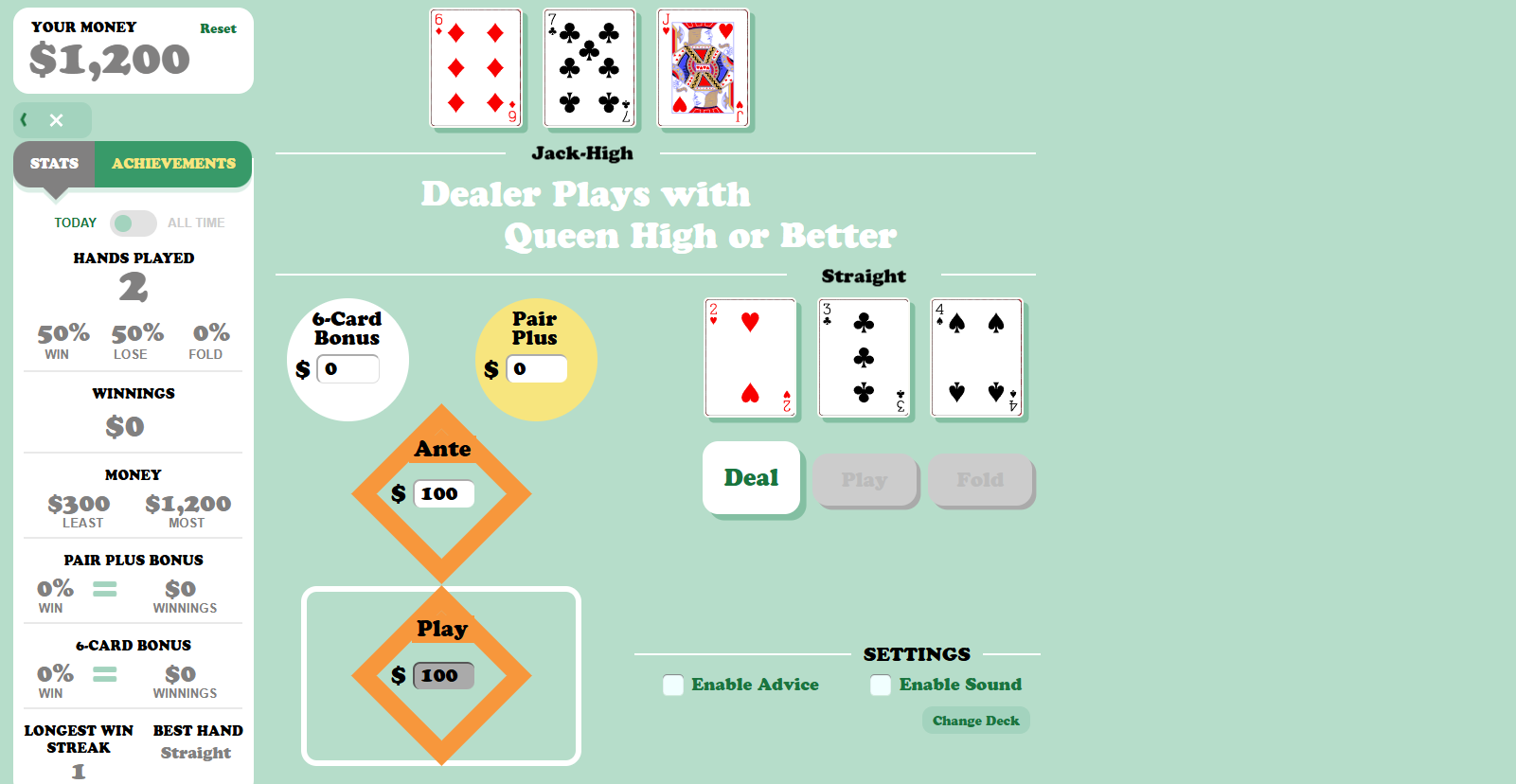
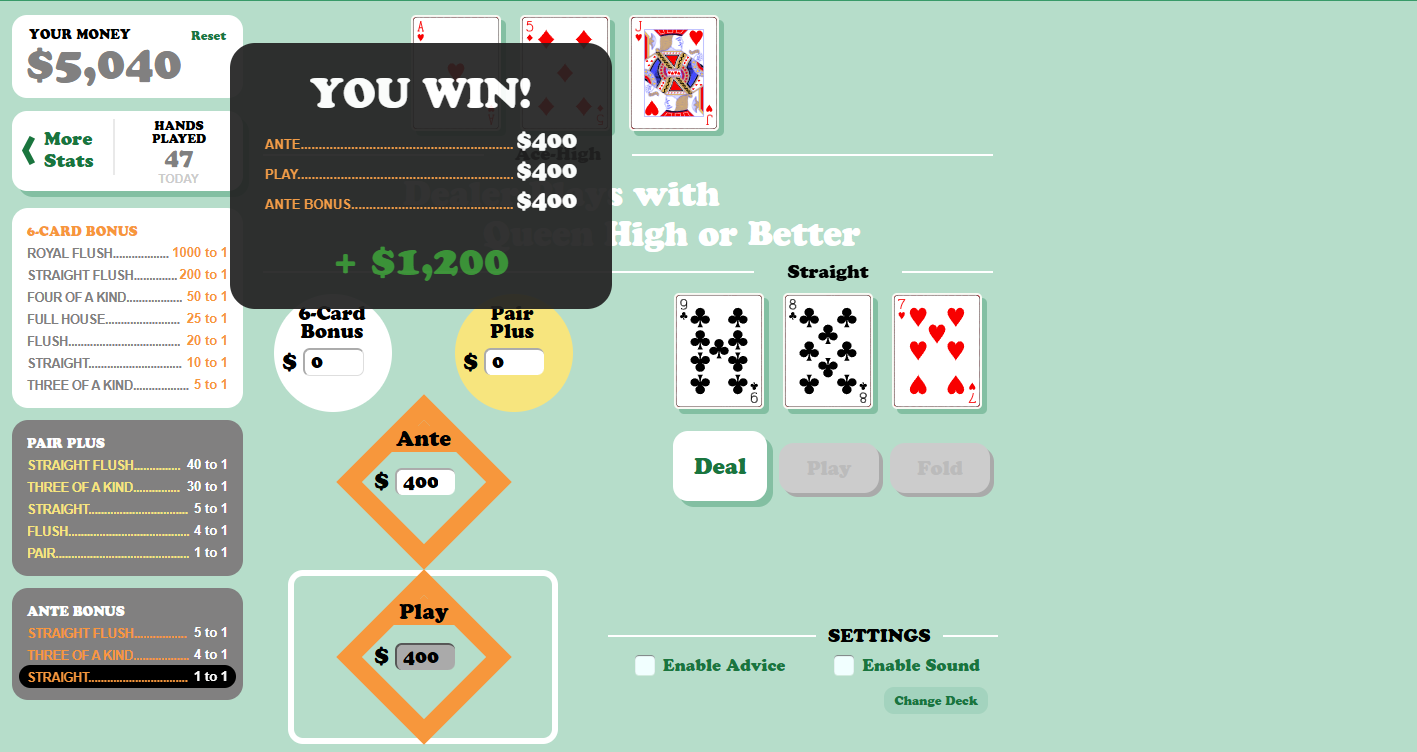
Unfortunately, after ~30 hands, I lost all my bankroll and had to put in another A$1,000. This time, I played with a smaller bet size of A$50. However, I soon realised that this wasn’t my day, and I lost again. It was time for a drastic strategy change. I bumped up the wager size to A$400 to see how the game plays with higher wagers, and luck finally turned on me. I won 6 times in a row, and got my bankroll up to A$5,040.
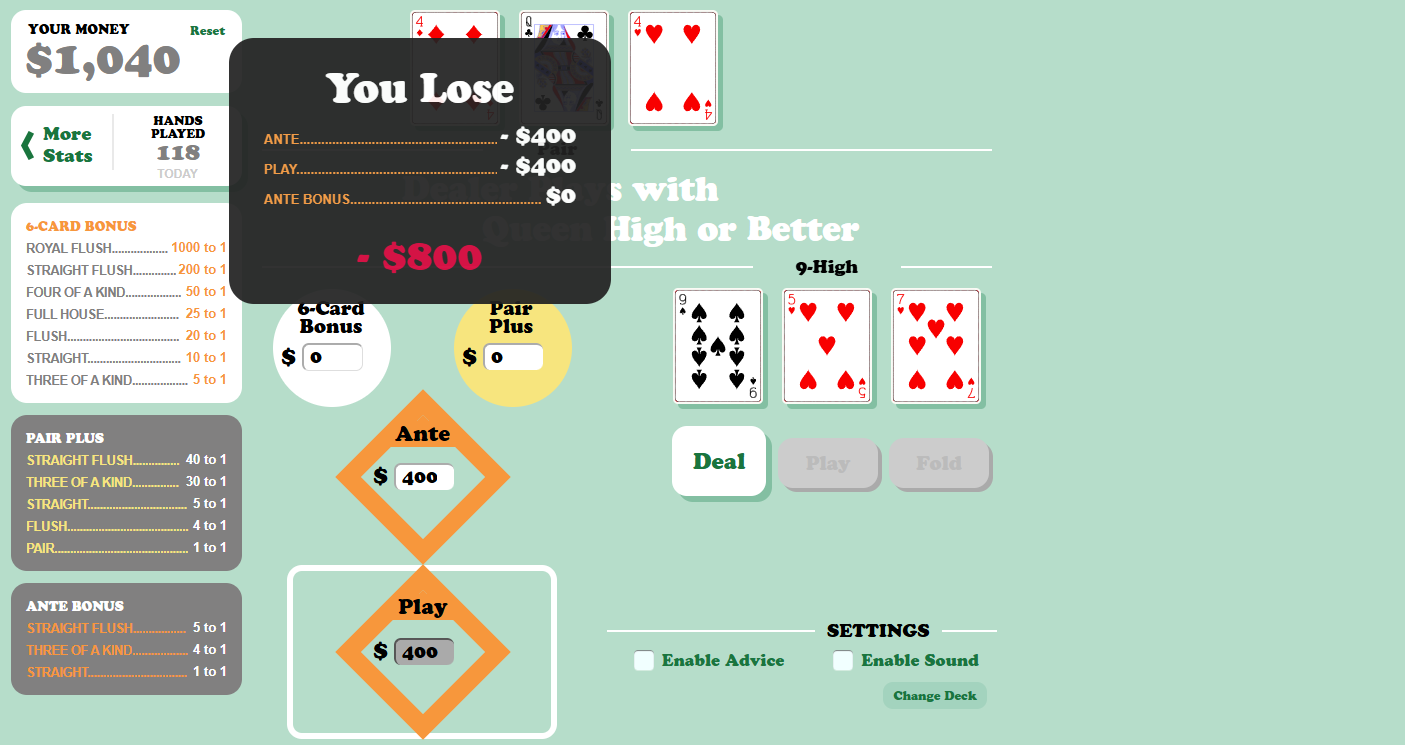
At hand ~120, I was still in the green, but after a series of losses, my bankroll dropped to around ~A$1,000 – exactly where I started.
I completed the 200 hands with A$900 in my bankroll, which is slightly worse than the advertised RTP of 96.63%, but if I had stopped playing around the ~50th hand, I would have been over A$4,000 in profit.
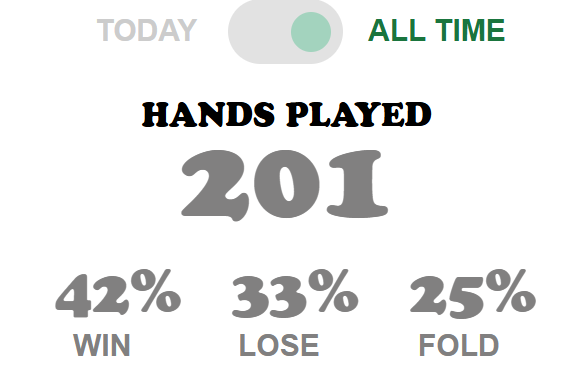
So, to share the findings of my test: Three Card Poker is a fun game that doesn’t necessarily feel like poker, but if you like games like baccarat, you’ll love it. I won 42% of the hands, lost 33%, and folded 25%, which lines up almost perfectly with the theoretical probabilities.
My Verdict: Should You Play Three Card Poker?
Three Card Poker is a fun casino game that I’d genuinely recommend to anyone who enjoys comparison-style games like baccarat or Dragon Tiger, because it follows the same principle of comparing the cards, but it still adds a bit of complexity and decision-making (which is not the case with baccarat, for example). You get to make one key choice every hand, which keeps things interesting.
That said, proper poker players probably won’t love it because there’s no real depth to the game, and it’s not a player-vs-player game where you have to outsmart them. The only real ‘strategy’ is to only play with a hand of Q-6-4 or better, so it’s almost entirely a game of luck.
FAQ
In Three Card Poker, you’re playing a card-comparison game against the dealer, not other players. You don’t play against other players, and your hand consists of 3 cards, which you compare to the dealer’s 3 cards.
The mathematically optimal strategy is simple: play with Q-6-4 or better, and fold everything weaker. This approach gives you the best possible rate of return of around 96.63%. Anything higher than that (like K-high or any pair) means that you have an advantage over the dealer.
No, card counting doesn’t work in Three Card Poker because the deck is shuffled before every single hand, whether you’re playing live or online. That means there’s no “running count” or memory from one round to the next, like there is in blackjack.
Latest Articles


Disclaimer: Gambling in Australia is strictly for individuals aged 18+. Our editorial team adheres to a strict policy to ensure that our reviews, recommendations, and content remain objective and free from external influence. We strongly encourage responsible gambling at all times. If you or someone you know is struggling with gambling addiction, visit the following gambling resources:
- https://responsiblewagering.com.au/
- https://www.gamblinghelponline.org.au/
- https://gamblershelp.com.au/get-help/