




What Is Ultimate Texas Hold’em Poker?
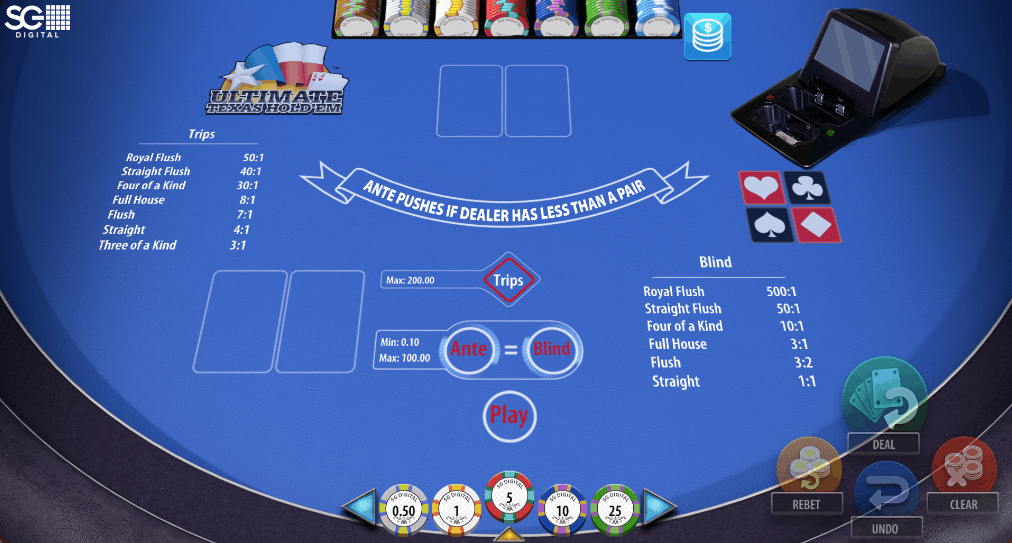
Ultimate Texas Hold’em is a casino table game based on Texas Hold’em, but instead of playing against other players, you’re playing directly against the dealer (just like Tri-Card Poker and Pai Gow Poker). It’s now available as both RNG and live dealer variants (under different names), but I’ll discuss the varieties later.
The most important point to remember is that, unlike in regular online poker, you do not play against other players in this variant. This is a single-player game (meaning it’s not PVP), and you play against the house. The house is represented by the dealer, and the goal is to form a better hand than the dealer.
You and the dealer both receive two cards, and five community cards are dealt on the table. From those seven cards, you need to make the best possible five-card poker hand. At the end of the round, your hand is compared to the dealer’s, and the stronger hand wins.
Obviously, unlike traditional poker, there’s no bluffing or reading opponents here, and, as the game’s rules indicate, ‘the outcome of the game is random, and the illusion of skill is for entertainment purposes only.’
Truth be told, I find this to be a bit misleading because there is indeed skill involved, but the ‘skill’ part is to make the right decisions at the right time, mainly whether to continue in the hand and how much to bet as the round progresses.
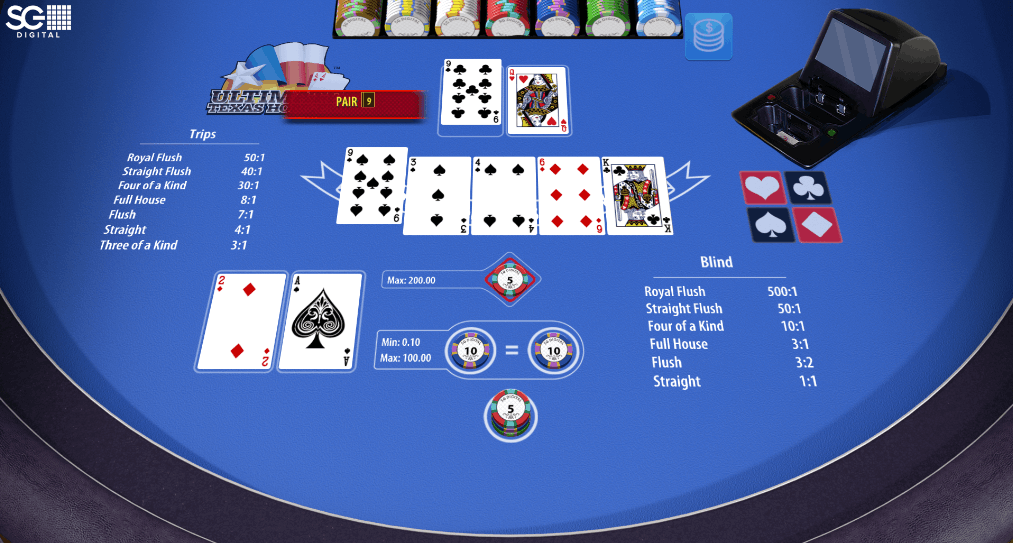
Ultimate Texas Hold’em was created in 2001 by Roger Snow, a senior executive at Shuffle Master, which was later purchased by Bally Technologies, and is now distributed by their sub-brand SG Digital.
The idea was to take the core mechanics of Texas Hold’em and turn them into a house-banked game that could work on a casino floor. Instead of competing against other players, you compete against the dealer while still using familiar poker rules. Thus, Ultimate Texas Hold’em was born, and it was immediately available in several Las Vegas casinos.
I remember the game being one of the most popular variants of the early 2000s, alongside other house-banked poker games like Video Poker, Jacks or Better, and Three Card Poker. All of them are now available at Australian online casinos as well, but being based on Texas Hold’em, this variant is the most popular one and has had the most re-creations.
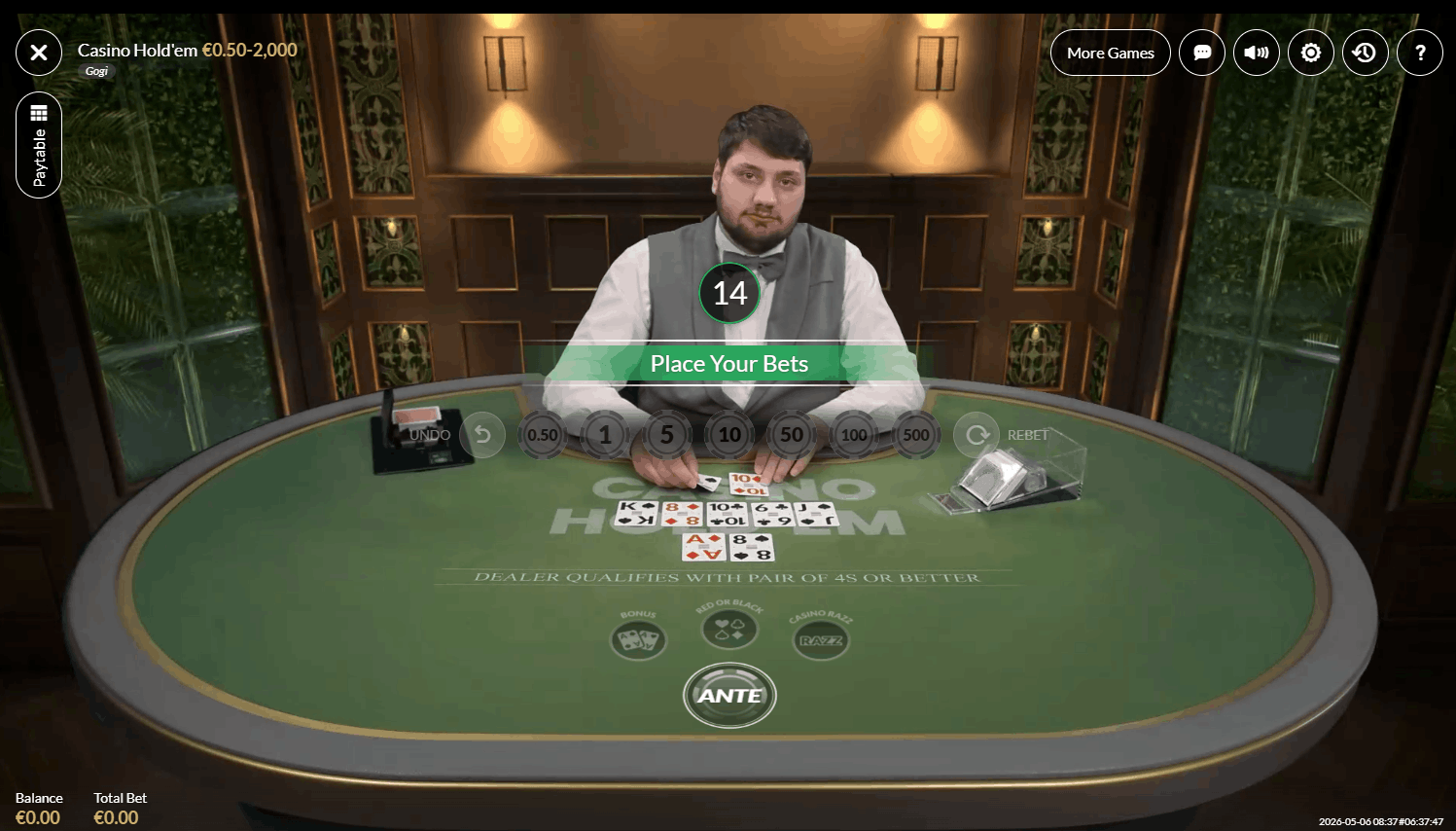
Note from Mike Waters: You’ll see plenty of Ultimate Texas Hold’em versions under different names. Some providers keep the original name, as Ultimate Texas Hold’em by TaDa Gaming, while others use titles like Casino Hold’em. Don’t let that confuse you – most of these games follow very similar rules, with only small differences in bets or dealer’s qualifying hand.
Ultimate Texas Hold’em Rules, Payouts, and Gameplay
I first tried Ultimate Texas Hold’em in a Las Vegas Casino in the mid-2000s, and let me tell you something: even if you have years of poker experience under your belt, this is an entirely different game.
Yes, you still need to make the best possible five-card poker hand using any combination of the cards and beat your opponent, but I suggest you read the ruleset first, especially around the Ante bet and the qualifying dealer hands.
The game is played with a standard 52-card deck, and the payout structure is fixed, meaning that you get paid based on your wager size.
To start, you place equal bets on the Ante and Blind (it’s mandatory to place both bets, so if you set the wager to, say, A$1, it means that you’re actually wagering A$2 in total) with the option to add a Trips side bet if you want. You and the dealer are then dealt two cards face down. You can look at your cards, while the dealer’s remain hidden.
At this point, you make your first decision. You can either check or make a Play bet of 3x or 4x your Ante, depending on the strength of your hand. For example, if you have a good hand, you can select the 4x Play bet.
The dealer then reveals the first three community cards, known as the flop. If you didn’t raise earlier, you can now act. You can check again or make a Play bet of 2x your Ante. If you have already raised before the flop, you don’t make any more decisions.
After that, the dealer reveals the final two community cards, the turn and river. If you’ve checked both times, this is your last decision. You either make a Play bet equal to your Ante or fold and lose your Ante and Blind.
Once all bets are locked in, both you and the dealer form the best possible five-card hand using your two cards and the five on the table. The hands are compared, and the round is settled.
The payout structure in Ultimate Texas Hold’em is a bit different from what you might expect if you’re coming from regular poker.
Since there are at least two wagers involved in every hand (Ante and Blind), plus one mandatory Play if you want to get to the showdown, the payout for each one of them is settled differently.
First, the dealer needs to qualify with at least a pair. If the dealer doesn’t qualify, your Ante bet pushes (you get it back), while your Play bet still gets paid 1:1 if you win. If the dealer qualifies, then both your Ante and Play bets are paid normally if your hand is stronger.
Here’s how the Ante and Play outcomes are settled:
| Winner | Dealer Qualifies | Blind | Ante | Play |
|---|---|---|---|---|
| Player | Yes | Win | Win | Win |
| Player | No | Win | Push | Win |
| Dealer | Yes | Lose | Lose | Lose |
| Dealer | No | Lose | Push | Lose |
| Tie | Doesn’t matter | Push | Push | Push |
Winning Ante and Play bets pays 1:1, and the Play also pays out 1:1, although you can bet up to 4x the wager for the Play bet (only available pre-flop).
The Blind bet, though, works differently. It only pays out if you win with a strong enough hand, and the payout increases depending on the strength of your final hand:
| Hand | Payout |
|---|---|
| Royal Flush | 500:1 |
| Straight Flush | 50:1 |
| Four of a Kind | 10:1 |
| Full House | 3:1 |
| Flush | 3:2 |
| Straight | 1:1 |
| All other hands | Push |
So, even if you beat the dealer with something like a pair or two pair, your Blind bet won’t pay extra, but it also won’t lose. However, if you lose your hand or if you fold, you lose the Blind too.
The payout structure is the most unique part of this game, and that’s one of the hardest parts to master when learning how to play Ultimate Texas Hold’em.
Note from Mike Waters: Yes, although it sounds a bit strange, all other hands weaker than a straight (three of a kind, two pairs, a pair, high card) result in a push with the Blind bet.
The original version of Ultimate Texas Hold’em has a very high return compared to most casino table games. With an optimal strategy, the maximum RTP you can get is around 99.47%, while the Ante bet itself is closer to ~98%. That’s why I often mentioned this game alongside blackjack as one of the casino games with the lowest house edge.
That said, this applies to the original version of the game. Modern variations usually tweak the rules slightly, which affects the RTP and payouts.
For example, some versions, like Ultimate Texas Hold’em by TaDa Gaming, use lower multipliers on the Blind bet, which reduces the potential return from strong hands.
On the other hand, many live dealer versions, often labelled as Casino Hold’em, require the dealer to qualify with at least a pair of 4s instead of just any pair, which also lowers the overall RTP of the game a bit.
In terms of volatility, Ultimate Texas Hold’em sits on the lower end. The pace of the game is slow as is, but there’s also a natural cap on how much you can bet per round, and the payouts are structured in a way that you won’t see big bankroll swings.
How to Play Ultimate Texas Hold’em Poker: Step by Step
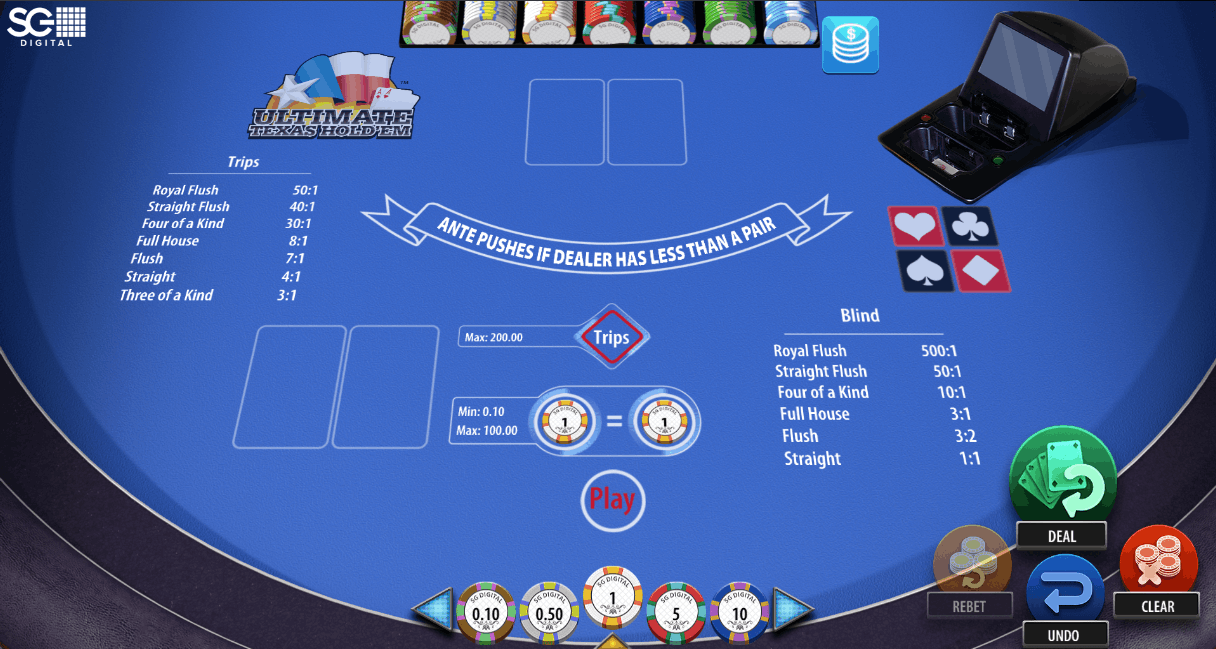
To give you a better idea of how the game is played, this is how a typical round unfolds. This should help you understand how the decisions and payouts work in practice.
1
Let’s say that you’ve set your wager at A$1, which means you’re actually putting down A$2 total on the Ante and Blind.
2
The dealer deals the cards, and you get 6 of Clubs and 8 of Hearts. It’s a weak starting hand, so you decide to check.
3
The flop comes out, and it’s 8 of Clubs, 6 of Diamonds and 6 of Hearts, which means that you now have a full house. At this point, you can either check again or place a Play bet of 2x your Ante (A$2), so you choose to bet because you think that you have the strongest hand.
4
The turn and river are revealed, and your hand holds up. The dealer qualifies with a Pair or higher, and you win the round.
5
Your Ante and Play bets are paid 1:1, and your Blind bet pays based on the multiplier table. For a full house, that’s 3:1 on the Blind.
6
In total, you receive A$10 back, which means your net profit is A$6.
This is a very positive scenario because the dealer qualified, which means your Ante bet didn’t result in a push, and you got the full house soon enough to be able to bet x2 with the Play bet. Also, you got the Blind multiplier bonus.
In reality, many hands result in a push or a small win/lose because either the dealer doesn’t qualify, or you may win with a weaker hand (like two pairs, for example), so you don’t get the blind bonus.
Side Bets in Ultimate Texas Hold’em
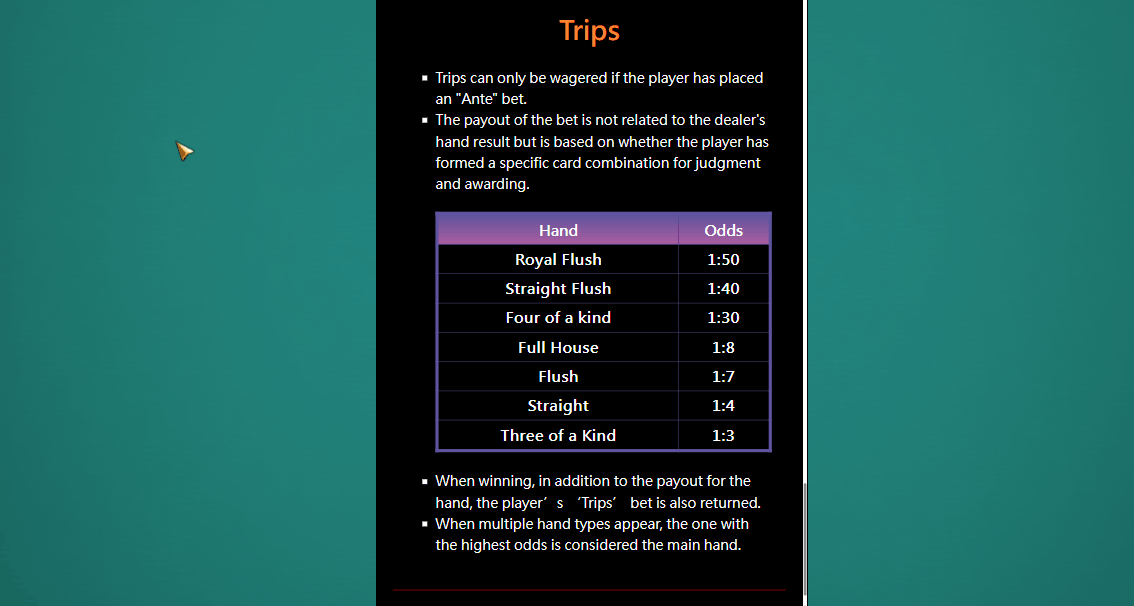
The original version of Ultimate Texas Hold’em only has one side bet, and that’s the Trips bet.
This bet is completely separate from the main game, so it doesn’t matter whether you beat the dealer or not. The outcome depends only on the strength of your final five-card hand.
You can place the Trips bet alongside your Ante and Blind, and it pays out if you hit a qualifying hand, usually three of a kind or better. If your hand is weaker than three of a kind, the bet is lost.
Here’s how the standard Trips paytable looks:
| Hand | Payout |
|---|---|
| Royal Flush | 50:1 |
| Straight Flush | 40:1 |
| Four of a Kind | 30:1 |
| Full House | 8:1 |
| Flush | 7:1 |
| Straight | 4:1 |
| Three of a Kind | 3:1 |
As with most side bets in table games like blackjack, roulette, and baccarat, the Trips bet comes with a significantly higher house edge of around 8%, so I don’t recommend it.
Some games, especially live dealer variants, introduce other side bets like AA+ or Jackpot bets. Essentially, they’re very similar to the Trips bet, but pay out if you have a different combination. The AA+ bet, as the name suggests, pays out a bonus if you have a pair of As or a stronger hand.
The Jackpot bet in Pragmatic Play’s Casino Hold’em is the most volatile side bet out there and pays out only if you hit a Straight, Four of a Kind, or a Straight Flush, but the max payout is 19,999:1.
My 100-Round Test of Ultimate Texas Hold’em
I started my 100-round test of Ultimate Texas Hold’em with a budget of A$2,000, and I set my wager at A$50. However, as I pointed out, you have to place a bet on both the Ante and Blind, which meant that my starting bet was A$100.
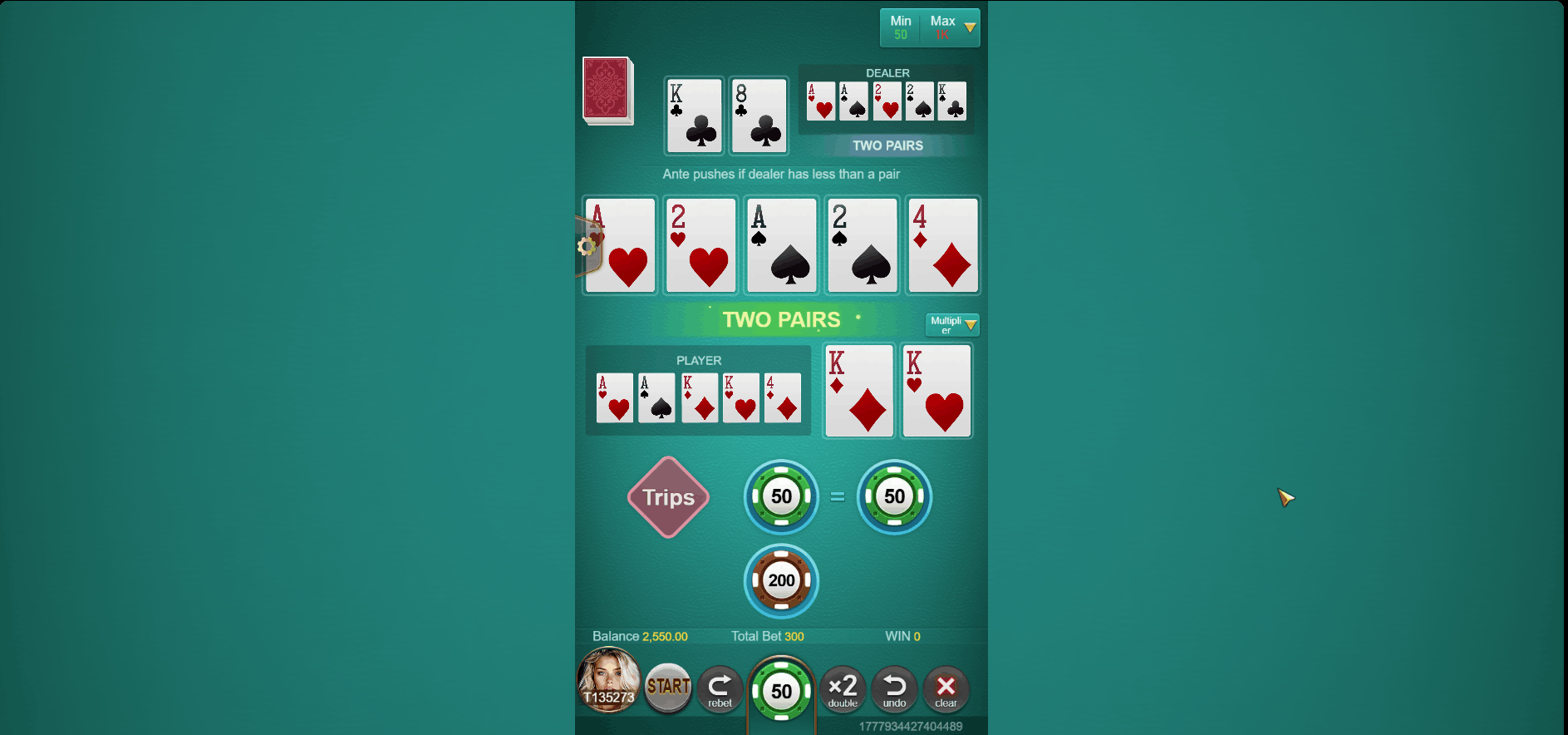
Call it beginner’s luck, but I won the first few hands, so I got carried away and increased the bet to A$100 per wager. Now, I have to be very clear here: when I say ‘I won’, I mean ending the hand in profit. How much you profit really depends on the hand and your luck.
For example, I had a pair of Ks, so I raised pre-flop 4x the bet. The flop came out, and I hit two pairs, which was enough to win against the dealer, and since there was a pair on the board, the dealer qualified, and I also won the ante bet. However, I narrowly missed out on a full house, so I didn’t win the Blind bet.
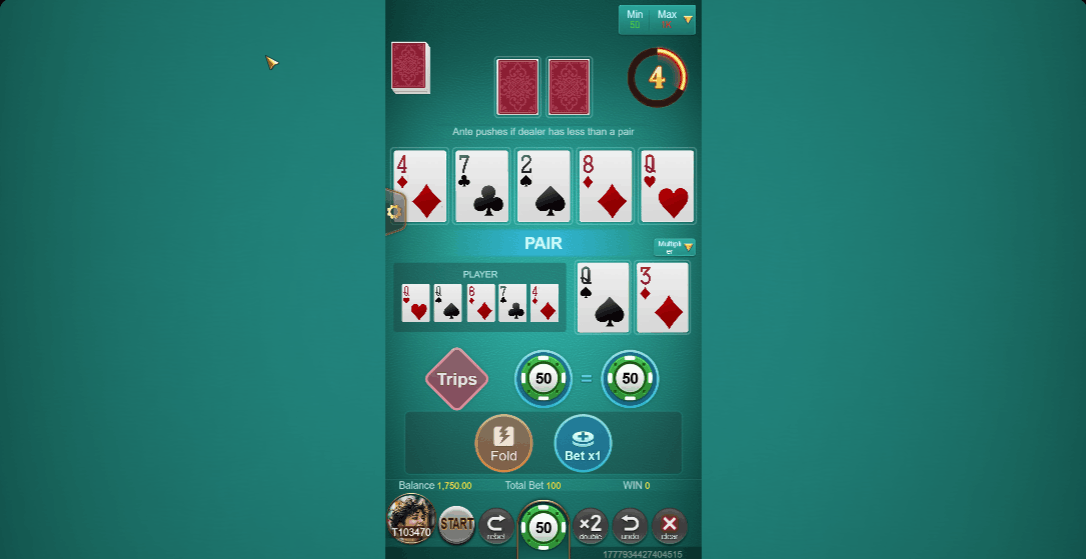
One thing I need to point out is that the betting time is rather short, and you need to be quick when making decisions. Even someone as experienced as I had to think twice before making a decision, and the betting time is limited to a few seconds.
To make things worse, in case you fail to make a decision on time (for example, whether to Check or Play on the turn), you will automatically fold, which means losing your bet.
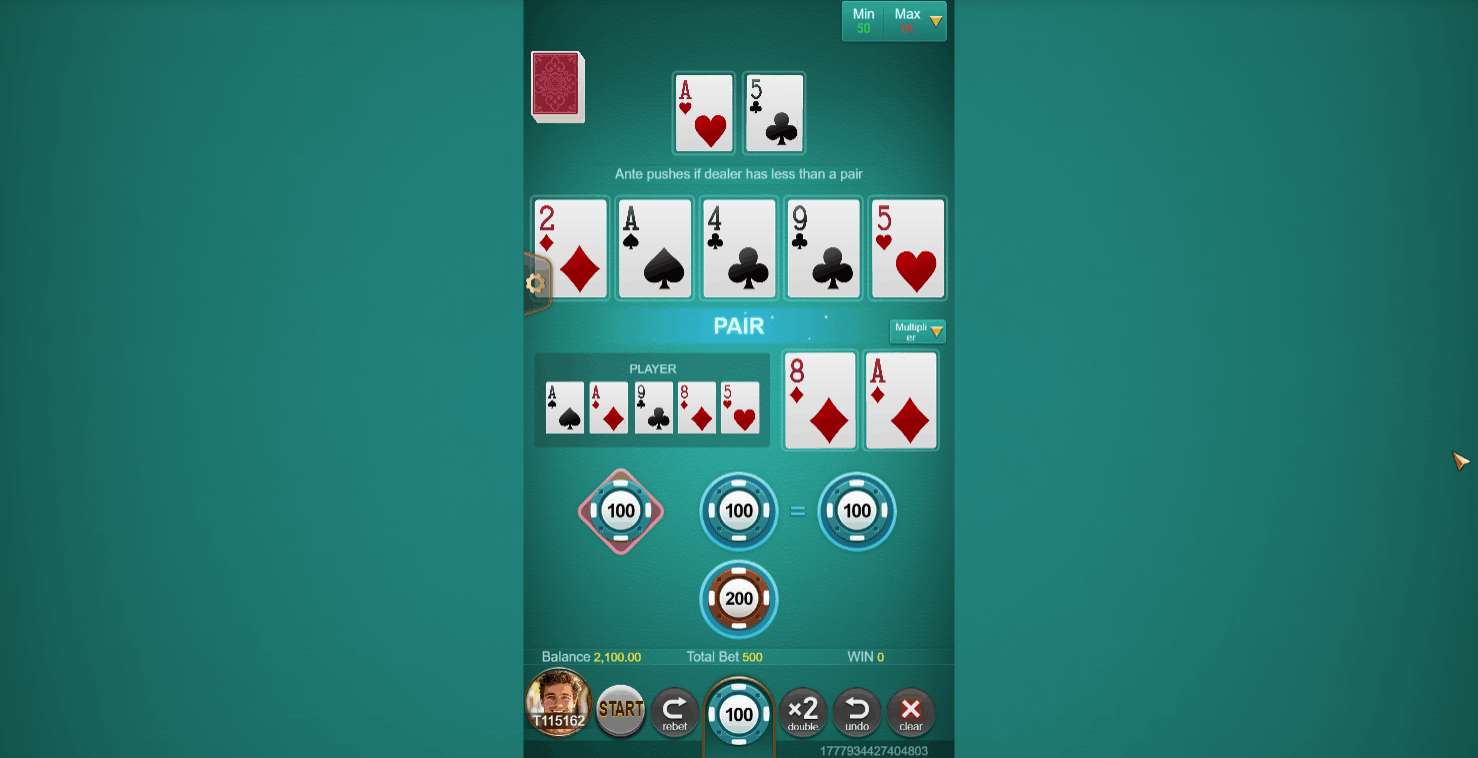
I also tried playing the Trips side bet, but I didn’t win once in 10 rounds, so I definitely cannot recommend it.
Back to my test now: despite my large bet size compared to my bankroll, I kept hovering around the A$2,000 mark, and if it wasn’t for my 10-round excursion with the Trips bet, I probably would have ended the session in profit.
However, and I don’t say this lightly: Ultimate Texas Hold’em is a game that requires 100% of your attention. You can’t play this game casually. Every decision you make is important, and you need to stay on top of it at all times.
I’d go as far as to say that Ultimate Texas Hold’em is one of the hardest poker games to master, so take your time to learn it properly in demo mode before committing real money.
On a more positive note, the high RTP and low volatility mean that, if you’re playing the game correctly, your bankroll will last you a long, long time.
Summary: Should You Play Ultimate Texas Hold’em Poker?
Love the decision-making part of Texas Hold’em, but don’t want to deal with all the bluffing and mind games that come with real poker tables? Try Ultimate Texas Hold’em.
The game is similar enough to Texas Hold’em that you’ll be familiar with the gameplay, but you don’t need to worry about things like traffic or strong opponents. It’s played against a dealer and widely available across Australian poker sites, so you can play it at any time.
It does take a bit of time to learn the betting structure and payouts, but once you devote enough time to learning it, it can become a very fun and strategic game to play.
FAQ
No. It uses the same hand rankings and community cards, but you’re not playing against other players. You’re playing against the dealer, and there’s no bluffing involved.
Ultimate Texas Hold’em is one of the higher RTP table games. The original version sits at around 99.47% with the optimal strategy, although this can vary slightly depending on the variant and rules.
It’s primarily a game of luck, but there is some skill involved. Decision-making is very important, so you will need an optimal strategy to extract the ~99.50% RTP of the game.
Latest Articles


Disclaimer: Gambling in Australia is strictly for individuals aged 18+. Our editorial team adheres to a strict policy to ensure that our reviews, recommendations, and content remain objective and free from external influence. We strongly encourage responsible gambling at all times. If you or someone you know is struggling with gambling addiction, visit the following gambling resources:
- https://responsiblewagering.com.au/
- https://www.gamblinghelponline.org.au/
- https://gamblershelp.com.au/get-help/