




What Is a Blackjack Strategy Chart?
A blackjack strategy chart is basically a decision-making cheat sheet that tells you the best move to make in every situation based on your hand and the dealer’s upcard.
It’s built using probabilities and simulations of millions of hands, and it follows that basic blackjack strategy (I’ve already prepared a guide, so I won’t repeat myself here), so the idea is to have it all laid out in front of you.
Basically, instead of relying on instinct or “what feels right” at the moment, the chart shows you the mathematically correct play every time. Whether it’s hit, stand, double, or split, you just need to look at the chart, and you know what to do next.
Blackjack strategy charts have been around for centuries, and if you follow them correctly, you can bring the house edge to ~0.5% (this largely depends on the particular variant), but that’s as good as it gets for a standard blackjack game.
A strategy chart doesn’t guarantee that you’ll win. The house edge remains, and the chart cannot remove it. Yes, it improves your decisions, but it doesn’t improve your luck.
Blackjack is ultimately a game of skill and luck, and you need to be prepared that you might lose, too. I get messages all the time from players saying they used my blackjack strategy guides, had a great session, and walked away with a profit. That’s great, but it can just as easily go the other way.
The way I like to explain it is this: Using a blackjack strategy chart is like entering a race where everyone has the same car, and you’ve done everything right before the start. Your tyre pressures are set, your setup is spot on, and you’re not giving away any easy advantages.
What you’re really doing is removing the mistakes that give the other side an extra edge. In blackjack, that “other side” is the house.
But even with everything in place, you’re still not guaranteed to win the race every time. There are still variables you can’t control, and ultimately, the house still has a tiny edge.
Note from Mike Waters: If you actually want to push beyond and try to become better in blackjack, you’re getting into a completely different territory with card counting and advanced strategy adjustments, which are sometimes impossible. For most players, the strategy chart is more than enough.
Blackjack Strategy Chart: Game Cheat Sheet
According to the basic blackjack strategy, your action depends on the hand you get. There are three types of hands in blackjack: hard, soft, and pair:
- Hard Hands: They’re hands with a fixed value, meaning there’s no A, so there’s no room for variation. For example, a J + 5 = 15. This is a hard 15 hand.
- Soft Hands: They’re hands where an Ace counts as 11. The Ace can switch to 1 if needed, giving you more flexibility and reducing the risk of busting.
- Pairs: They’re hands where you get two cards of the same value, for example, 8 and 8.
Without further ado, I’ll share the blackjack strategy chart (cheat sheet) that follows the basic strategy.
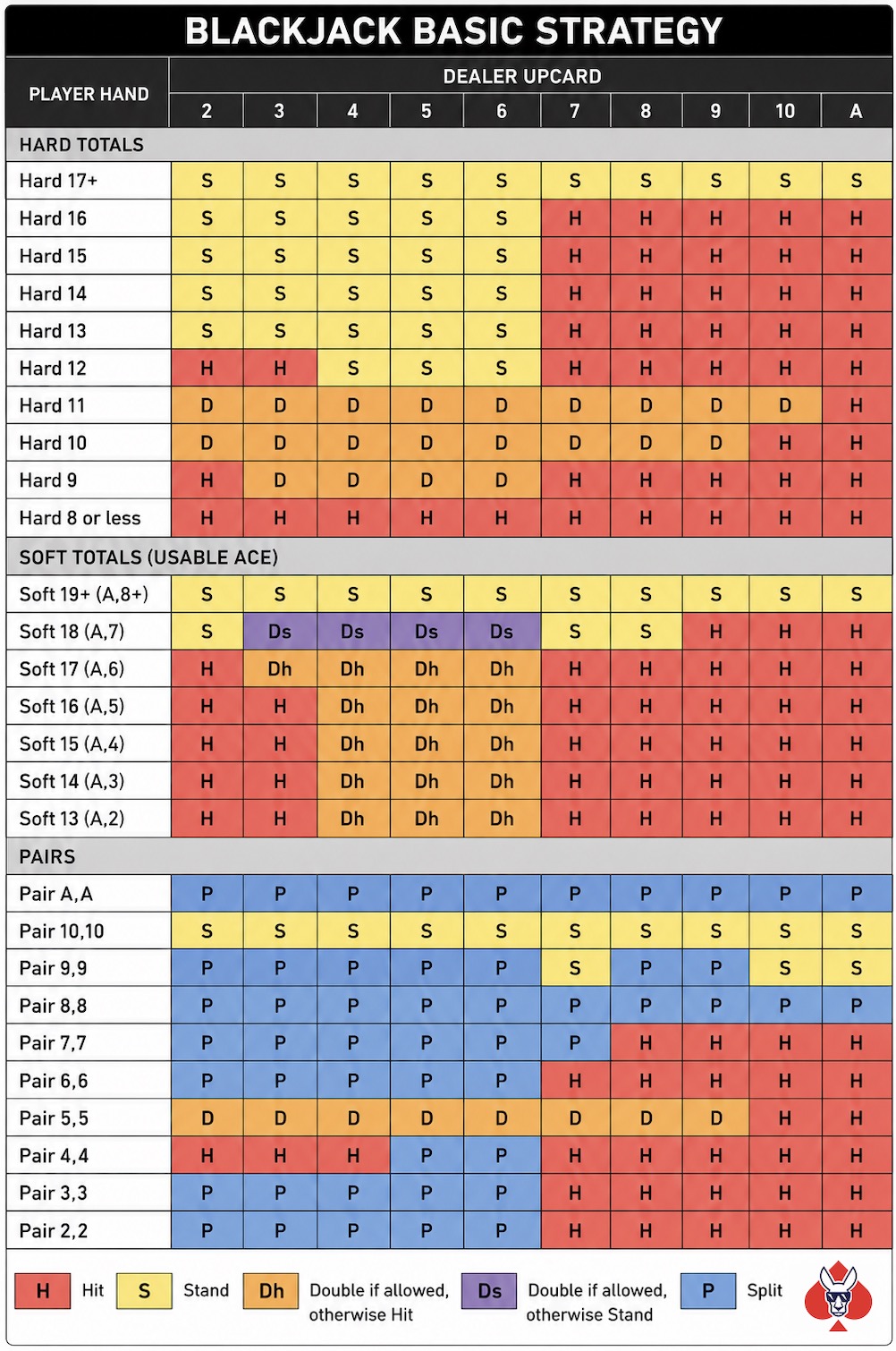
Simplified Blackjack Strategy Cheat Sheet
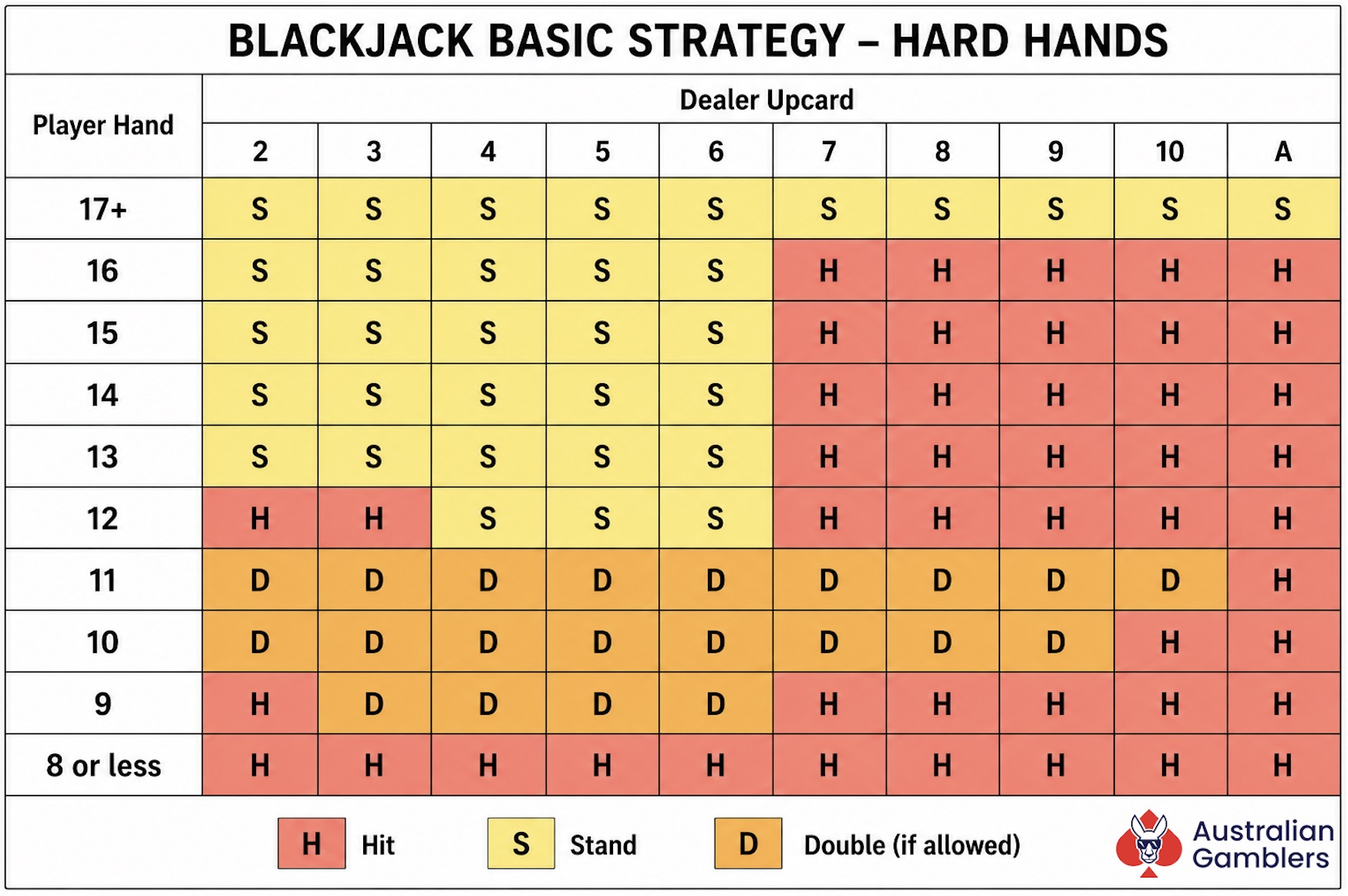
If you find the standard cheat sheet a bit too complicated, I’ve prepared separate cheat sheets depending on whether you have a hard hand, soft hand, or a pair.
Hard Hands
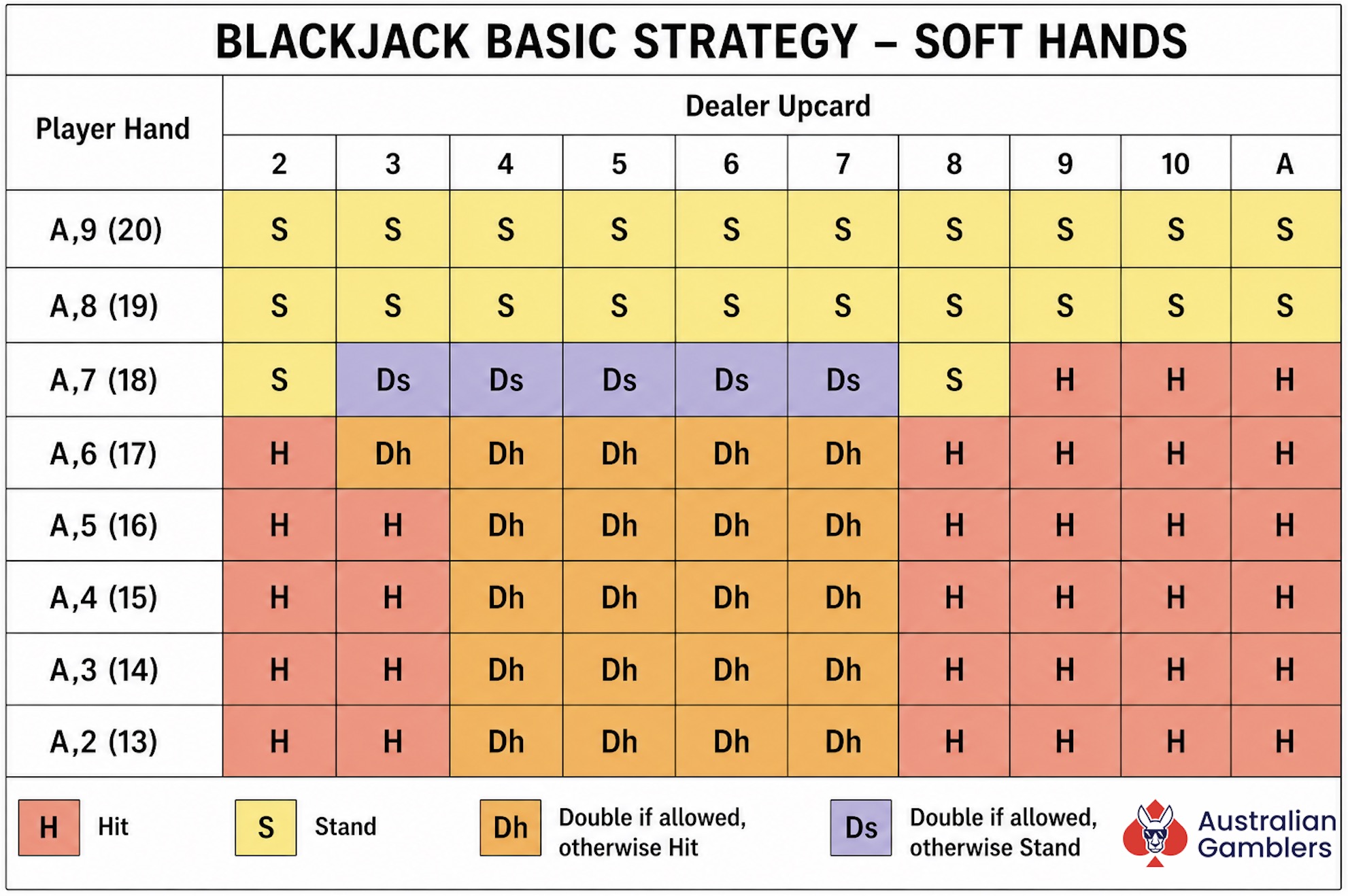
Soft Hands
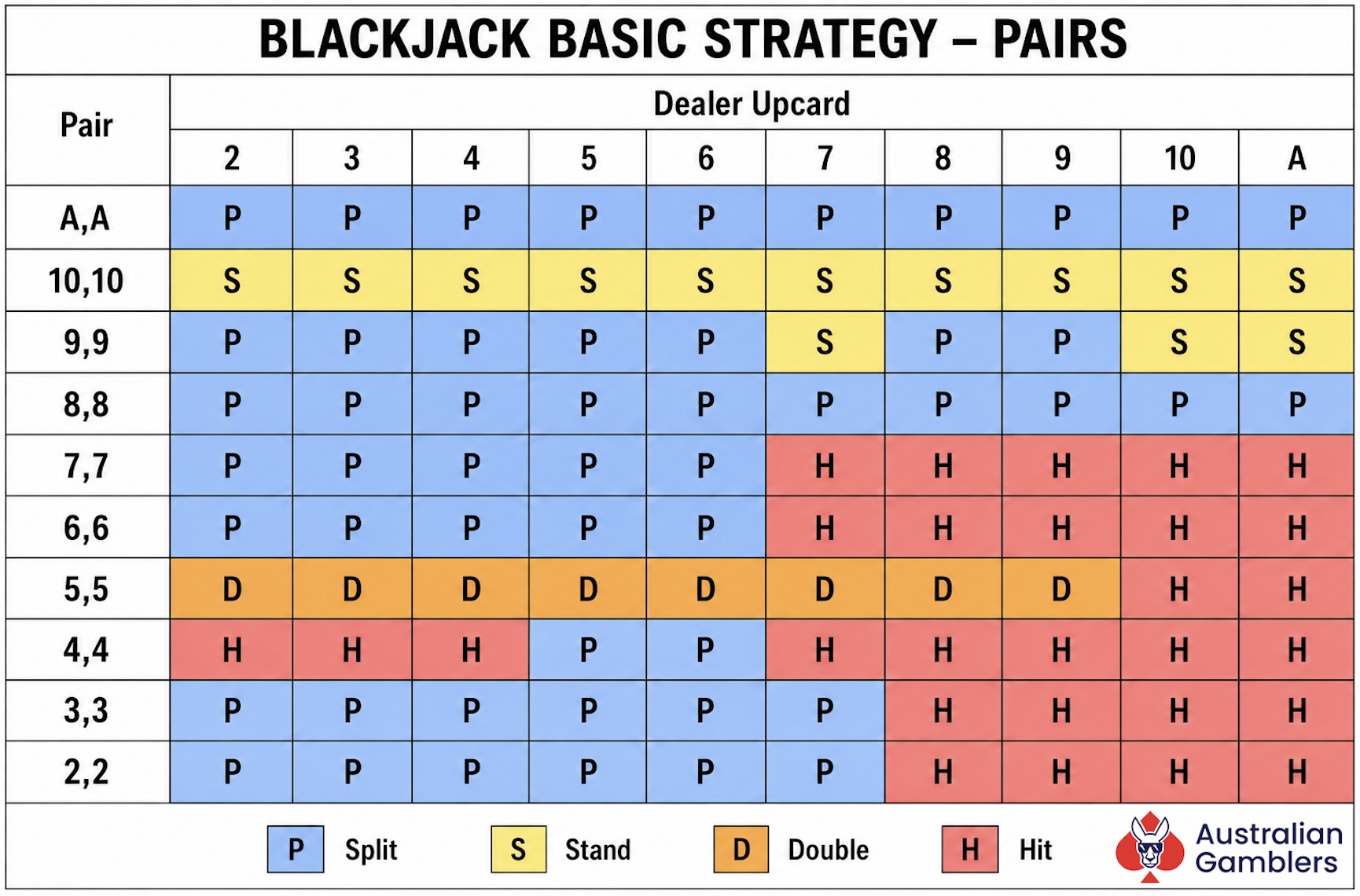
Pairs
Note from Mike Waters: If the game offers surrender, the basic strategy suggests that you should surrender hard 16 against a dealer 9, 10, or Ace, and hard 15 against a dealer 10.
Rules to Remember from the Blackjack Strategy Chart
Some players remember things better in text than in charts, so I’ve put together a simplified version of the strategy that you can learn as a set of rules. The idea is that you look at your hand, recall the rule, and then adjust based on the dealer’s card.
Hard Hands
- 17 or more > always stand
- 13 to 16 > stand against dealer 2-6, otherwise hit
- 12 > stand against 4-6, otherwise hit
- 11 > always double
- 10 > double against 2-9, otherwise hit
- 9 > double against 3-6, otherwise hit
- 8 or less > always hit
Soft Hands
- A,9 (20) > always stand
- A,8 (19) > stand (double against 6)
- A,7 (18) > double against 2-6, hit against 9-Ace, otherwise stand
- A,6 (17) > double against 3-6, otherwise hit
- A,5 to A,2 > double against 4-6, otherwise hit
Pairs
- Always split Aces and 8s
- Never split 10s
- Split 9s against 2-6 and 8-9 (stand against 7, 10, Ace)
- Split 7s against 2-7
- Split 6s against 2-6
- Split 4s against 5-6
- Split 2s and 3s against 2-7
- Double 5s against 2-9, otherwise hit
Order of Decisions When Using a Strategy Chart
How should you execute the strategy? Well, the blackjack strategy isn’t random. There’s a clear order you should follow when deciding what to do with your hand, and if you go through this sequence in every hand, you’ll avoid some beginner mistakes:
1. Should I Surrender?
This is always the first thing to check. Surrender is only available on your first two cards, so if you don’t think about it straight away, you lose the option. If the situation calls for surrender (I explained the few surrender situations above), take it and move on. If not, go to the next step.
2. Should I Split?
Next, check if you can (and should) split. Splitting only applies when your first two cards are of the same value, so again, this is an early decision. If the strategy says to split, do it. If not, move on.
3. Should I Double?
Doubling is usually done in a strong position, so when the chart tells you to double, it means you’re in a spot where you have a higher chance of winning. Note that some blackjack games have restrictions, but if doubling is available and recommended by the chart, you should take it.
If doubling isn’t an option, or the chart doesn’t suggest it, go to the final step.
4. Hit or Stand
Only after ruling out surrender, split, and double should you think about hitting or standing. Always consider the three other options first, and if none of them applies to your hand, H or S, depending on what the chart calls for.
How Different Rules Affect the Blackjack Strategy
In my guide about blackjack types, I mentioned that not all blackjack games you’ll find at Australian online casinos are the same. The strategy chart you’ve seen above is based on standard rules (multi-deck game, dealer stands on soft 17, doubling allowed on most hands).
Truth be told, you’ll find this type at most online casinos in both RNG and live dealer form, but small rule changes can slightly affect the correct play.
Here are the main ones to be aware of:
This is one of the biggest differences.
- Dealer stands on soft 17 (S17) is better for the player
- Dealer hits on soft 17 (H17) is slightly worse for the player
If the dealer hits on soft 17, they have more chances to improve their hand, which increases the house edge. In these games, some doubling decisions become less favourable.
For example, with a soft 18 (A,7) against a dealer 2, basic strategy recommends doubling when the dealer stands on soft 17. But if the dealer hits on soft 17, that same double becomes less attractive, and in some cases, it’s better to just stand.
Another example is soft 19 (A,8) against a dealer 6. In S17 games, doubling here is the correct action, but in H17 games, many players prefer to just stand since the dealer has a better chance of improving their hand.
Some games offer surrender, others don’t. The best option for you is to surrender late if the game offers it, but even if it doesn’t, just follow the chart and move to the next decision.
This is a big one: always try to play 3:2 blackjack. There are variants that pay out 6:5 for blackjack (or worse), but this new rule increases the house edge significantly, even if everything else is the same. Don’t play 6:5 blackjack or, truth be told, any other variant than a standard 21 with a 3:2 payout for a natural blackjack.
Not every blackjack game lets you double as freely as you’d expect, and this can have a direct impact on how you play certain hands. In the best-case scenario, you can double on any two cards, which is what the strategy chart is based on.
However, you’ll find games that only allow you to:
- Double only on 9, 10, or 11
- No doubling after splitting a pair
For example, hands like soft 16 (A,5) or soft 17 (A,6) are often good doubling spots when the dealer shows a weak card (like 4, 5, or 6). But if doubling isn’t allowed in those situations, you’re forced to just hit instead, which slightly reduces your expected return.
The same goes for pairs. If you split something like 8,8, and you’re not allowed to double afterwards, you lose the chance to maximise value.
In most blackjack variants, you can split pairs, but how many times you can do it depends on the casino. Some allow multiple splits, others cap it at one or two. Aces are usually the most restricted, because they’re the most powerful, and you sometimes get only one card per Ace and can’t hit further.
There are also games where you can’t double after splitting, which also limits your upside, so make sure to read all the rules in detail.
Are Blackjack Charts Legal?
Blackjack charts are legal, and if you’re playing at an online blackjack site, there’s nothing to worry about. You can have the chart open in another tab, on your phone, or even printed next to you. It’s just a reference tool, and it’s not like you’re cheating. You’re not doing anything shady; you’re just following basic strategy, and there’s no way for the casino to ‘catch you for using a cheat sheet’ because you’re doing anything wrong.
Now, land-based casinos are a bit different. If you walk up to a table with a printed cheat sheet and start checking it before every move, don’t be surprised if someone from the staff comes over and asks you to put it away.
It’s not like having a printed cheat sheet is illegal, but in my experience, casinos don’t like it when you show up at the table with a printed sheet or when you’re looking at your phone all the time while playing.
Also, you’ll likely be slowing the game a bit, and other players on the table might complain. But, using your memory is always fine, so you can try to memorise the chart I shared below before your next visit to the casino.
Summary: Do You Need a Blackjack Strategy Chart?
Don’t get me wrong – using a blackjack strategy chart is not mandatory. You can absolutely sit down and play without it, and plenty of players do. But if you’re serious about getting the most out of blackjack, then using a cheat sheet will make a noticeable difference.
It removes bad decisions, keeps you consistent, and gets you as close as possible to that ~99.50% RTP we talked about earlier.
I’ll go as far as saying this: if you’re not using basic strategy, you’re just giving away extra edge for no reason.
Even if you’re an experienced player, there are situations where you don’t remember what the perfect play is in a given situation, so the chart is still useful. I still go back to it from time to time just to double-check certain spots or refresh my memory.
So no, you don’t have to use it, but if you want to play blackjack with the best odds, you probably should.
Latest Articles


Disclaimer: Gambling in Australia is strictly for individuals aged 18+. Our editorial team adheres to a strict policy to ensure that our reviews, recommendations, and content remain objective and free from external influence. We strongly encourage responsible gambling at all times. If you or someone you know is struggling with gambling addiction, visit the following gambling resources:
- https://responsiblewagering.com.au/
- https://www.gamblinghelponline.org.au/
- https://gamblershelp.com.au/get-help/