

Table of Contents
Written by
 Mike Waters
Edited by
 Matthew Scott
It first appeared in crypto casinos, but now, you’ll find Mines in almost all Australian online casinos, usually in the instant-win or “Other Games” section alongside Plinko and Crash. So, in this guide, I’ll explain what Mines is and how it works, how the number of mines changes the risk and volatility, and whether there’s anything even close to a “strategy” in a game that gives you absolutely no information to work with.
What’s Mines?
Mines is one of the simplest casino games you’ll ever play. It’s based on the same concept as the classic Minesweeper, and the idea is very straightforward: you have a grid of covered tiles, and underneath some of them are hidden mines. Your goal is to open as many safe tiles as possible without hitting any mines.
Now, the important part: every safe tile you reveal increases your payout multiplier, but just one mine ends the round (and you lose your bet).
In most casino Mines games, before you begin, you choose how many mines you want on the board. Obviously, fewer mines means that it’s easier to avoid them, while higher mine counts mean that you have lower chances of hitting a “clear” tile. The winning tiles usually have a star, a bell, a diamond, or a similar symbol.
The payouts are simple as well: there’s a multiplier, and each tile you uncover increases the multiplier. You can cash out at any time, so for example, if you bet A$20 and cash out at a 2x multiplier, you’ll win A$30. After each tile, you have the chance to either cash out and continue, so Mines works sort of like crash games.
There’s usually the option to increase the number of mines on the board, which increases the multipliers too, so it’s up to the player to decide how risky they want the minefield to be.
Note from Australian Gamblers: Most Mines games you’ll find online are provably fair, which basically means that you can verify that each round was generated fairly and wasn’t altered by the casino. A lot of players think this only applies to games at crypto casinos, but that’s not true. Provably fair simply uses cryptographic seeds (a server seed, a client seed, and a nonce) to generate the result, and you can check those seeds afterwards to confirm that the mine positions weren’t manipulated after you chose a tile.
Funny enough, Minesweeper itself wasn’t originally built as a “game” at all. This may come as a surprise if you’re Gen Z, but we didn’t have computers back in the early ’90s. So, when the personal computer made its breakthrough, people didn’t really know how to use the mouse, so the Minesweeper game was built into our PCs to help users practice left-click and right-click precision. Well, it’s safe to say that it became one of the most iconic time-killers ever made, and the Mines casino game is based on it.
Now, while the idea is inspired by Minesweeper, the casino version removes everything that actually helped you play the original game. There are no numbers after you click on a ‘safe’ tile, so there’s no logic in the game. It’s purely luck-based, so you can’t use deduction either, so there’s no real way to know which tile is ‘safe’.
Every tile is a blind guess, but obviously, after each correct guess, the number of mines on the field remains the same, while there’s one less ‘safe’ tile, so the risk increases.
So, while the two look very similar, the only thing the two versions share is the basic concept of uncovering tiles while trying to avoid hidden mines. Minesweeper is a puzzle game, and Mines is a casino game with a built-in house edge, which means that the payouts for each safe tile are slightly lower than the true odds. I’ll explain how the expected value works in this game later in this guide.
Mines Basics: Game Layout and Settings
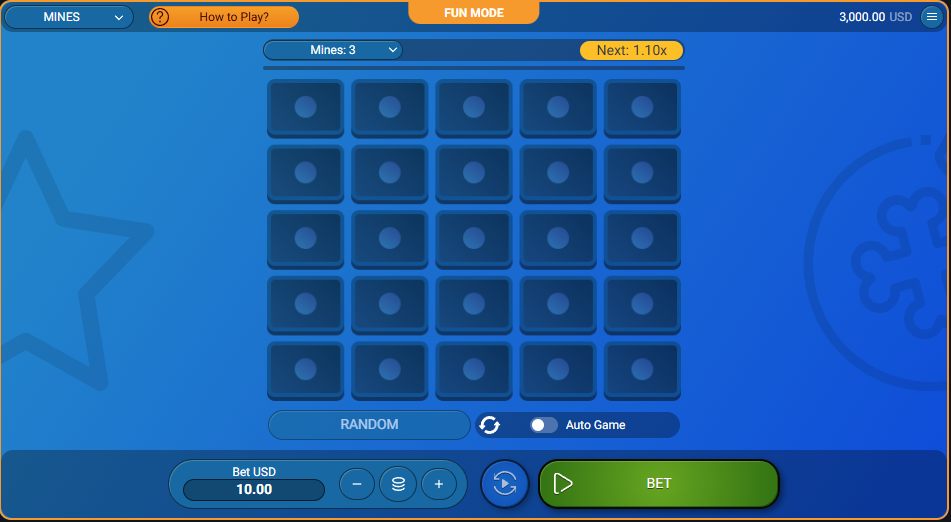
When you open any Mines game, the layout is almost always the same: there’s a square grid of covered tiles, a small settings panel where you choose how many mines you want on the board, and the bet controls that are usually at the bottom. Different providers may change the colours or animations, but most Mines games look largely the same:
Here’s what you’ll usually see on the screen when you load a Mines game:
- A 5×5 grid (sometimes you can change the grid, depending on the provider)
- A dropdown menu where you choose how many mines you want (often from 1 to 24)
- A multiplier indicator showing the value of your next safe pick
- A place where you set your bet
- Optional Auto Game or “Auto Pick” settings
Below, I’ll explain the settings you’ll come across in most Mines games and what they mean.
The Minefield
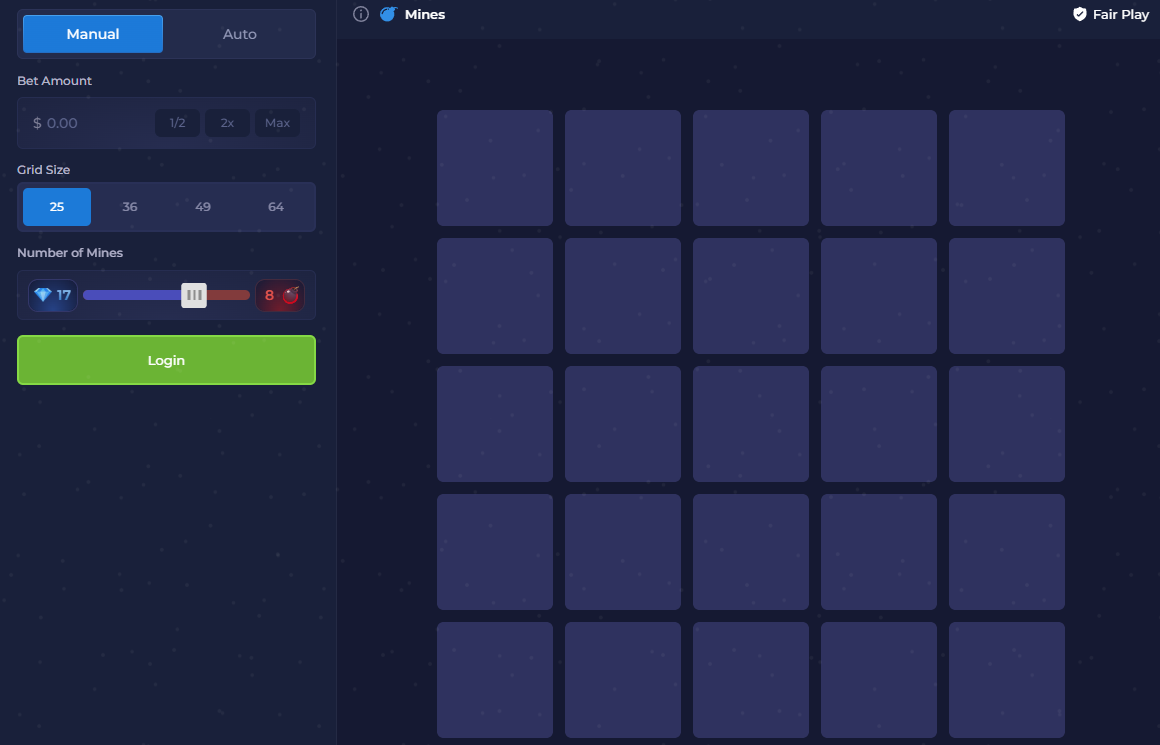
The ‘minefield’ is the grid where the game is played. On the grid, there are tiles that you need to click on and reveal whether they’re a pass or a fail (a mine means you lost).
Now, the vast majority of Mines games I’ve come across have a standard 5×5 grid (so 25 tiles in total); however, some games allow you to increase the grid size to 6×6 (36 tiles in total), 7×7 (49 tiles in total), 8×8 (64 tiles in total), etc.
The bigger the grid, the safer the first rounds will be, making the game less volatile. For example, if you pick an 8×8 grid with 8 mines, obviously, it’s much easier to miss the mines because they cover just 1/8th of the grid. On the other hand, if you play on a 5×5 grid and there are 8 mines, they cover more than 1/3rd of the grid, so you have just ~65% chance of missing them on your first attempt, and it lowers with each following tile.
Note from Australian Gamblers: I’ve noticed that a bigger grid often feels safer because you have more tiles to open, but the overall EV (expected value) stays roughly the same, so the grid size doesn’t matter much unless you specifically want very low or very high volatility.
The Mine Count (Difficulty Level)

This is the most important setting in Mines and the one that sets the game’s volatility. Before each round, you can select how many mines to be on the grid. I’ll be using a standard 5×5 grid because it’s the most common type, so let’s say you choose to play with 3 mines.
It means that there will be 22 safe spots on the grid and 3 dead zones. Now, with every safe tile you open, the number of safe spots reduces, so the multiplier increases. Now, maths time: the chance of hitting a safe tile on your first click is:
22 / 25 = 0.8822
Based on this calculation, we’ve got an 88% chance of choosing a safe tile on our first click.
Now let’s see what happens if you increase the mine count but keep the same 5×5 grid:
- 8 mines and 17 safe tiles: The chance of hitting a safe tile on your first click is 17 / 25 = 68%.
- 15 mines and 10 safe tiles: The chance of hitting a safe tile on your first click is 10 / 25 = 40%.
The mine count in Mines works like a volatility slider. The fewer mines, the lower the game’s volatility. The more mines you have, the more the volatility of the game increases. Theoretically, you have 24 volatility levels, because you can choose between 1 and 24 mines on the field, with 1 mine being the least volatile version of Mines, and 24 mines being the most volatile version of the game.
I’ll explain later how software providers use these odds to set the multipliers and insert a house edge.
Betting Controls
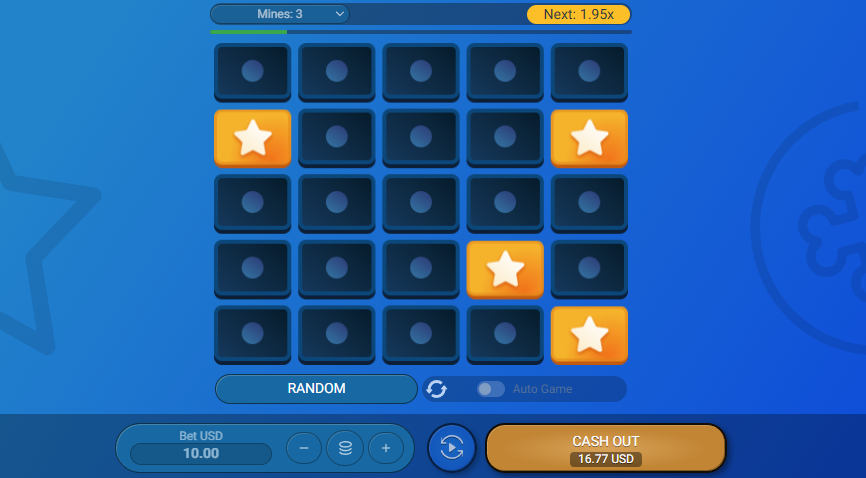
Before each round starts, you choose how much you want to wager. Mines works just like most instant-win games in this regard (or even pokies), where you choose in the beginning, and it stays locked in for the entire round. The only two outcomes are cashing out with a multiplier or hitting a mine and losing the full amount.
The betting range is usually flexible, starting at A$0.10 or A$0.20 per round, up to A$100 and sometimes even more (especially if you play with crypto like BTC).
Once the round starts, you can’t change the bet, which means that you can either cash out after opening one or more safe tiles or click on a mine and lose your bet. The final payout is your original wager multiplied by the current multiplier. So, if you wager A$10 and the current multiplier is 2.90x, you’ll win A$29.
Manual vs Auto Game
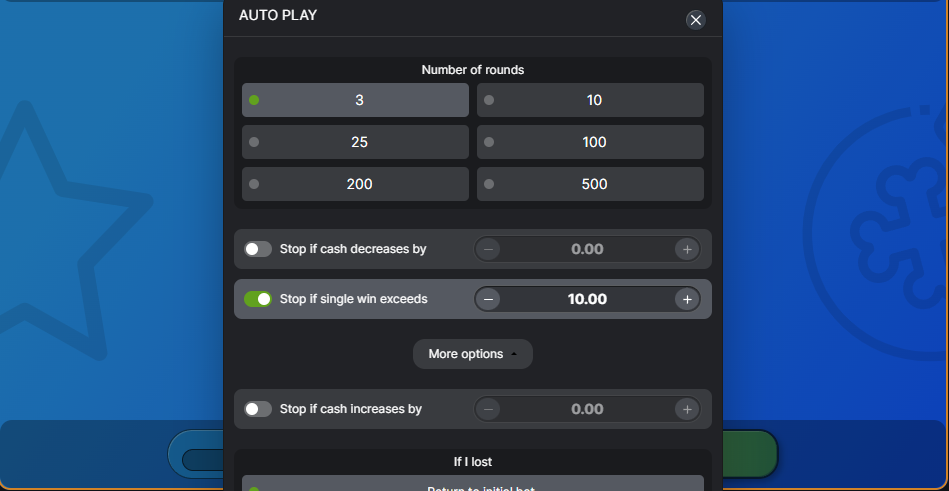
Most Mines games can be played in two ways: manually clicking each tile yourself, or using an Auto Play (sometimes called “Auto Pick”) feature. Auto Game lets you pre-set how many tiles you want the game to have in each, how many rounds you want to run, and whether the auto-play should stop after a win, a loss, or a specific multiplier.
It’s important to point out that in Auto mode, you pre-select the tiles that you want to open. So, for example, you can set a grid with 5 mines, and you can pre-select 3 tiles and let the game run for 10 rounds. The game will automatically click on the same 5 tiles for all 10 rounds.
Manual Mode, as the name suggests, is the classic way to play Mines – one tile at a time. You click on the tiles that you want to reveal manually, and you can cash out manually whenever you want to.
Note from Australian Gamblers: In Auto mode, if you pre-select 5 tiles and set it to run for 10 rounds, you can’t cash out early at 3 or 4 tiles. The game will always play out the full number of tiles you selected before moving to the next round. This mode speeds up Mines and makes it feel more like a pokie, so unless you specifically want that, I don’t recommend using Auto mode.
Payouts in Mines: Multipliers and RTP
I like Mines because the payouts are calculated on very clear maths. The game uses the simple probability of picking a safe tile to calculate the multiplier (which is then slightly reduced to create the house edge), making the payout system very easy to understand.
I must point out here that although it’s easy to understand, it doesn’t mean that the system is easy to manipulate, but I’ll share some tips and Mines strategies later in this guide.
After every safe tile you open, the multiplier in Mines increases. The exact multiplier depends on three factors:
- How many mines you select before the round
- How many tiles are left
- The provider’s multiplier curve (RTP)
Since your chance of hitting a safe tile decreases after each reveal, the fewer safe tiles remain on the grid, the faster the multiplier climbs. For example, with 3 mines on a standard 5×5 grid (25 tiles), we calculated that the chance of hitting a safe tile is 88%.
So, a fair multiplier here would be 1.13x. If something has an 88% chance of winning, a fair payout would be 1 / 0.88 = 1.13. However, in most Mines games, the multiplier for the first safe tile is around 1.10x, which means that there’s already a built-in house edge.
Mines doesn’t cheat or manipulate the positions of the mines. The house edge in this game is created entirely by the multipliers being slightly lower than the true mathematical odds of choosing a safe tile after each reveal. The game really is fair (in terms of cheating/rigging), but since it’s a casino game, the payouts have been adjusted by the provider/casino.
For example, in a game with a 5×5 grid and 3 mines, the multipliers usually look like this:
- After 1 safe tile: ~1.10x
- After 2 safe tiles: ~1.25x
- After 3 safe tiles: ~1.45x
- After 4 safe tiles: ~1.68x
- After 5 safe tiles: ~1.98x
As you can see, the house edge remains largely the same after each reveal. I have to be very clear here: these aren’t exact values, and every provider uses slightly different curves, but they’re very close to what you’ll see in most Mines games at Australian casinos.
Most Mines games have an above-average RTP of 97%-99%. The exact number depends on the provider, and as I discussed, the RTP is calculated on all possible outcomes of the game, so whether you choose 1 mine or 20 mines, it stays basically the same.
What I like about Mines is how easy it is to notice which game has a higher RTP than another one, and you can even compare it yourself. Launch two Mines games by different providers side by side, pick the same grid and mines, and notice the multipliers. The game that has the higher multipliers has the higher RTP.
How to Play Mines
Mines is not a complicated game, and you don’t need any preexisting knowledge to play it. The grid and mine count are really simple to understand, and although it might take you some time to come up with a strategy (determine what type of grid you prefer, mine count, bet level, etc), it’s pretty easy to pick up.
You choose your bet size, choose the mines, and start clicking on tiles. Then, you can cash out whenever you want. This is how a typical round of Mines works:
1
Choose your bet size
You start by choosing the amount you’re wagering for the entire round. Most casinos let you bet anywhere from A$0.10 or A$0.20 up to A$100 or more (some casinos allow wagers up to A$10,000 per round). The amount stays the same throughout the entire round, and it’s multiplier with each safe pick.
2
Select the grid you want
If the game allows it, select the grid you want. Most grids start at 5×5, but some Mines games allow you to play on a larger grid, like 6×6, 8×8, or 9×9.
3
Select how many mines you want
The fewer mines you have, the lower the volatility. More mines = higher volatility.
4
Open your first tile
Once you have placed your bet, you can start opening tiles. If the first tile is safe (it will usually have an icon like a Star or a Diamond), you can proceed by either cashing out or opening a new tile. Early picks are safer, and the difficulty increases after each safe tile.
5
Decide whether to continue or cash out
This is the part that makes Mines feel like a Crash game. After every safe tile, you can stop and cash out based on the current multiplier, or continue playing for a higher multiplier.
6
Hit a mine or walk away with a win
If you don’t cash out at any point, there are only two scenarios in Mines: whether you click on a mine at lose your bet, or click on all the safe tiles and end up with the highest multiplier.
Tip from Australian Gamblers: The chance of avoiding all mines on a 5×5 grid is only 4%, and that’s why the payout for clearing the grid is usually around x24.50. Realistically, though, most players cash out long before getting anywhere near the full clear, and unless you really want to try your luck, I don’t recommend going for it.
Different Mines Variants
While we’re used to seeing many different variants of casino games, that’s not really the case with Mines. The game really is that simple that even casino game software developers can’t think of many different versions, but just like Plinko, there are a few different versions where some elements are changed, like the grid, payouts, or added bonuses or special tiles.
These are some of the most popular Mines variants among Australian players:
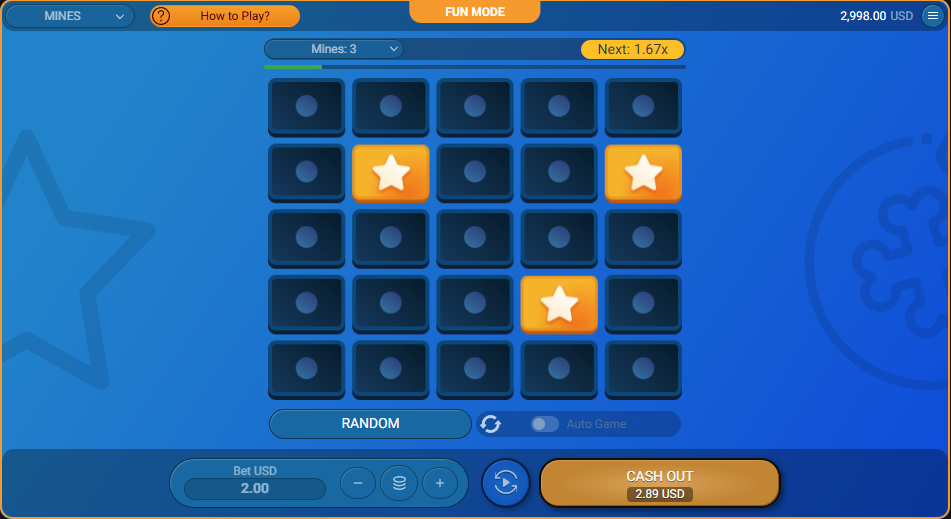
This is the most common and most popular version of Mines – classic Mines. You’ll find many different versions from developers like Spribe, SmartSoft, Stake Originals, and more, and they’re all virtually the same.
There’s a 5×5 grid with 25 tiles, and you can set the bet yourself. There’s Auto and Manual mode, and all you need to do is choose your tiles and decide when you want to cash out. The RTP is usually from 97% to 99%.
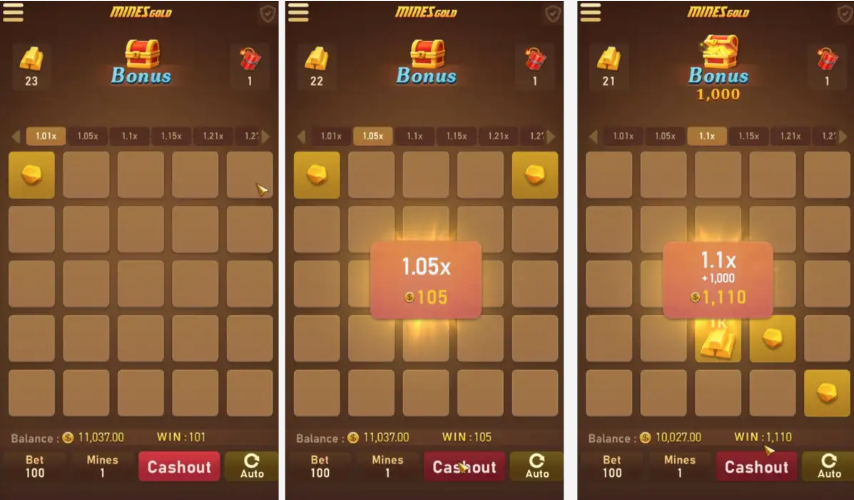
Some developers have reworked the standard Mines idea and added bonuses on top of it. For example, Mines Gold by TaDa Gaming introduces special tiles that, when clicked, can be converted into Gold Pebbles or Gold Bars. If this happens, a bonus round will be activated, and during the bonus round, players can win a multiplier of up to 10x.
The bonus amount is then added to the regular cashout. However, the regular multipliers have been lowered to accommodate this change.
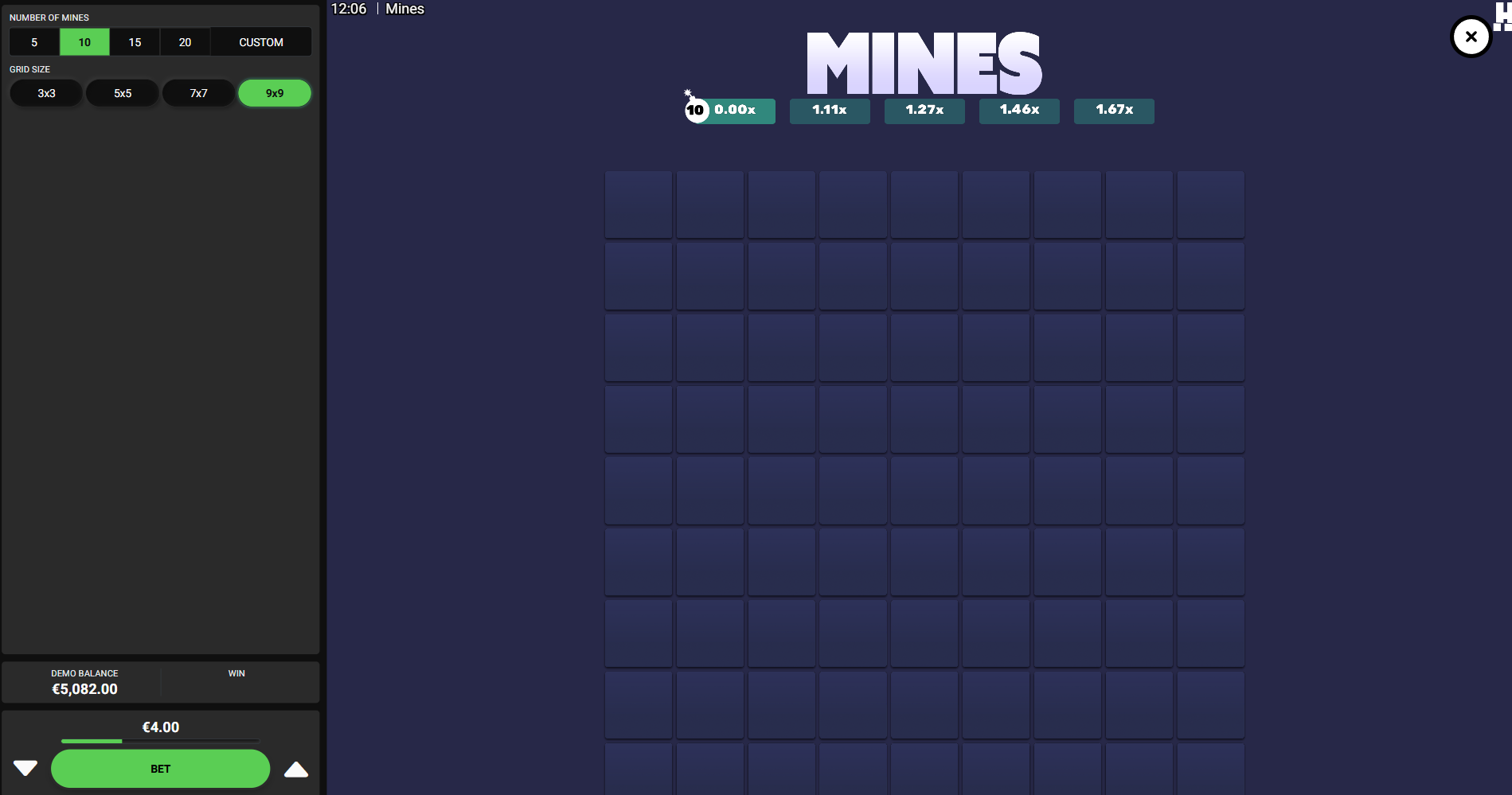
I already mentioned that some Mines games allow you to adjust the grid. A good example is Hacksaw’s Mines, one of the most popular instant-win games out there. The lower the grid is, the higher the volatility (when playing with the same amount of tiles).
Although this is not a major variation of the standard game, it still adds some versatility, and with the larger grids, the multiplier increments can be smaller, which means that you get more chances to cash out.
Mines Tips & Strategies
There’s a popular Mines progression strategy that’s been circulating on TikTok and Reddit forums, promising a guaranteed win. Well, let me tell you something: there’s no strategy that can guarantee winnings in a casino game that has a built-in house edge, but I’ll share it here and debunk it:
- The strategy suggests starting with A$1 and playing on a 5×5 grid with 1 mine. Since the chance of hitting a mine is just 4% per click, it suggests aiming for 5 safe tiles. Do this for 5 consecutive rounds until you have a A$1 in profit. Unfortunately, the strategy doesn’t tell what to do if you lose in one of these rounds.
- Next, the idea is to play with your profits. You continue with the same A$1 bet, but now, you cash out at just 3 safe tiles (usually around 1.15x multiplier).
- You need to repeat step 2 over and over, and once you have a total of A$2 in profit, you put A$2 aside, and proceed with step 1 (cashing out at 5 gems with A$1.24). If you lose the dollar, you repeat step 2 until you have A$2 in profit again.
- The goal is to repeat this process until the profit is A$10.
I have to admit it, the strategy looks good on paper, but the problem is that every step of the strategy carries the full mathematical risk of hitting the mine. Over enough rounds, the 4% failure rate will catch up with you, and since the multipliers are lower than the true odds, the house edge guarantees that you’ll end up losing more money than you’ll make.
Here are some actual tips for playing Mines:
- Stick to medium volatility for the best Mines experience. This is a purely game of luck, so there’s no real strategy on how to win, so at least enjoy it while you’re playing. Low mines are too slow, and high mines can be frustrating, so playing with 5-10 mines is the best option.
- Avoid Mines variants with lower RTP: Some providers add bonuses or extra features that lower the overall RTP to around 96%, so I suggest you avoid them and play standard versions with an RTP of around 98% or higher
- If you want to try a progression system, keep it simple: Oscar’s Grind or Fibonacci are popular progression-based betting strategies, but realistically, Mines isn’t an ideal game for these systems, so you’d be better off trying them in a game like roulette.
My 200-Round Mines Test
For my 200-round test of Mines, I decided to play Mines by Hacksaw. I know that this is not a real ‘classic’ variant, but I thought: what’s the point of going back, when most new variants let you choose the grid size? Also, Hacksaw’s game looks very modern and has an intuitive interface.
I started with a standard 5×5 grid, 5 mines, and a bet of A$10.
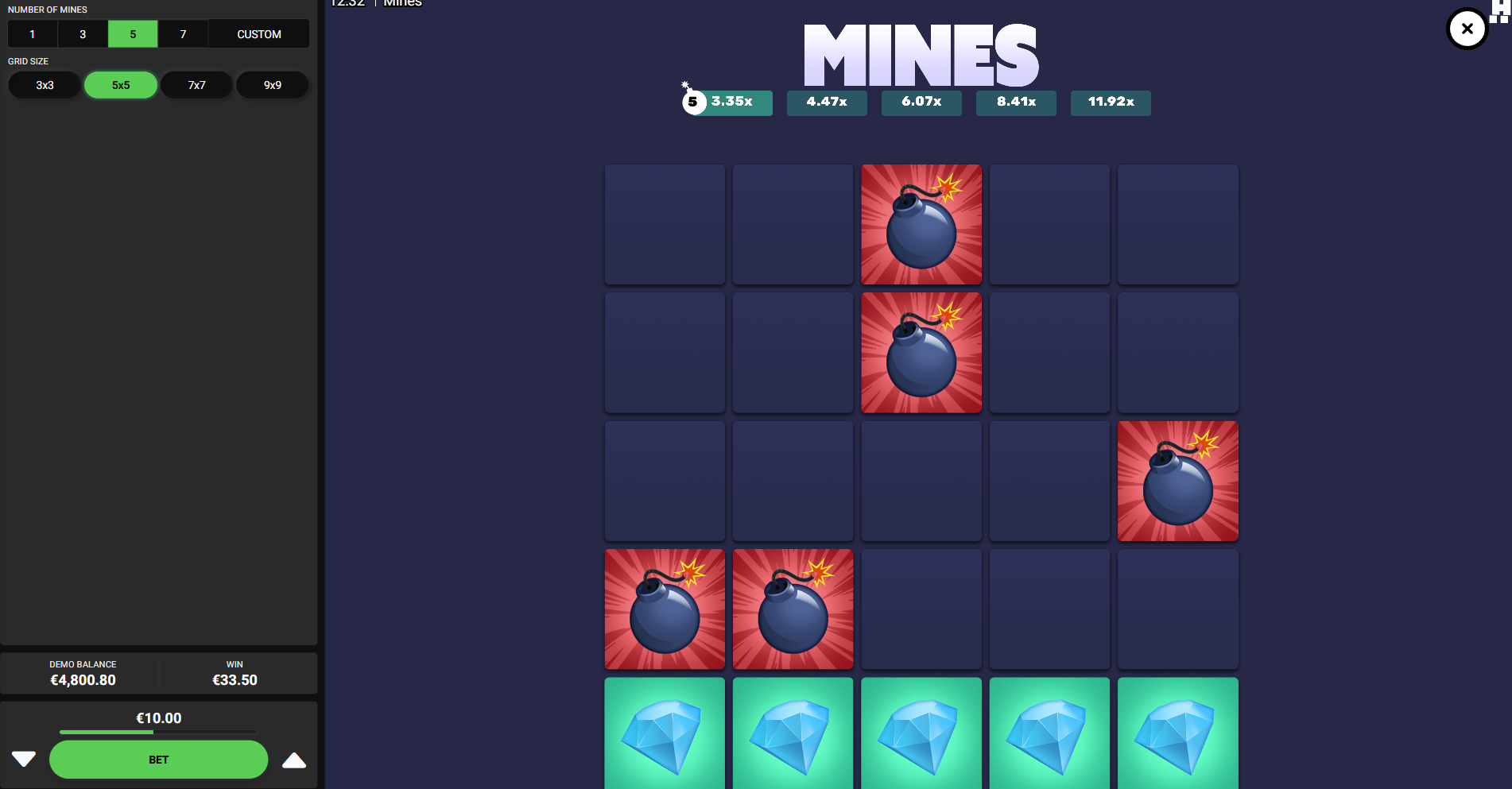
Now, a very important note about Hacksaw’s Mines: this game doesn’t have an Auto mode, which means that you will have to play each round manually. And while the pace genuinely feels slow (much slower than any pokie), it’s actually an enjoyable experience.
After ~100 rounds, I was around A$100 down, but I’ll credit that to my experimenting with different risk levels. Based on my experience, the best way to play the game is to cash out at ~2x multiplier. The odds are around 50%, so you get a largely fair chance of winning. With an RTP of over 98%, you actually get better odds than playing Red/Black in a game like European roulette, for example.
Now, to test how the game feels with a higher volatility, I tried the 3×3 grid with 3 mines.
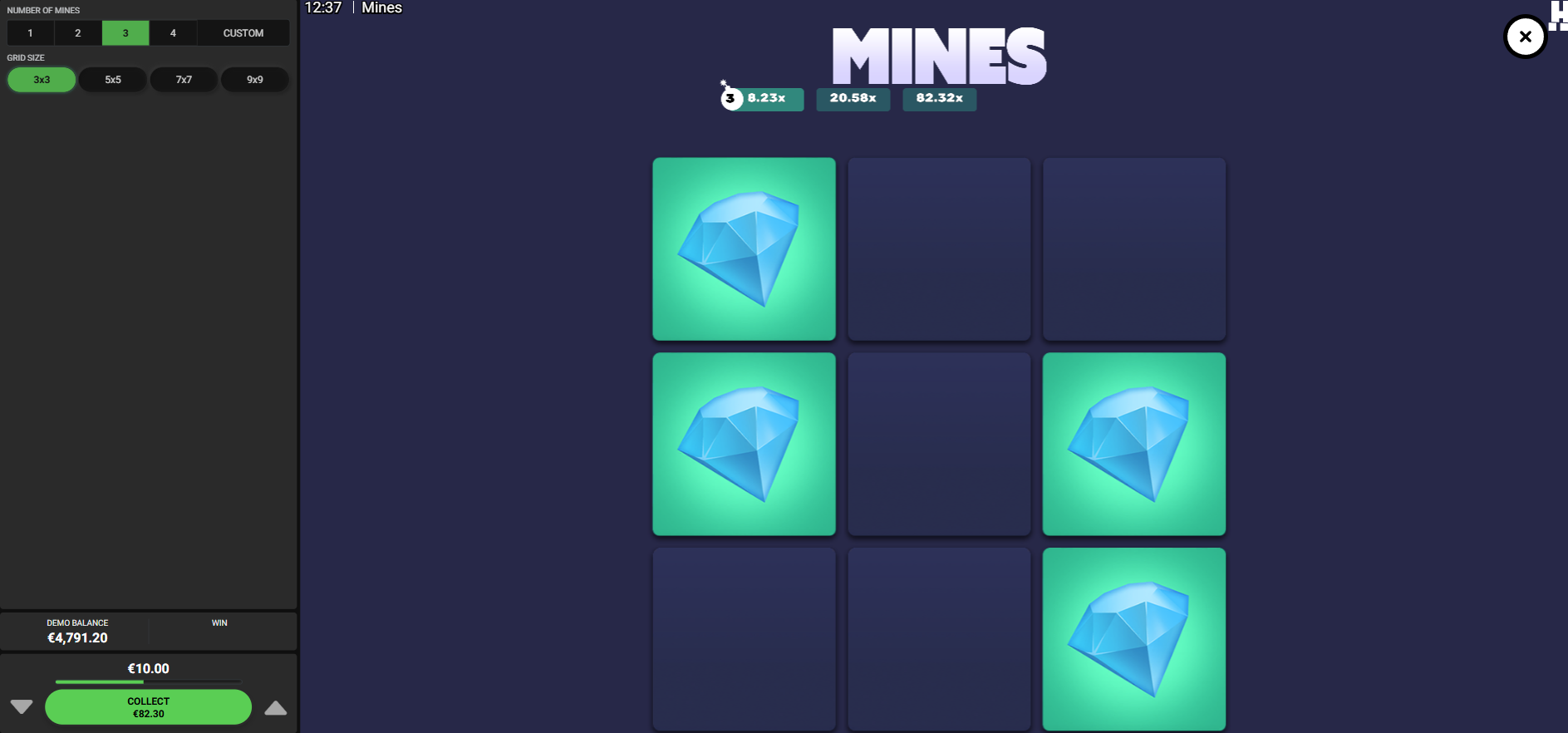
I’ll credit it to my luck, but I had better success with this more volatile variant of Mines. Obviously, this is a much riskier variant, and I often hit a Mine even on my first click.
Now, to see how the game performs in the least volatile setting, I tried it with a 9×9 grid and just 5 mines.
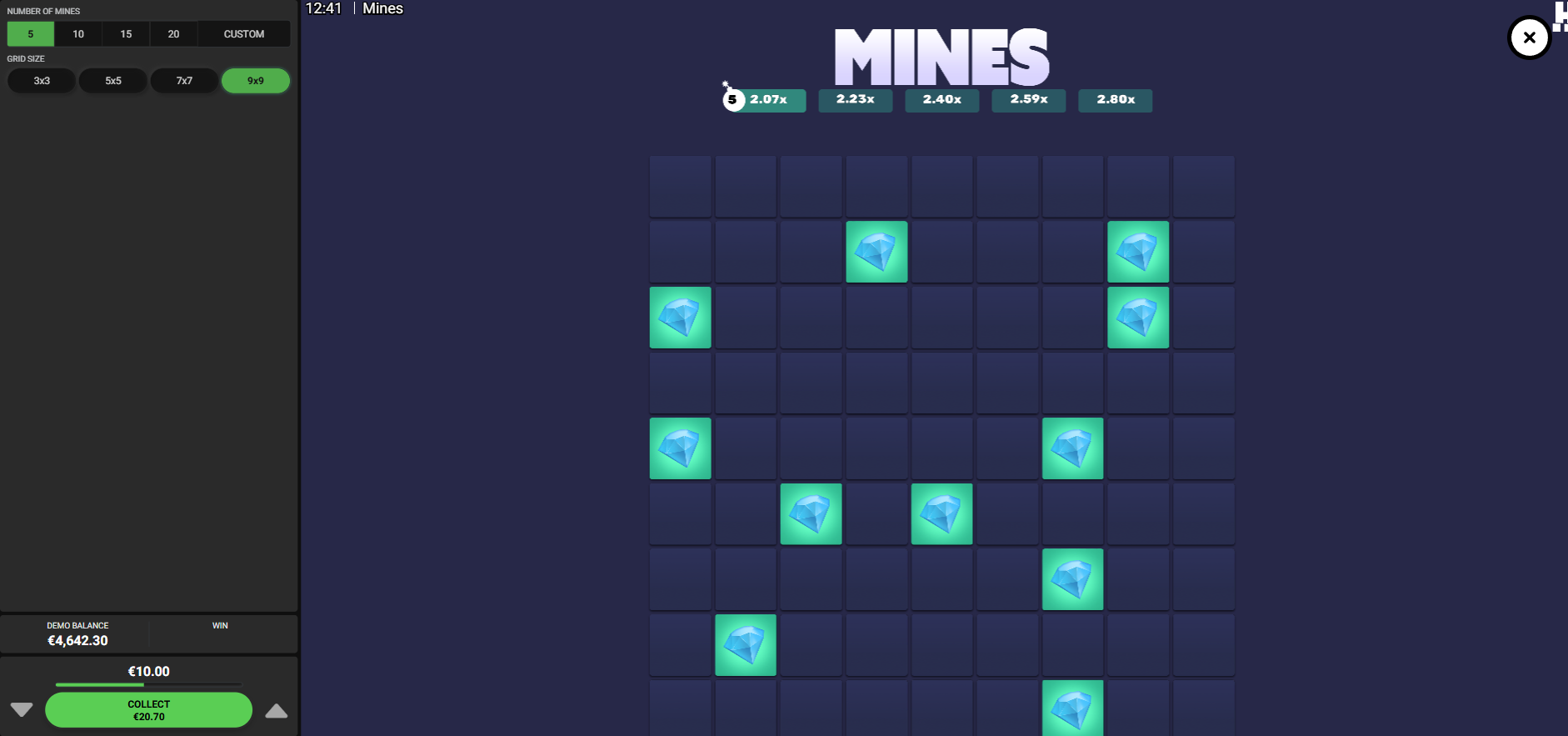
This is a much less risky option, but you need to open 11 safe tiles for that 2.0x-or-higher multiplier, so the actual RTP is the same.
While playing Mines with the highest volatility (small grid and a lot of mines) can be frustrating because you’ll be constantly hitting mines, the lowest volatility can be frustrating too because the multipliers are very low, and you can still hit a mine fairly early in the game and lose your bet.
I suggest playing with a standard 5×5 grid and medium volatility with 5 mines for the best experience.
Summary: Should You Play Mines?
Mines may look like Minesweeper, but the two are very different games. This is NOT a game of skill, and since there’s no information on the minefield, every pick is a blind guess. This means that the game comes down entirely to your luck, how many mines you choose to be on the grid, and when you decide to cash out.
There are many different volatility levels, so if you prefer lower volatility, choose fewer mines. If you want bigger multipliers, increase the mine count and reduce the grid size.
With RTPs often around 98% or higher, Mines is a surprisingly fair casino game, and it’s also a good choice if you prefer a slower pace (when compared to games like pokies and roulette) and more player engagement.
Latest Articles


Disclaimer: Gambling in Australia is strictly for individuals aged 18+. Our editorial team adheres to a strict policy to ensure that our reviews, recommendations, and content remain objective and free from external influence. We strongly encourage responsible gambling at all times. If you or someone you know is struggling with gambling addiction, visit the following gambling resources:
- https://responsiblewagering.com.au/
- https://www.gamblinghelponline.org.au/
- https://gamblershelp.com.au/get-help/