
Two bookmakers can offer different odds on the same match, even when they’re pricing the exact same outcome. The bookie that offers the higher odds obviously offers a better return, but there’s more to analysing the betting odds than comparing numbers.
Odds indicate how the market is pricing an outcome, but you also want to consider how much of the price reflects the bookmaker’s margin and whether the potential return justifies the risk. Odds movements add another factor to consider, particularly when prices shift before a match, or there’s a last-minute odds shift.
I’ve prepared this guide to teach you all about analysing betting odds, including how to calculate implied probability, identify the bookmaker’s margin, compare prices across bookmakers and assess whether the odds offer good value.
What the Odds Say About the Favourite and Underdog

Let’s use a basketball matchup between the Los Angeles Lakers and the LA Clippers to see how much you can learn from a bookmaker’s betting odds. The example below uses the prices in our screenshot, with the Lakers at 1.52 and the Clippers at 2.53.
| Match winner | Decimal odds | Implied probability |
|---|---|---|
| Los Angeles Lakers | 1.52 | 65.8% |
| LA Clippers | 2.53 | 39.5% |
The Lakers are the clear favourites, while the Clippers are the underdogs. But why? And does the difference between these prices make sense?
Why Are the Lakers Favourites?
The first thing to do is look at the teams themselves. You could start with their recent results, the quality of their key players, their performances against similar opponents and any injuries that could affect the game.
For example, Luka Doncic and Austin Reaves are two of the Lakers’ main offensive threats. On the Clippers’ side, Darius Garland is an important player, particularly when other scoring options are unavailable. These are the kinds of players you want to research before deciding whether the odds reflect the likely balance between the teams.
In the example matchup, let’s say that the Lakers enter the game with a 3-1 record, compared with the Clippers’ 1-2 record. Obviously, it’s still early season, but let’s say that the Lakers have also scored more points per game, while the Clippers seem like they’re struggling defensively. However, four games is a small sample, so it would be a mistake to treat those numbers as conclusive evidence of which team is better.
Injuries, Scheduling & Other Analysis
Injuries are another important part of the picture. The pre-game reports listed several Clippers players as unavailable, including important players like Bradley Beal, Brandon Ingram, Rui Hachimura, Max Strus and Jordan Miller. The Lakers had Adou Thiero and Cameron Carr listed as out.
Missing players can affect every aspect of the game, but they’re especially important in games like basketball, so you should check the latest team news before interpreting the prices.
There is also a scheduling factor to consider. In our example, the Lakers are playing on consecutive nights after facing Portland, while the Clippers had two days of rest. Fatigue could affect the Lakers’ performance, particularly if their key players had played heavy minutes the previous night.
You see how the analysis starts to take shape? The Lakers’ stronger early-season record and the Clippers’ injury list help explain why the Lakers might be favoured. However, the Lakers’ back-to-back games and the fact that the Clippers had two days of extra rest, plus the fact that they’re playing in an arena just 11 miles from their home, are factors that could work in the opposite direction.
Does the Favourite Offer Good Value?
This is where you need to separate the likelihood of an outcome from the odds’ value.
At 1.52, a A$100 bet on the Lakers would return A$152, while the same stake on the Clippers at 2.53 would return A$253. The Clippers offer a bigger potential payout, but that doesn’t automatically make them a better bet.
Let’s say your research suggests the Lakers have a 60% chance of winning and the Clippers 40%. Their fair odds would be 1.67 and 2.50, respectively. Based on your estimates, the Lakers’ price of 1.52 looks too short, while the Clippers at 2.53 could offer better value.
These probabilities are hypothetical, of course. Your assessment should account for factors such as recent form, injuries, player matchups and fatigue. The goal is to determine whether the bookmaker’s price reflects the outcome’s actual likelihood, not simply to back the favourite or chase a bigger payout.
How to do so?
Compare your research to the actual odds, and calculate the implied probability and the bookmaker’s margin.
What Over/Under (Totals) Odds Tell You
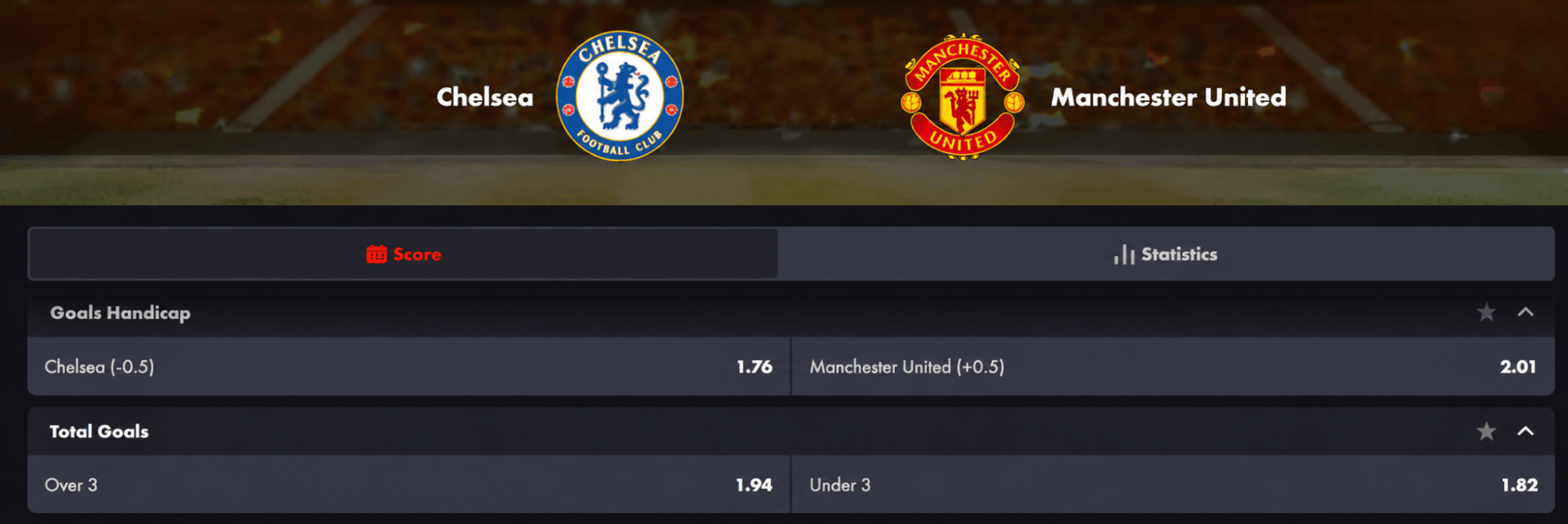
Match-winner odds tell you which team the bookmaker favours, but the total goals market gives you another angle. It shows how the bookmaker prices the number of goals/points in a match, and comparing different totals betting lines can help you understand what kind of game the market expects.
Let’s use a Premier League match between Chelsea and Manchester United as an example.
The bookmaker offers the following prices:
| Total goals | Over | Under |
|---|---|---|
| 2.5 goals | 1.59 | 2.30 |
| 3 goals | 1.94 | 1.82 |
| 3.5 goals | 2.46 | 1.52 |
| 4 goals | 3.61 | 1.27 |
At 1.59, Over 2.5 is the shorter price, suggesting the bookmaker considers three or more goals more likely than two or fewer. However, at the main line of 3 goals, Under is priced shorter at 1.82. This suggests the market is less confident about the game producing four or more goals.
There’s an important detail here: if you bet Under 3 and exactly three goals are scored, your stake is returned under standard Asian total-goals rules. The same applies to Over 3. This is why the odds at a whole-number line work differently from those at 2.5 or 3.5, and I generally recommend sticking to .5 lines to avoid confusion.
Why Might We Expect Goals in This Match?
Start by looking at each team’s attacking and defensive records in the 2026 season so far. Chelsea had scored 17 goals and conceded 15 in their first eight league matches. At home, they had averaged 2.8 goals scored and two conceded per game.
Manchester United, meanwhile, had scored 10 and conceded 13 across their first eight matches, and were yet to win away from home. Both teams had also struggled to keep clean sheets.
Those numbers give you reasons to investigate the Over market. Chelsea have shown they can score several goals at home, while United’s defensive record… well… let’s just say that it suggests they may give up a lot of chances.
But there are reasons not to assume this will be a high-scoring game. Let’s say that Chelsea’s leading scorer, João Pedro, is expected to miss the match with a thigh injury.
We can assume that United have also struggled to score consistently, including in recent league matches. If Chelsea’s attack is less effective without Pedro and United fail to contribute, the total could stay below the higher lines.
This is how you should approach totals. You should always look at the evidence for both outcomes and see which one makes more sense, and why.
What Can the Other Goal Lines Tell You?
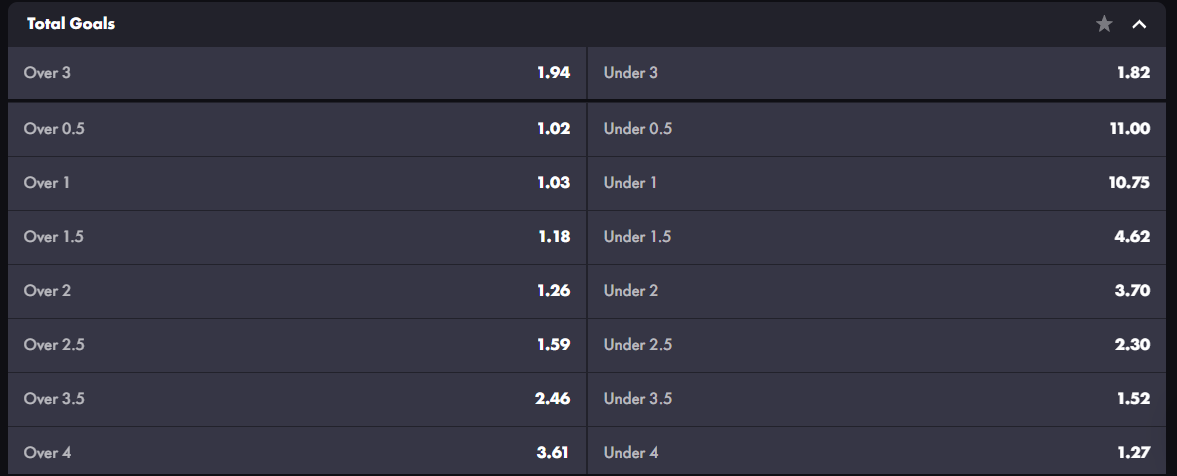
The ‘base’ goal line for this matchup is 3 goals, but there are alternative lines starting from Over/Under 1.5 goals to Over/Under 12 goals and anything in between. So, let’s analyse their odds:
- Over 1.5 at 1.18: The bookmaker strongly favours at least two goals being scored.
- Over 2.5 at 1.59: Three or more goals are priced as a reasonably likely outcome.
- Under 3.5 at 1.52: The bookmaker favours three goals or fewer over four or more.
- Under 4 at 1.27: Four or more goals are considered less likely.
These prices paint a more detailed picture than simply saying the bookmaker expects a high-scoring game. The market leans towards at least two goals, but the shorter prices on the higher Under lines suggest that a goal fest is less likely.
Of course, the odds don’t tell you exactly how many goals will be scored. They reflect the bookmaker’s pricing, including its margin, and can change as team news and betting activity develop.
Before drawing a conclusion, check the teams’ recent expected goals (xG), shots on target, scoring rates against similar opponents, likely line-ups and injury reports. Then compare your assessment with the available prices. The question isn’t only whether you expect goals, but whether the odds offer enough value for you to place an Over/Under bet.
Handicap Betting (Line Betting)
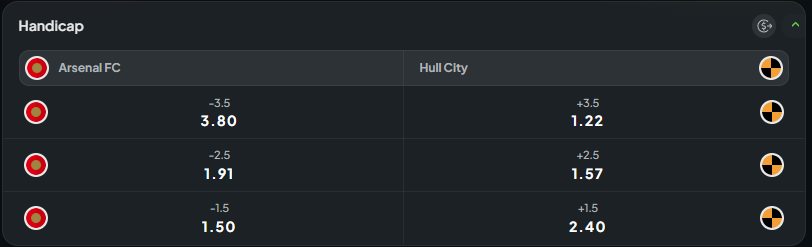
Handicap betting can give you a much better idea of what a bookmaker expects from a match than almost any other type of bet. The handicap line tells you how big the gap between the two teams is expected to be, while the odds show how likely the bookmaker considers each side to cover that line.
In soccer, you’ll often see the market displayed as a goal handicap. In basketball and other sports, it’s usually expressed in points. The principle is the same: one side gets a virtual advantage, while the other has to win by a certain margin to cover the handicap.
Let’s use an Arsenal vs Hull City example in a matchup in the Premier League. The bookmaker offers three different lines:
| Handicap | Arsenal FC | Hull City |
|---|---|---|
| 3.5 goals | -3.5 at 3.80 | +3.5 at 1.22 |
| 2.5 goals | -2.5 at 1.91 | +2.5 at 1.57 |
| 1.5 goals | -1.5 at 1.50 | +1.5 at 2.40 |
Look at what the market is telling you. Arsenal are expected to be the much stronger side, but the bookmaker isn’t saying they’re equally likely to win by any margin.
At -1.5, Arsenal are priced at just 1.50, suggesting the market sees a two-goal victory as a fairly realistic outcome. Move the handicap to -2.5 and the price increases to 1.91. At -3.5, it jumps to 3.80 because Arsenal now need to win by at least four goals.
The other side of the market tells the same story. Hull City +3.5 is only 1.22, meaning the bookmaker considers it very likely that Hull will either win, draw or lose by three goals or fewer. At +1.5, however, the price rises to 2.40 because Hull needs a much more specific result to cover the line.
What Does the Handicap Tell You?
The handicap is useful because it gives you an idea of the expected margin, so you can get a feel for what the bookmaker expects to happen in the match.
If a bookmaker sets Arsenal at -1.5, the odds attached to the line show how strongly the market expects Arsenal to cover that margin. With odds of just 1.50, I’d say the bookmaker considers an Arsenal win by two or more goals a fairly likely scenario. However, is it a value bet? Not necessarily.
For example, Arsenal might be 1.20 to win the match but 1.50 at -1.5. That might look like a reasonable price at first glance, but you’re asking Arsenal to do more than simply win. They need to win by at least two goals, and that’s not an easy result even for a strong favourite.
If Arsenal win 1-0, 2-1 or 3-2, your -1.5 bet loses despite correctly predicting the winner. You’re taking on considerably more risk, but the 1.50 odds don’t necessarily give you enough of a return for that extra risk.
That’s why handicap bets can be particularly useful when analysing a match where the favourite has a very short head-to-head price. Instead of simply saying “Arsenal are likely to win”, look at the handicap and ask how comfortable that win is expected to be.
The line might suggest that a two-goal victory is likely, but you still need to decide whether 1.50 is a good enough price to take that risk.
How to Analyse Handicap Odds
When analysing a handicap, look at both the line and the odds. The line tells you what margin the bookmaker expects, but the odds tell you whether you’re getting enough return for taking that risk.
In our Arsenal example, I’d rather take Arsenal to win at 1.20 than back them at -1.5 for just 1.50. Arsenal might be very likely to win, but winning by two or more goals is a different bet, and 1.50 doesn’t give me much reward for that extra risk.
If I don’t like the handicap price, I’d rather stick with the head-to-head market or look at another option such as Over/Under. The point isn’t to find the bet with the biggest odds, but the one where the price makes sense for the outcome you’re predicting.
What Do Other Betting Odds Tell You?

While handicap and Over/Under markets can give you a pretty good idea of how a bookmaker expects a match to play out, other markets can also provide useful information, but the further you move into player props and more specific outcomes, the harder the odds can be to interpret.
Take the try scorer market in rugby league, for example. Let’s say that Mackenzie Wiki and Stacey Waaka from the New Zealand Women’s team in a match against Samoa are both priced at 1.80 to score at least one try, 4.75 for two or more and 13.00 for three or more.
The obvious takeaway is that the bookmaker expects both players to have a reasonable chance of scoring. But that doesn’t tell you everything.
A try scorer bet depends on far more than the player’s ability to score, including their position, attacking opportunities, team selection, opposition defence and how the match develops. All of these factors can have a major impact, so it’s not only on Wiki to score a try.
Why Player Prop Odds Can Be Difficult to Analyse?
Player props are often much harder to predict than standard match markets because you’re relying on one player to produce a specific outcome.
A player might be one of the team’s best try scorers and still fail to score because their team doesn’t create enough chances, they spend less time on the field than expected, or the opposition keeps them away from the try line.
The same applies to other player markets. A basketball player might be priced at 1.80 to score 20+ points, but that doesn’t mean they’re likely to reach that number simply because they’ve done it several times recently. Minutes, matchups, injuries and the pace of the game are all very important factors to consider.
That’s why I wouldn’t rely too heavily on a single player’s odds when analysing a match. The price can tell you what the bookmaker expects, but predicting an individual performance is notoriously difficult, and I believe it’s not worth it.
In fact, the more specific the market becomes, the more difficult it can be to make a confident prediction. A match-winner bet asks you to pick the team that wins. A try scorer bet asks you to pick the player who scores – and the odds aren’t necessarily that much better.
Read the Lines, Not Between Them
A 1.50 price, a -1.5 handicap or an Over 2.5 line can tell you a lot about a matchup. The bookmaker’s line and price reflect its pricing of the outcome, along with the margin built into the market. Your job is to understand what that price implies and decide whether your own assessment is different.
If Arsenal are 1.20 to win but 1.50 to win by two or more goals, ask yourself why the handicap is priced that way. If Over 2.5 is 1.59 but Over 3.5 is 2.46, think about what that tells you about the expected number of goals. And if a player is 1.80 to score, think about whether that’s a value bet, even if it’s one of the teams’ best attacking players.
The odds give you clues, but they don’t give you the answer. You still need to look at the teams, players, form, injuries, matchups and other factors that could influence the outcome.
Most importantly, even if something is a likely outcome, it doesn’t necessarily mean that it’s a good bet. A 1.05 favourite can be very likely to win and still offer poor value.
To master analysing betting odds, you need to understand what the bookmaker expects, why they’ve priced it that way, and whether you agree with the price.