
You can know everything about your favourite team, follow every game and know it inside out, but betting odds offer a different perspective. They reflect how the market views a sporting outcome, how likely it is considered to happen and what you could win if it does.
Let’s say the Wanderers are playing in the A-League and you see odds of 2.50 for them to win. A $20 bet would put $50 back in your pocket if they get the job done, leaving you $30 up. The same odds suggest the market gives them a 40% chance of winning, although the bookmaker’s margin affects the exact figure.
I’m going to help you make sense of betting odds and understand different formats, calculate potential returns and work out implied probability. I’ll use real sporting examples to see how the numbers work in practice and what they can tell you about a match.
What Are Betting Odds?
Betting odds are the numbers bookmakers set to show how they price different outcomes in a sporting event and how much you could win if your prediction is correct. Odds also give you an indication of how likely an outcome is considered to happen, based on the bookmaker’s assessment and the information available.
What Do Betting Odds Represent?
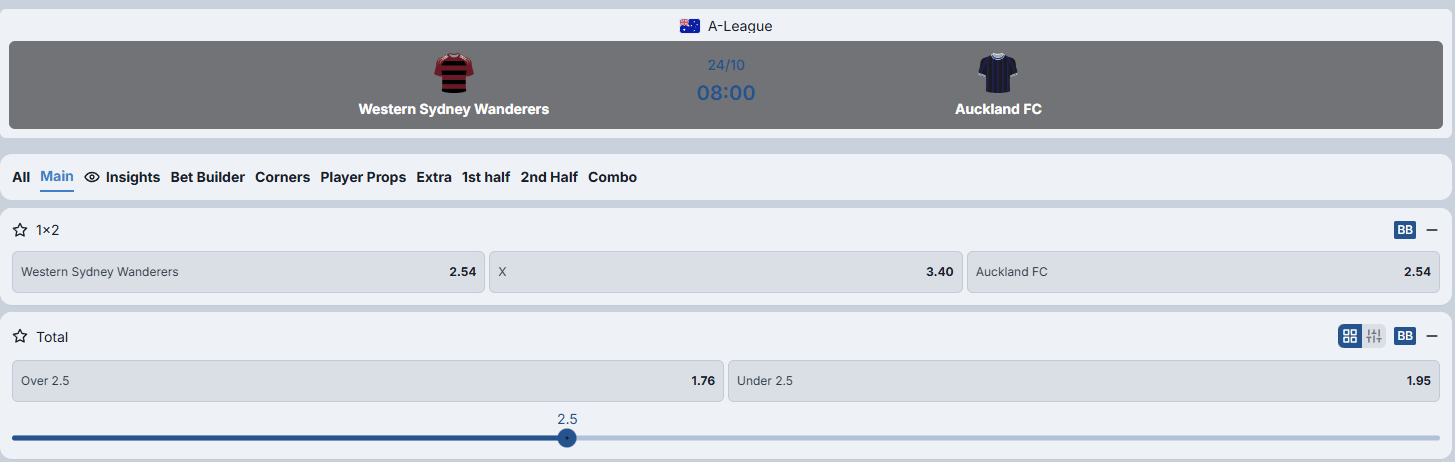
Decimal odds show the potential return on a bet, including your original stake. The lower the odds, the less you receive for a winning bet, and vice versa. Higher odds offer a bigger potential return.
For example, if Australia are priced at 2.00 to beat England in a cricket match, a A$10 bet would return A$20 if Australia win. At odds of 3.00, the same stake would return A$30.
In other words, the lower the odds for Australia to win, the bigger a favourite the bookie considers it to be in the match.
How Do Betting Odds Relate to Probability?
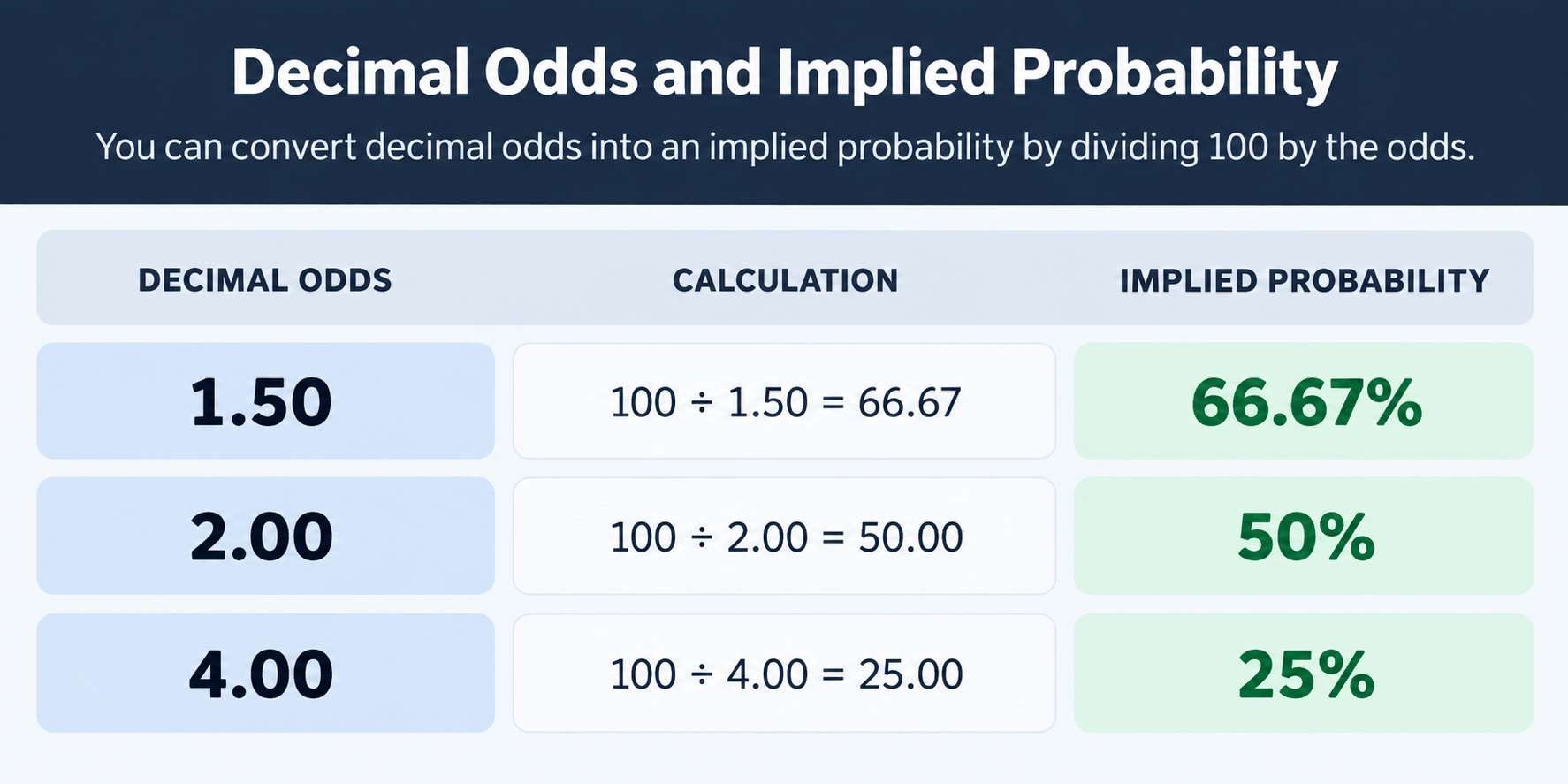
Odds can be converted into an implied probability, which expresses the likelihood of an outcome as a percentage. With decimal odds, you simply divide 100 by the odds.
For example, odds of 2.00 imply a probability of 50%, while odds of 4.00 imply a 25% likelihood of an outcome happening.
A note from Sophie: Implied probability is a useful way to understand what odds suggest about an outcome, but it isn’t the same as its actual chance of happening. Bookmakers include a margin in their prices, so the implied probability may be higher than the true likelihood of that result.
Why Do Betting Odds Differ?
Odds vary depending on the teams, players, available information and the market you’re looking at. A cricket match might have separate odds for the match winner, top batter or total runs scored, with each market covering a different outcome.
I see odds as a live matter because they’re constantly moving as new information becomes available, meaning the price you see when Australia are announced to play England will probably look quite different by the time the match begins.
For example, a key player getting injured, a change in the weather or even a shift in how the market views either team can influence the odds, which is why it’s important to remember that they’re never necessarily fixed, even when the teams and match remain the same.
How Do Decimal Betting Odds Work?
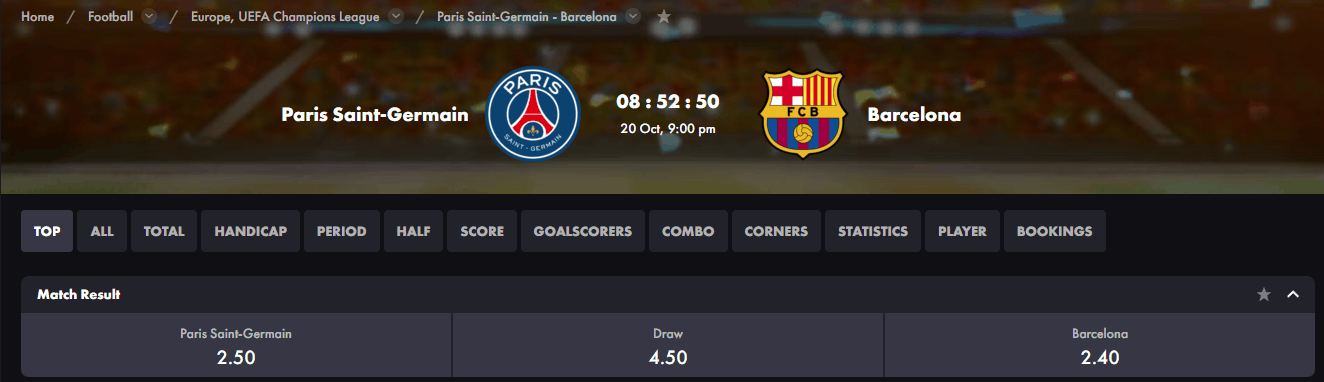
In Australia, we generally use decimal odds, which are pretty straightforward. The number literally tells you how much you’ll get back for every dollar you stake, including your original stake, so you don’t need to do any complicated maths to work out your potential return.
Let’s say Barcelona FC are playing in the Champions League against Paris Saint-Germain, and the odds for PSG to win are 2.50. So, if you put A$20 on them to win, and they do, you’ll receive A$50 in total, which includes your original $20 and $30 in profit, and that’s all there is to it.
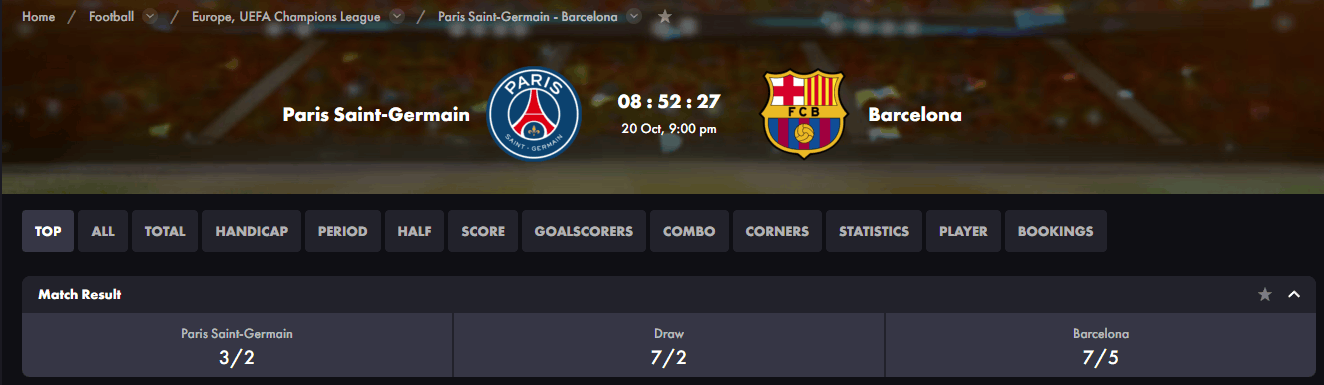
Other countries use different formats, and you’ll generally come across three main types of betting odds:
- Decimal odds: Common in Australia and Europe, these show your total return for every dollar staked.
- Fractional odds: Popular in the UK, these show your potential profit relative to your stake, such as 3/2.
- American odds: Common in the United States, these use positive and negative numbers, such as +150 or -150.
Sophie’s Two Cents: We’re pretty lucky to have decimal odds here in Australia, because the Brits have to deal with fractions, which can make things a little more complicated if you’re not used to them, while the Americans have their own system. You can use our odds converter to help you convert different odds types.
Stumbled upon something else?
You can use our odds converter to help you convert different odds types.
How to Calculate Betting Odds and Potential Returns
Decimal odds are as straightforward as it gets, so calculating your potential winnings is simple. Multiply your stake by the odds to get your total return, then subtract your original stake to find your profit.
This is the formula:
Total return = Stake x Decimal odds
Profit = Total return – Stake
Let’s say you’re looking at an AFL match between Collingwood and Carlton and want to see how different stakes affect your potential returns at various odds.
| Sign Up Bonus | Bonus Offer | Wagering Req. |
|---|---|---|
| Deposit 1 | 100% up to A$4,000 + 100 free spins | 35x |
| Deposit 2 | 50% up to A$4,000 + free spins gift box | 35x |
| Deposit 3 | 75% up to A$2,000 + 50 free spins | 35x |
| Deposit 4 | 100% up to A$4,000 + 50 free spins | 40x |
As you can see, both your stake and the odds affect how much you stand to receive. Higher odds mean a bigger potential return for the same stake, but they generally indicate that the market considers the outcome less likely, and vice versa.
Of course, these figures only apply if your bet wins. If it loses, you generally lose your stake. I say ‘generally’ because in some specific situations and sports, a draw or another specified outcome is considered a push, which means that you get your stake back.
What Is Implied Probability?
The term ‘implied probability’ indicates the percentage chance of an outcome suggested by the betting odds. Or, in simpler terms, it gives you an idea of how the market views a particular result in a match. Note, though, that it doesn’t necessarily reflect the outcome’s actual likelihood.
To calculate implied probability from decimal odds, divide 100 by the odds:
Implied probability (%) = 100 ÷ Decimal odds
Here are three examples:
- Odds of 2.00: 100 ÷ 2.00 = 50%
- Odds of 4.00: 100 ÷ 4.00 = 25%
- Odds of 1.50: 100 ÷ 1.50 = 66.67%
Let’s say Jannik Sinner is priced at 1.50 to beat Carlos Alcaraz in a hypothetical Australian Open tennis match. Those odds imply a probability of 66.67%, making Sinner the favourite. However, that doesn’t mean he’ll win exactly two out of every three matches at those odds, as the actual outcome depends on the players’ form, playing conditions and plenty of other factors.
Sophie’s Take: Although you might have never heard of this term, implied probability is a useful starting point when comparing odds. However, it’s just that – a starting point, so don’t mistake it for a guarantee. The exact betting odds are affected by many factors, including the bookmaker’s own margins.
How Bookmakers Set Odds and Make Their Money
Bookmakers don’t just pick odds out of thin air. Behind the odds you see on a betting market are oddsmakers, also known as traders, who work out how to price different sporting outcomes.
These days, it’s rarely just one person making a judgement call, as bookmakers rely on teams of specialists, statistical models and, in recent times, sophisticated AI systems to analyse performance data, player availability, historical results and betting activity.
They aren’t simply trying to predict the winner, but their odds also include a built-in margin, often called the overround, which gives them a mathematical advantage across a market.
How Does the Bookmaker’s Margin Work?
Let’s use a hypothetical AFL match between Collingwood and Carlton, where both teams are priced at decimal odds of 1.90.
The implied probability for each team is:
- Collingwood: 100 ÷ 1.90 = 52.63%
- Carlton: 100 ÷ 1.90 = 52.63%
- Combined implied probability: 105.26%
Since only one team can win (if we count extra time, too), the combined probability would ideally be 100% if the odds perfectly reflected the underlying probabilities without a margin. Here, it adds up to 105.26%, leaving an overround of 5.26 percentage points.
That extra percentage is how the bookmaker builds a margin into the market. It doesn’t mean the bookmaker is guaranteed to make a profit on every match, but it gives them a mathematical edge over many bets.
Note that the calculated percentage of 5.26% isn’t the actual profit of the bookmaker, as they too have running costs, but it’s a useful measure.
Why Do Odds Differ Between Bookmakers?
Different bookmakers can assess the same match differently, use different pricing models or adjust their odds in response to betting activity, so yes, you can get different odds for the same bet at different betting sites.
For example, one might offer Collingwood at 1.90 while another offers 1.95, even though both are pricing the same match. Another might give Collingwood 2.05 and Carlton 1.85, so it’s best to use our implied probability calculator to calculate the exact probability in each situation.
Our tools are free to use
Use them instead of guessing what the implied probability is.
That difference matters to you because odds determine your potential return. That’s why I suggest you understand implied probability and the bookmaker’s margin: the price reflects how the bookmaker has chosen to price the outcome, and that can give you valuable information.
How to Read Betting Odds in Different Sports
The good news is that decimal odds work pretty much the same way across sports. The not-so-good news is that the number of things you can bet on seems to grow every time you open a sportsbook, so there are now hundreds of betting types for the same match.
I can’t possibly list them all, so I’ll focus on some examples from sports Australians love, and popular bets like outright winner, handicap bets, multis, totals, and similar. You can check out my bet types guide, where I explain all these types in detail.
Soccer
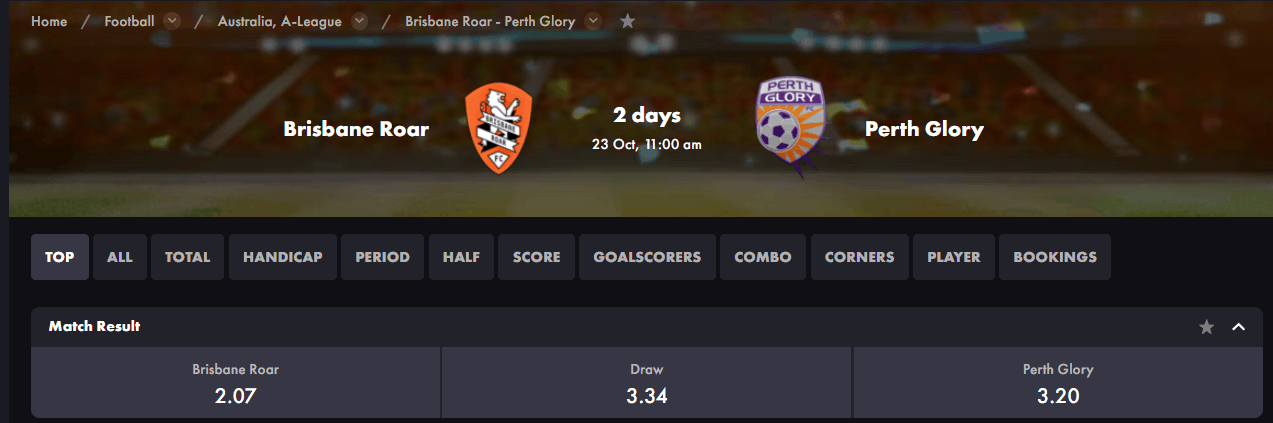
Soccer commonly uses three-way match-winner markets, where you can back the home team, the away team or a draw.
For example, if Australia are priced at 2.00 to beat Japan, a A$20 bet would return A$40 if Australia win. The draw is a separate outcome with its own odds, unlike a two-way market where a draw may result in a refund under certain rules.
AFL and Rugby League
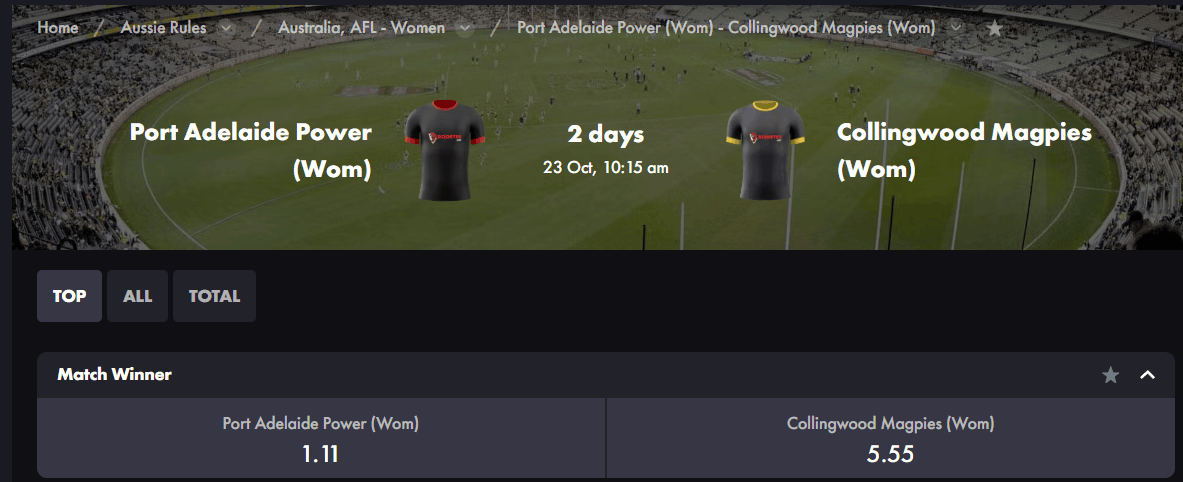
In AFL and NRL, you’ll often see head-to-head markets, where you pick the winning team, and handicap markets, which give one team a points head start or deficit.
For example, if the Brisbane Lions are priced at 1.80 to beat Carlton, a A$20 winning bet would return A$36, including A$16 profit. A handicap market might instead require Brisbane to win by more than a specified margin for your bet to succeed, but the odds are adjusted for the favourite ‘to cover the handicap’.
Cricket
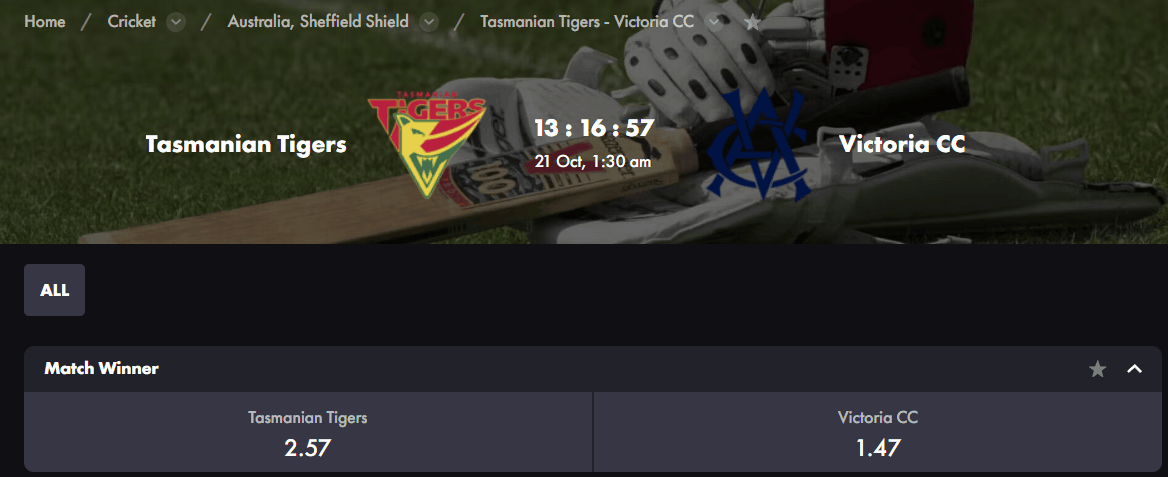
Cricket betting can vary depending on the format. In a T20 match, you might back Australia to beat England, while a Test match can end in a draw, so the available outcomes are different depending on the particular match.
For example, a A$20 bet on Australia at odds of 1.70 would return A$34 if they win, including A$14 profit. In a Test match, a draw may be offered as a separate outcome with its own odds, but if there are odds for a draw, the odds for each team to win tend to be lower.
Tennis
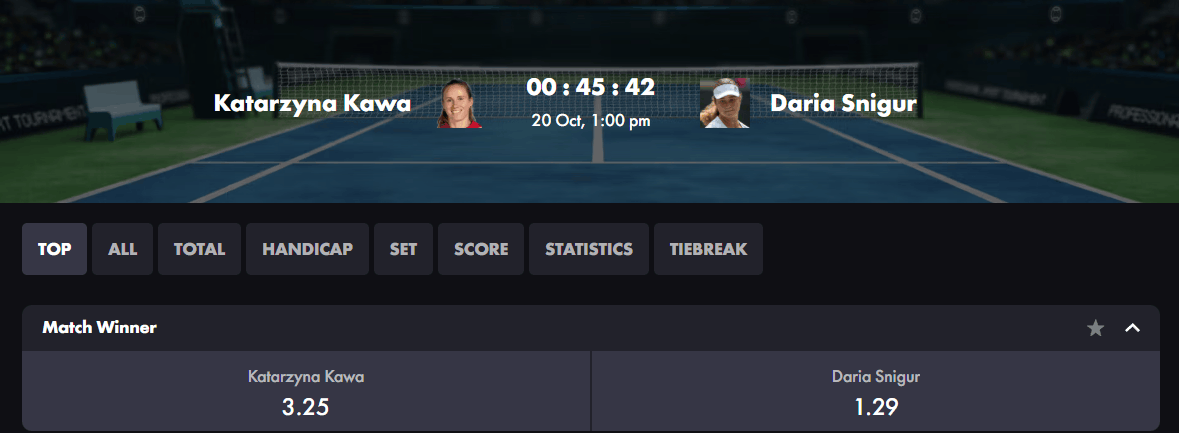
Tennis markets often include the match winner, set betting and the total number of games played. You could back Novak Djokovic to beat Alexander Zverev or predict the match will go to three sets.
For example, if Djokovic is priced at 1.60 to win, a A$20 bet would return A$32, including A$12 profit.
Basketball
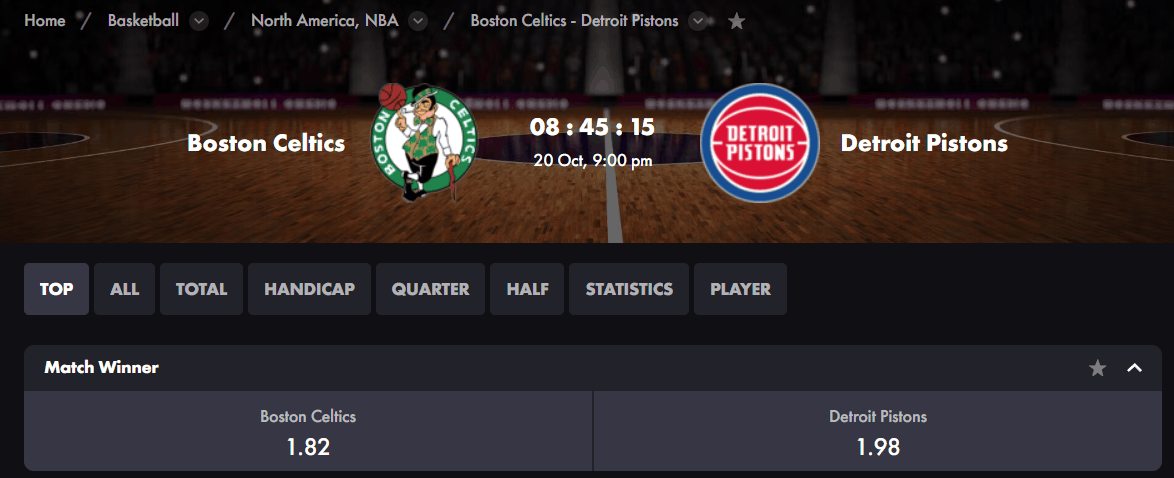
The most common options in basketball betting are totals, where you predict whether the combined score will be over or under a set number of points, and point spreads (handicaps), where a team must win by a certain margin or stay within it for the bet to succeed.
For example, if an NBA game between the Boston Celtics and Los Angeles Lakers has a total of 220.5 points, you can bet on whether both teams will score more or fewer than that combined. A point spread is the same as a handicap, and it might require Boston to win by at least 6 points, so the point spread in that case would be -5.5 points.
Factors That Influence Betting Odds
Betting odds shift all the time before the match starts and for all sorts of reasons. They are usually released days or even months ahead, and they change for days before a match and sometimes just minutes before it starts.
This is because bookmakers adjust their prices as new information becomes available, whether it’s a key player getting injured, a change in team selection or punters backing one side more heavily than the other.
Here are some of the main factors that can influence the odds:
- Injuries and suspensions: If a key player is ruled out, their team’s chances may change, prompting bookmakers to adjust the price.
- Team selection: A surprise inclusion, a rested player or a different starting line-up can affect how a team is rated.
- Weather and playing conditions: Even the weather can affect the odds. For example, heavy rain can influence a cricket match, while strong winds may affect scoring in an AFL game or a golf game.
- Recent form and new information: A team on a winning streak might attract more attention, although bookmakers consider plenty of other factors beyond recent results.
- Betting activity: Although this is usually not visible to punters, if the bookmaker notices that a lot of bets come in on one outcome, they may adjust their prices to manage their exposure and respond to the market.
An Example of Why Odds Change
Imagine the Western Sydney Wanderers are priced at 2.50 to win an A-League match, but their main striker is ruled out before kick-off. The bookmaker might increase their odds to 2.80 to reflect the potential impact of his absence, while shortening the odds on their opponent.
Obviously, these changes are adjusted depending on how important a player is, the available alternatives, and what the market already expects.
In fact, you’ll often see odds move dozens of times before a match begins, which is why the opening price is often very different from the one available before kick-off.
A Tip from Sophie: Once you’ve placed a bet, the odds you’ve accepted are locked in, even if the price changes later. For example, if you back Max Verstappen to win a race at 5.80 and his odds shorten to 2.20 as his form improves or more people back him, your original bet still stands at 5.80. If he wins, your return is calculated using the odds you took when placing the bet, not the new price.
Betting Odds vs Actual Chances
Betting odds give you an idea of what the market expects to happen, but sport has a funny way of ignoring expectations. Favourites have shorter odds because they’re considered more likely to win, while outsiders have longer prices, but neither comes with a guarantee.
No form of gambling offers guarantees, and sports betting is no different. Imagine Jannik Sinner is priced at 1.40 to beat Carlos Alcaraz, who is sitting at 3.00. Sinner is the obvious favourite, but Alcaraz hasn’t travelled all that way to hand him the trophy. A few brilliant shots, a couple of crucial points or an off day from Sinner or a minor injury could change everything.
You might even think Alcaraz has a better chance than the odds suggest, based on his recent form or the matchup and your own analysis. That’s your own assessment, though, and it doesn’t automatically make the price good value. There’s always a dose of risk that things won’t go your way, and that’s an inherent part of betting.
Value Betting: Myth or Reality?
You’ll often hear experienced bettors talk about ‘finding value in betting odds’, but what does that actually mean? The idea is simple: a bet may offer value when the odds are higher than they should be based on your estimate of the outcome’s true probability.
In theory, identifying these opportunities regularly can give you a long-term mathematical edge. The tricky part is knowing whether your estimates are accurate in the first place.
Let’s say you’re looking at an AFL match and believe the Brisbane Lions have a 45% chance of beating Collingwood. That estimate translates to fair odds of approximately 2.22, while the bookmaker is offering 2.50. The market price is higher than your estimated fair price, which could indicate value.
But there’s a catch: your 45% estimate might be wrong. Sure, you can know everything about the Lions, but bookmakers have access to extensive data and sophisticated models, and even experienced analysts can’t predict sporting outcomes with certainty.
So, while value betting isn’t a myth, it’s not a magic formula for making money either. The same goes for strategies such as hedging, which involves placing bets on different outcomes to reduce potential losses or lock in a profit under certain conditions. These approaches can be useful in specific situations, but none guarantees a profit in every scenario.
Common Betting Odds Mistakes
Even if you understand how betting odds work, it’s easy to misread what they actually tell you. These are some of the most common mistakes to watch out for when reading and comparing odds:
- Confusing total returns with profit: If you bet A$20 at odds of 2.50, your total return is A$50, but your profit is only A$30 because your original stake is included.
- Assuming odds of 2.00 guarantee a 50% chance of winning: These odds imply a probability of 50%, but bookmaker margins affect the calculation, and no one can accurately predict the outcome of a match, so there are no guarantees.
- Treating favourites as certainties: Even if the Sydney Swans are strong favourites, that doesn’t guarantee they’ll win. Yes, short odds do indicate that an outcome is considered more likely, not that it’s a sure thing.
- Chasing bigger odds without considering probability: A team priced at 6.00 offers a bigger potential payout than one priced at 1.60, but it’s generally considered less likely to win. Just because you see alluring odds doesn’t mean that the bet is a great value.
- Assuming odds movement guarantees a result: This is an easy one to fall for, even if you’re an experienced bettor. If a tennis player’s odds shorten from 2.50 to 1.80, it doesn’t mean they’re certain to win. Odds reflect changing information and market expectations, but the bookmaker might use this as a strategy to attract more bettors, so don’t fall for it blindly.
- The bookmaker’s margin: The implied probabilities of all possible outcomes often add up to more than 100% because bookmakers build a margin into their prices. Bookies are businesses that make money, so ignoring this can lead you to misinterpret what the odds actually tell you.
Wrap Up
Betting odds aren’t too difficult to understand, largely because we use decimal odds here, while fractional and American odds are a bit more complicated.
However, while you can learn the maths, calculate potential returns, and compare the odds prices in minutes, the tricky part is knowing how much faith to put into those numbers.
Odds give you an idea of what the market expects, but they can’t tell you what will happen once the game starts. Favourites all the time, and even the best analysis can only take you so far.
So, while you should learn how the numbers work and use them to your advantage, you should ultimately keep your expectations realistic and remember that no bet is ever a sure thing.