

Table of Contents
Written by
 Mike Waters
Edited by
 Matthew Scott
However, there are two major mistakes you can make in Pai Gow Poker: not setting your hands properly and playing the wrong version of Pai Gow Poker.
Yes, you read that right, it’s “hands”, because Pai Gow Poker is played with two hands each round. You’ve got a ‘high’ or ‘big’ hand consisting of 5 cards (like regular poker) and a ‘low’ or ‘small’ hand of 2 cards. You then compare them to the dealer to see who won.
I know this sounds a bit complicated, so follow me in this Pai Gow Poker guide where I’ll cover the rules, hand-setting basics, and give you a few tips about increasing your winning chances.
What is Pai Gow Poker

Let’s clarify something from the start: there’s an old Chinese domino game called Pai Gow (which is still very popular today), but it has almost nothing to do with Pai Gow Poker. Other guides may suggest that “Pai Gow Poker mixes traditional poker hands with the old Chinese game Pai Gow”, but in reality, the two have very little in common.
Unlike most poker games, you’re not playing against other players at the table. You’re only trying to beat the Banker (I’ll explain the dealer ≠ Banker situation later) by setting two separate hands from the seven cards you’re dealt.
Separating the 7 Cards Into Two Hands
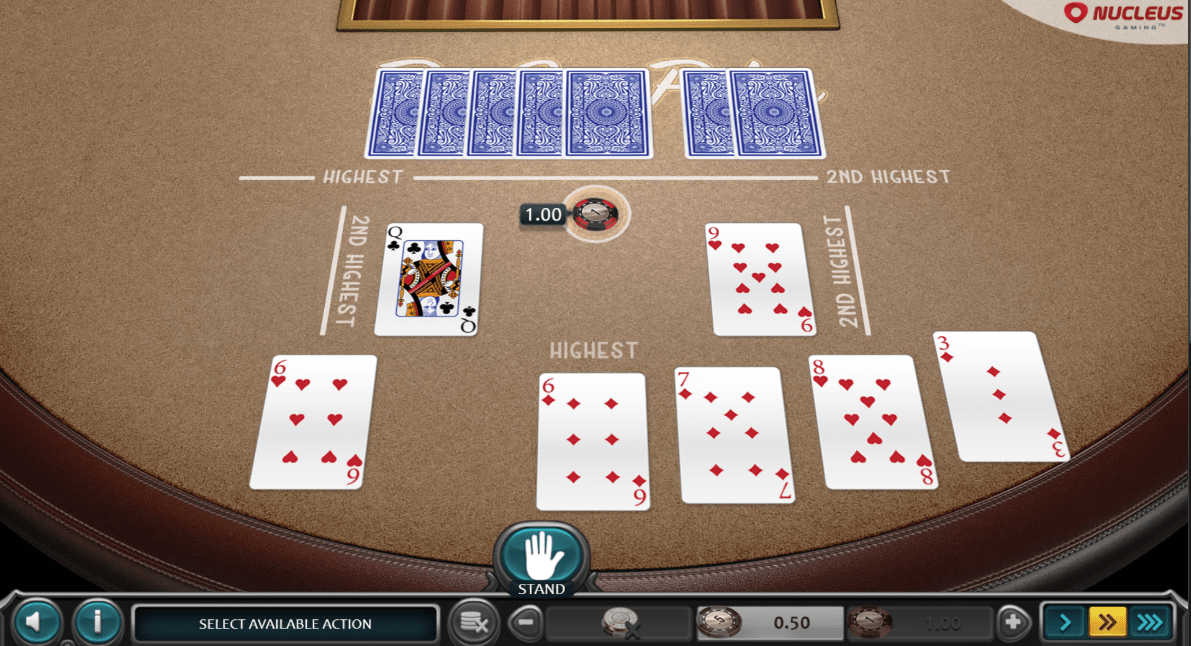
Each round, you split your seven cards into a five-card “high hand” and a two-card “low hand”. To win, both hands need to beat the dealer’s hands. If you win one and lose the other, the hand is a push, which is something that happens a lot in Pai Gow Poker.
Because you need both hands to win the round, the game is very slow and has low volatility. The payout is always 1:1, and you place your bet before the round starts, so there’s no way to raise your bet or go all-in mid-round.
The high hand follows the traditional poker rules, which means that you need the strongest poker combination out of 5 cards, while the low hand only has two-card hands: pair and high card.
Pai Gow Poker is played with 53 cards (the 52 standard-deck cards and 1 Joker card), and a typical table can seat up to 6 players plus the dealer. There are special rules about the Joker card, and they often depend on the variant you’re playing, but it usually acts as a Wild card that can replace any other card or as an Ace. For example, in a hand with 3, 4, 6, and 7, the Joker can act as a Wild and substitute for the 5 to form a Straight.
Pai Gow Poker was created in the mid-1980s by Sam Torosian, the owner of the Bell Card Club in California. The idea came from the original Chinese Pai Gow game, which uses dominoes instead of cards and is known for its slow pace and high number of pushes. But realistically, this is the only thing that the two games have in common.
Torosian’s goal was to turn that concept into a poker-style game that would work better in American casinos. By replacing dominoes with a standard 52-card deck plus a joker, he created a game that felt familiar to poker players but still kept the slow pace of the original.
The game became popular in Las Vegas casinos and beyond, like the 5% rake/commission, the dealer’s “house way” for setting hands, and the “Banker wins ties” rule to increase the house edge.
The first and most popular online Pai Gow Poker variant is Pai Gow Mania, which was released in the mid-2000s, and is widely recognised as the game that made Pai Gow popular worldwide. The digital format makes it easier for players to learn the game without slowing the table down, and it’s now available as both an RNG game and with live dealers.
Yes, Pai Gow Poker is available at many Australian online casinos, though it’s nowhere near as common as blackjack or roulette. You’ll mostly find it as an RNG table game, while live dealer Pai Gow Poker exists but is much rarer and usually limited.
In land-based casinos, Pai Gow Poker is harder to come by in Australia compared to the US. You’ll occasionally see it in larger casino venues, but it’s not something you’ll find in pubs, clubs, or RSLs like pokies.
Most Pai Gow Poker games follow the same basic rules, but some important variations can increase the house edge. The main variations come down to whether the player pays a 5% rake (commission) on their winnings, and whether the dealer uses a fixed “house way” to set their hands. These don’t change how the game plays, but they can affect the house edge.
Tip from Australian Gamblers: If you have a choice, always look for a Pai Gow Poker table that doesn’t charge a 5% commission on winning hands. Commission-free games offer the lowest house edge and give you better value over long sessions. That said, most online Pai Gow Poker variants now include a rake, but I still believe it’s worth taking a minute to read the rules before you start playing.
You probably noticed that I refer to the dealer as the ‘Banker’, and there’s a reason behind it.
Yes, in most online Pai Gow Poker games, the dealer is actually the Banker. This keeps things simple and consistent, especially in RNG versions where the house sets its hand using a fixed “house way” so there’s no real dealer, and the house is the Banker (your opponent).
In land-based Pai Gow Poker, especially in the US, players are sometimes allowed to act as the banker and rotate that role around the table. That option is rare in Australia and almost non-existent online, so you can safely assume you’ll always be playing against the house.
When the dealer is the banker, the house edge comes from the 5% commission on winning hands and one specific rule that if the hand is a tie (meaning that both you and the Banker have the same hand, which is rare), you lose the bet.
Note from Australian Gamblers: The rules in all Pai Gow Poker games say that “the banker wins ties”, but this can be misleading. A tie only happens if both your high hand and low hand push against the dealer. That’s quite rare in practice, so this rule doesn’t come up often, even though it looks worse than it really is on paper.
How to Play Pai Gow Poker
If you’ve played any form of poker before, Pai Gow Poker’s high hand will feel familiar. The difference is that you’re not playing against other players, and you’re not trying to build one strong hand. Instead, you’re splitting seven cards into two hands and trying to beat the dealer (or Banker) with both.
It might sound confusing at first, but once you’ve played a few rounds, the flow becomes second nature. Now, no matter how experienced you are, Pai Gow Poker does require a strategy, and it’s a very, very slow game. You do need time to think about how you will set your hands, and even then, many hands end with a push.
Here’s a step-by-step look at how Pai Gow Poker works:
1. Place Your Bet
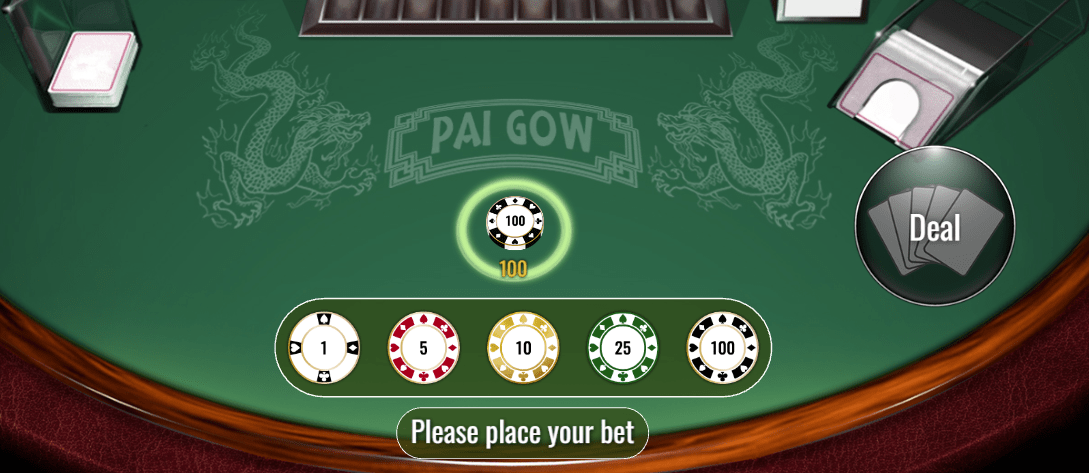
Every round starts by placing your main bet. Most online Pai Gow Poker games have low minimums, and combined with the slow pace of the game, you can really stretch your bankroll. Poker is a game of skill, and Pai Gow Poker is no exception. In fact, I consider this to be one of the most complex RNG games you can play at the casino, so don’t rush and take your time to learn it.
When I say “learn it”, I mean learning how to set your high and low hands to be in the strongest possible position against the Banker. Now, many online Pai Gow Poker games allow you to use the “house way” of setting the hands, but there are many situations where the house way is not the best way to set your hands.
2. Receive Seven Cards (Deal)
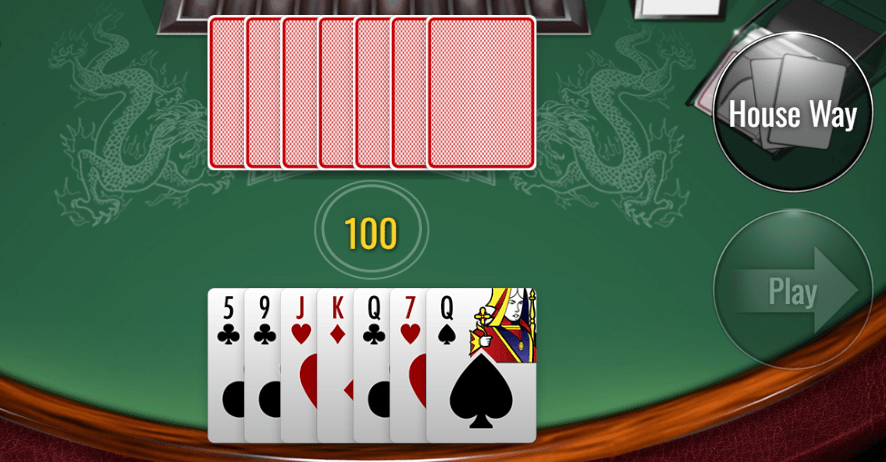
Once you place your bet, you need to press the Deal button, and you’ll receive seven cards. Pai Gow Poker uses a standard 52-card deck plus one Joker. The Joker can act as an Ace or be used as a Wild to complete a straight or flush.
The 7 cards are dealt face up, and there’s usually no time limit on setting your hands. So, you’ve got all the time in the world to think about it before the 3rd step.
3. Set Your Hands (High Hand and Low Hand)

This is the most important part of the game. You must split your seven cards into:
- a five-card high hand
- a two-card low hand
Remember that the high hand must always rank higher than the low hand. If you set your hands incorrectly, your hand is fouled, and you might automatically lose. This is called a ‘dead hand’, and while some casinos allow ‘dead hands’ to be considered a push, in many cases, you will lose the bet because of this simple mistake.
It’s very important to read the rules of the exact Pai Gow Poker variant you’re playing (especially around the Joker), because you can easily make a mistake and end up with a weaker hand than you thought.
I’ll share a situation that happened to me: I had a Three-of-a-Kind as my high hand, so I decided to set my low hand with a K and a Joker, thinking that the Joker is a Wild and I have a pair as a low hand. However, in the game I was playing, the Joker could only serve as an A in the low hand, so I ended up with a high-card hand as my low hand, and I lost the bet.
The entire strategy revolves around how you set your hands, so this is definitely a game that requires a bit of engagement. Or, the other option is to play the “house way” each round.
The “house way” is a fixed set of rules the dealer must follow when setting their two hands. Instead of choosing how to split their cards, the dealer always arranges the high hand and low hand according to pre-defined guidelines set by the casino.
For example, with two pairs, most house ways do not keep both pairs in the five-card hand. Instead, the dealer usually puts one pair in the five-card high hand and the other pair into the two-card low hand.
This is done to give the low hand a strong chance to win, rather than leaving it with two random high cards.
This system exists to keep the game fair and consistent, but each game has its own “house way” rules. The “house way” is important because, since Pai Gow Poker involves hand setting, the house way removes any advantage the dealer might get from making judgment calls, and it also speeds up the game.
If you’re a beginner, the house way can be useful because it gives you a reference point. Many beginners copy the house way when learning how to set their own hands, as it’s usually close to optimal. That said, it’s not perfect, and experienced players usually deviate from it.
In online Pai Gow Poker, you’ll often see an option to auto-set your hand using these rules if you don’t want to do it manually, but it’s up to you whether you will use it or not.
4. Dealer Sets Their Hand

Once you lock in your two hands, the dealer reveals their seven cards and sets them automatically using the casino’s fixed house way. I want to point out that the dealer doesn’t make any decisions here, and their hand is always arranged according to pre-defined rules.
Why is this important? Because it might just give you a slight advantage, because you’ll know how the dealer sets their hand, so it helps you when setting your own hand. I’ll explain how this works in practice later, but for now, you need to know that the dealer doesn’t choose how they’ll set their hands.
5. Compare Hands and Settle the Bet
After both hands are set, your cards are compared against the dealer’s hands. First, your five-card high hand is compared to the dealer’s high hand. Then, your two-card low hand is compared to the dealer’s low hand.
To win the round, both of your hands must beat the dealer’s. If you win one hand but lose the other, the result is a push, and your main bet is returned. This outcome is very common in Pai Gow Poker and is a big reason why the game feels slower and lower risk than most other casino games.
If both of your hands lose, you lose the bet. If both hands win, you’re paid out, usually after a 5% commission on your winnings, depending on the table rules. In the rare case that both hands tie, the Banker wins the bet.
Hand Rankings in Pai Gow Poker
The poker hands in Pai Gow Poker are fairly standard, but they’re not exactly the same as in other poker variants. The biggest difference is the Joker and how it can be used, which changes the strength of some hands.
Another thing to keep in mind is that the low hand can only be a high card or a pair, but in most variants, the Joker is always counted as an Ace for the low hand, and not a Wild.
I’ve prepared a table where you can see how hands rank in Pai Gow Poker from strongest to weakest for the high hand:
| Rank | Hand | Notes |
|---|---|---|
| 1 | Five Aces | Four aces plus the Joker (the highest possible hand) |
| 2 | Royal Flush | A-K-Q-J-10 of the same suit |
| 3 | Straight Flush | Five cards in sequence, same suit |
| 4 | Four of a Kind | Four cards of the same rank |
| 5 | Full House | Three of a kind plus a pair |
| 6 | Flush | Five cards of the same suit |
| 7 | Straight | Five cards in sequence |
| 8 | Three of a Kind | Three cards of the same rank |
| 9 | Two Pair | Two different pairs |
| 10 | One Pair | One pair |
| 11 | High Card | No made hand |
Basic Pai Gow Poker Strategy
The single biggest mistake new players make when playing Pai Gow Poker is trying to build the strongest five-card hand every round without protecting the low hand. That often leaves the two-card hand too weak, which leads to a push at best, and a loss at worst.
I need to point out that Pai Gow Poker does involve a learning curve, and this is just the basic strategy that I’ll provide here. In reality, it takes a lot of time to really master this game. Since this is a completely different game from the standard Texas Hold’em poker, for example, you can’t really use that knowledge here.
Here’s what to focus on if you’re playing Pai Gow Poker:
Always Protect Your Two-Card Hand
Both hands matter equally in Pai Gow Poker, and this is a very common mistake that players make. Winning just the high hand (the five-card hand) means nothing here if your two-card hand loses.
So, when playing Pai Gow Poker, try to balance the two hands. It can be counter-intuitive at first, especially if you have played other poker variants before, like Texas Hold’em or even Video Poker or Three Card Poker, but here:
- You shouldn’t overload the five-card hand if it leaves you with rubbish in the two-card hand.
- A pair in the low hand is often more valuable than upgrading your high hand.
If you see the house way, the splits will look “wrong” at first, but that’s the idea – it’s not trying to win, but to avoid losing.
I’ll give you some real-life scenarios about how to split (and how not to split) your hands:
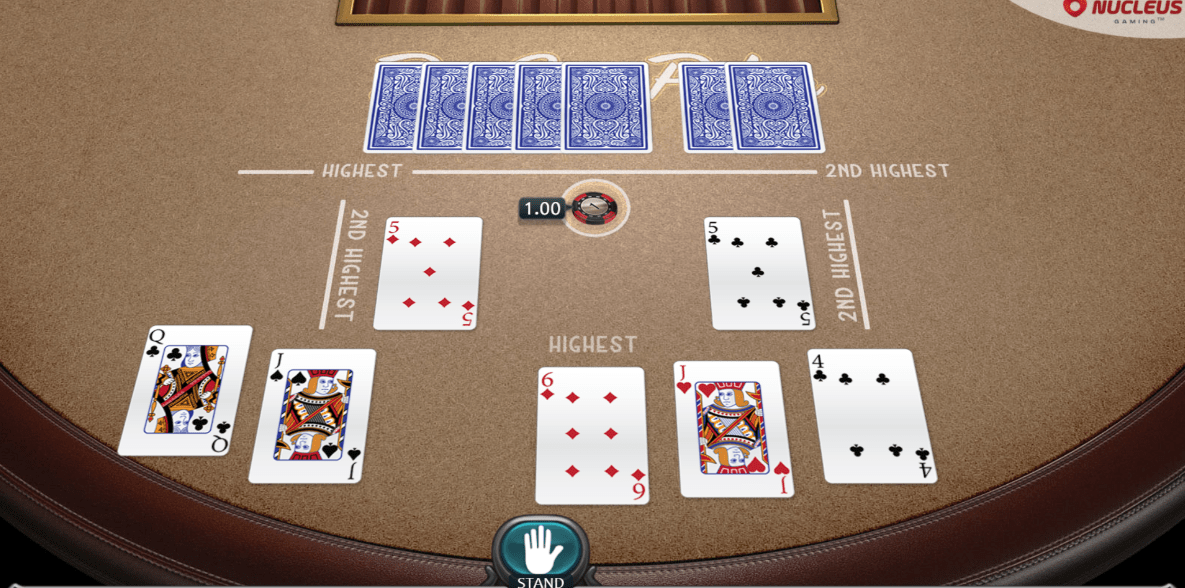
The 7 cards I’ve been dealt here are a Q, J, 5, 6, J, 5, 4. So, in theory, the strongest five-card hand I can create here is two pairs (Js and 5s) with a Q kicker. However, if I do that, the two-card hand becomes weak, and that’s a problem.
See how I’ve split the two pairs into both hands. This way, I keep a pair in the two-card hand, so I give myself a chance to win that side of the bet. The Js are not really strong for the five-card hand, but they’re not that weak either, and I believe the trade-off is worth it. This split can look “wrong” if you’re used to games like Texas Hold’em, but it’s exactly how Pai Gow Poker is meant to be played.

If you’re curious, this is what happened: the dealer had a Flush in his high hand, so he won it, but had a K-high as his low hand, so he lost that hand.
In other words, had I kept the two pairs and played any other scenario here, I would have lost the wager. This way, I won at least the low hand, so it’s a Push.
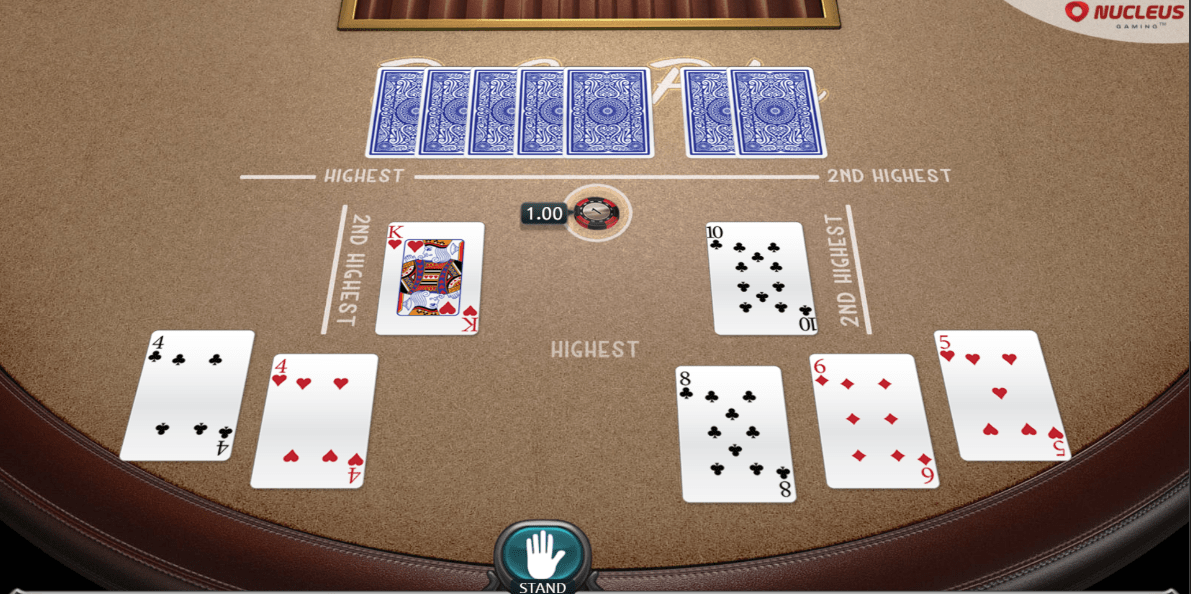
This time, I was dealt a 4, 4, K, 10, 8, 6, 5. So, my strongest hand here is the pair of 4s. However, since the rules state that your strongest hand must be in the high hand (the five-card hand), I’ve got no other option but to keep the 4s and have a K-high hand as my low hand.
Now here’s how my strategy deviates from the “house way”:
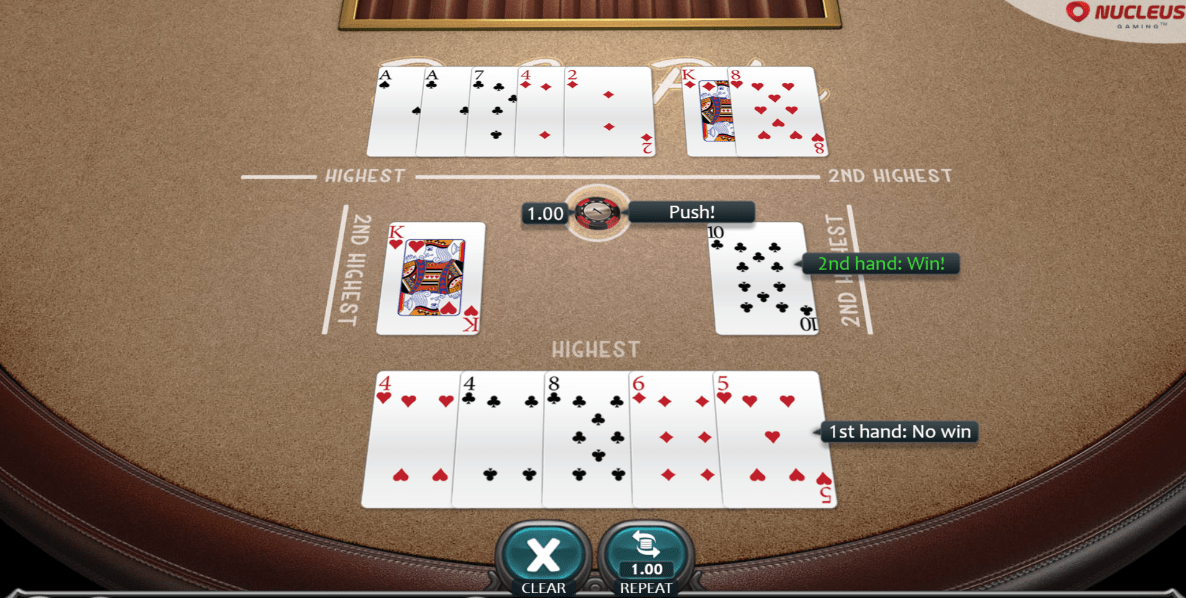
As you can see, this hand ended with a Push again. Why? Because I knew that my high hand was weak (a pair of 4s is not a strong five-card hand), I did my best to protect the low hand by having a K-high and the 10 as a kicker. The dealer had a K-high with 8 as a kicker, so I won that hand and managed to get a Push from a very weak hand overall.
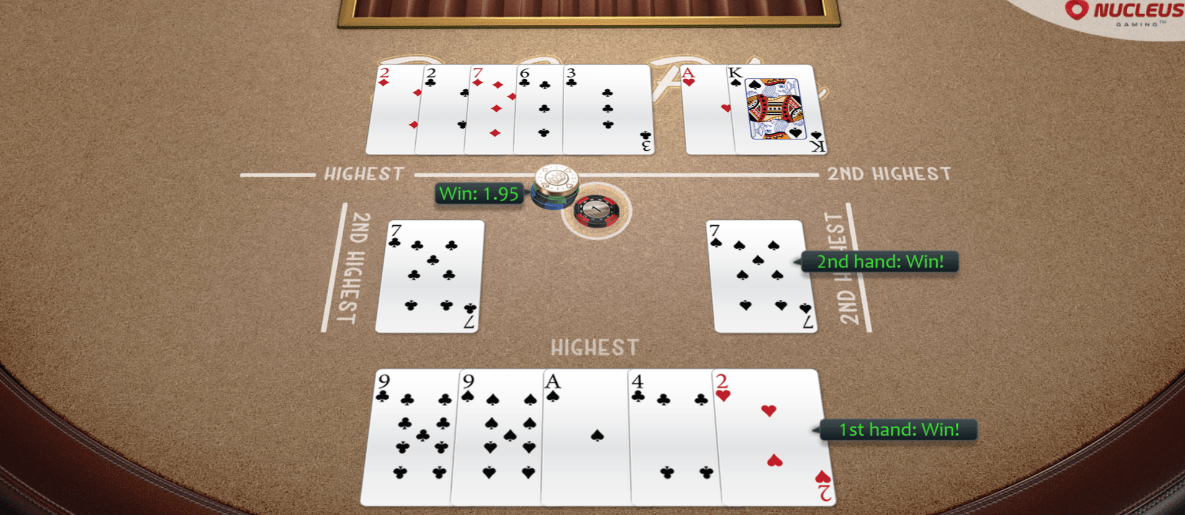
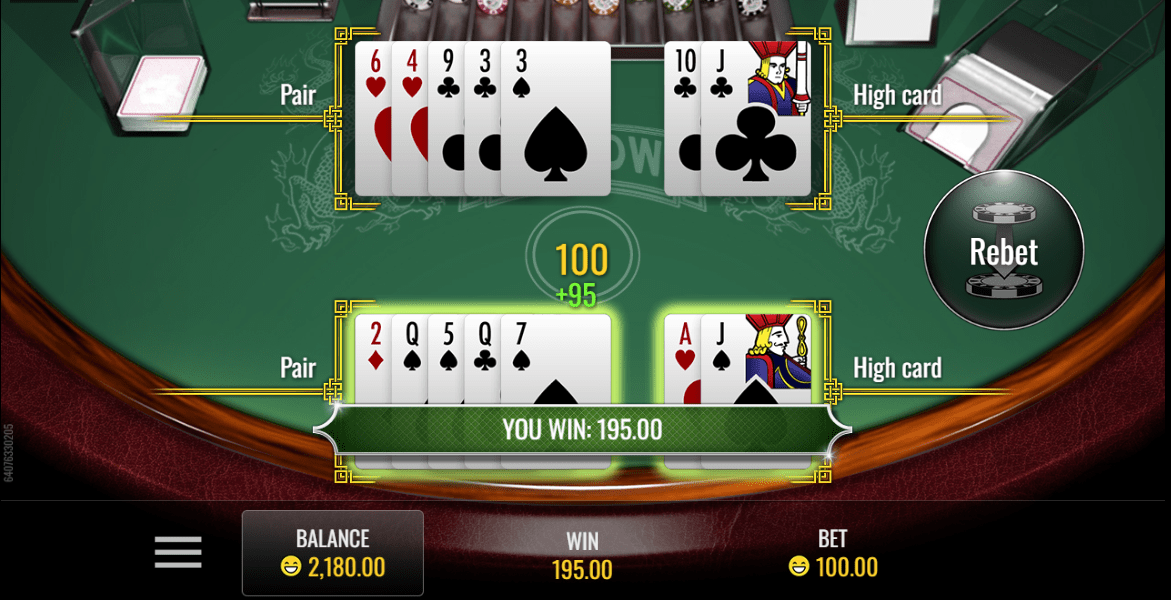
This time, my pair of 9s beat the dealer’s pair of 2s in the high hand, and my pair of 7s beat their A-high low hand, so I won the bet. As you can see, however, I got paid out A$1.95 instead of A$2 (with a bet of A$1) because I paid the 5% commission on every win.
Copying the House Way Is a Safe Starting Point
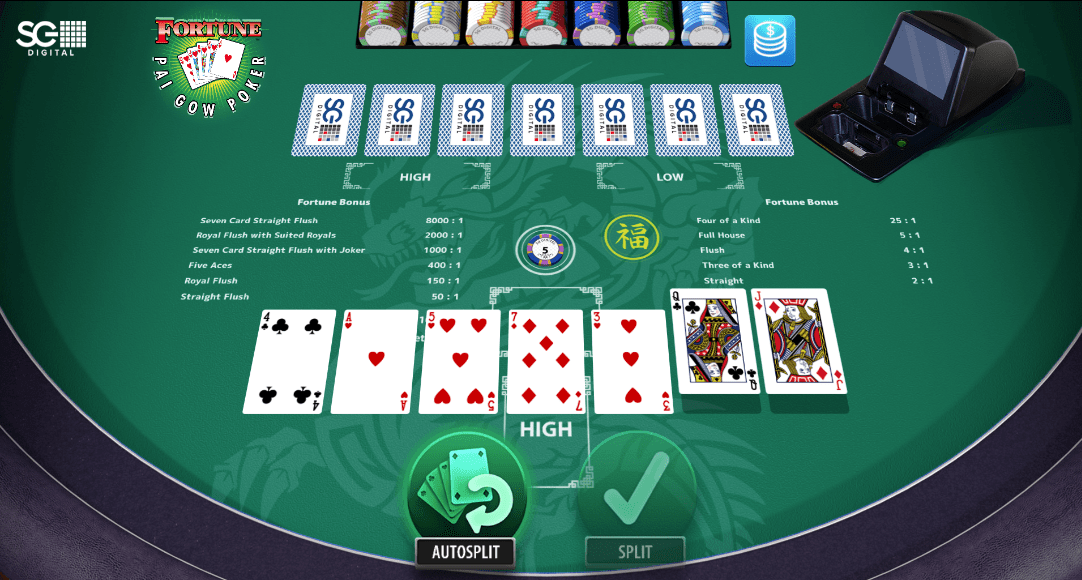
If you’re new, following the house way is a solid approach. Truth be told, it won’t squeeze every last fraction of value out of the game, but it will stop you from fouling hands and avoid the most common beginner mistakes.
Now, not every game allows you to play the “house way”. For example, Pai Gow Poker by Nucleus Gaming, which happens to be one of my favourites, doesn’t have the “play the house way” option.
That’s why I always recommend trying the game in demo and seeing if you’re comfortable with the rules. If you’re looking for a game that has the option to play the “house way”, I can recommend Fortune Pai Gow Poker by SG Gaming, which you can easily find at Australian casinos. It has an ‘autosplit’ option that will set your hands the “house way”.
Don’t Play the Side Bets
In Pai Gow Poker, the only additional bet you’ll usually see is the Dragon Hand bet. This bet pays extra if you beat the dealer by a certain margin, such as winning both hands, winning with specific strong combinations, or winning with premium hands like full houses or four of a kind.
The Dragon Hand side bet comes with a much higher house edge than the main bet, so I advise playing it very occasionally (or not playing it at all).
RTP and Volatility in Pai Gow Poker
Pai Gow Poker is one of the most misunderstood table games when it comes to RTP and volatility. On paper, the numbers look decent, but in practice, a lot comes down to your decisions.
The theoretical RTP of Pai Gow Poker depends on a few specific rules, but in a standard setup (dealer is Banker, house way used, 5% commission on wins), the RTP usually sits at around 97.5%, which translates to a house edge of roughly 2.5%.
However, the actual RTP depends on whether you use the “house way” or the optimal strategy. Also, it very much depends on whether you pay commission on winnings or not, because the house edge comes from the 5% commission on winnings and from the rule that the banker wins exact ties. If you manage to find a no commission Pai Gow Poker (which is very rare), the RTP can climb to 99.79%.
Note from Australian Gamblers: Always read the rules before you play. Some Pai Gow Poker tables charge commission not only on wins, but on pushes as well, which is honestly ridiculous. Pai Gow Poker is all about pushes, so if a game takes commission on pushes, avoid it at all costs.
Now, let’s talk volatility. Pai Gow Poker is one of the lowest-volatility table games you can play. Because each round has three possible outcomes (win, loss, or push), and because pushes happen so often, your bankroll simply doesn’t move very fast.
A large percentage of hands end in a push, meaning your bet is returned and nothing happens. Even when you do lose, losses are usually spaced out rather than coming in long streaks. So, if you’re looking for a game with extremely low volatility, Pai Gow Poker is the number one choice.
However, most casino games have now been sped up, so this one might feel really slow and boring, especially if you’re not that much into poker.
My 200 Hand Test of Pai Gow Poker
For my 200-hand test of Pai Gow Poker, I deliberately chose Rival Gaming’s Pai Gow Poker, which is a very standard variant that doesn’t have any added features and charges the standard 5% commission on wins.
I started with a bankroll of A$2,000 and set the bet size to A$100, which might seem high, but this is a very low volatility game, so I expected my bankroll to last through the 200 rounds despite the high bet size.

By round 20, everything was going as expected, and my bankroll was slightly above what I started. However, I must point out that this is an extremely slow game, and since I need time to think when setting each hand (because I don’t use the house way), I spend around 30 seconds to a minute per round.
As I expected, more than half of the hands ended with a Push, so the bankroll was hardly moving, and the slow animations didn’t help either.
RNG vs Live Dealer vs Land-Based Pai Gow Poker
Pai Gow Poker comes in three main formats today: RNG versions, online live dealer tables, and the traditional land-based casino version. I’ve played all three, and while each one has its place, they don’t feel the same at all.
While RNG versions are the quickest and work well for learning hand setting, even then, the game still feels slow because of how many pushes you get. Live Dealer Pai Gow Poker looks great, but in practice, it’s very slow online, as every round takes time to play out.
So, Pai Gow Poker is one of the few games I actually prefer in a real casino. Its low volatility makes it perfect for long and relaxed sessions. You can sit there for hours, grab a drink and some snacks (on the house, of course), and just enjoy the game, because you likely won’t be winning (or losing) anything substantial.
Summary: Do I Recommend Playing Pai Gow Poker at Australian Casinos?
Yes, I do recommend Pai Gow Poker for Australian players, as long as you understand what kind of game it is.
It’s fun in a very different way from most casino games. It takes time to get good with the hand setting, and that learning curve is part of the appeal – at least for me.
Most importantly, Pai Gow Poker is extremely low volatility, which means that you’re not putting yourself at big risk, andthere won’t be any major bankroll swings.
So, if you like slower games where your decisions actually influence the gameplay, Pai Gow Poker is absolutely worth playing at Australian casinos.
Latest Articles


Disclaimer: Gambling in Australia is strictly for individuals aged 18+. Our editorial team adheres to a strict policy to ensure that our reviews, recommendations, and content remain objective and free from external influence. We strongly encourage responsible gambling at all times. If you or someone you know is struggling with gambling addiction, visit the following gambling resources:
- https://responsiblewagering.com.au/
- https://www.gamblinghelponline.org.au/
- https://gamblershelp.com.au/get-help/