Betting exchanges work a little differently from the betting sites most Aussie punters are used to.
Instead of placing a bet directly with a bookmaker, you can bet against other users, backing an outcome to happen or laying it not to happen. The exchange matches bets between customers and typically takes a commission on net winnings.
If you’ve only ever used traditional bookmakers, the idea of laying a bet might sound a bit strange at first. Betting exchanges can take a little more getting used to than traditional bookmakers, but they also change the way you approach betting.
Besides understanding the odds, you also need to learn how to set your own prices, match bets with other users, and calculate your potential liability when laying an outcome. If you’ve come here to learn more about betting exchanges, you’re at the right place.
What Is a Betting Exchange?
A betting exchange is an online platform where users can bet against each other rather than placing bets directly with a bookmaker. The exchange doesn’t provide odds. Instead, it acts as an intermediary, matching users who want to back an outcome with those willing to lay it.
For example, say Australia are playing England in a cricket match. You think Australia will win, so you want to back them. Another user believes England will win and is willing to offer odds on Australia losing. If your odds and stake requirements match, the exchange can match your bets.
Unlike traditional bookmakers, betting exchanges let their users offer their own odds rather than simply accepting the prices set by a betting site. You can choose odds that suit you, although there’s no guarantee another user will accept them.
Exchanges typically make money by charging a 4-5% commission on net winnings, which means they don’t have a built-in bookmaker’s margin in the odds of their markets the way a traditional bookie does. The commission rate and rules vary between platforms, so it’s worth checking these before placing a bet.
Betting odds in Australia are usually displayed in decimal format, but you may come across fractional or American odds when using international betting sites.
Need to do the math fast?
If you need to convert between different formats, you can use our free odds converter.
How Betting Exchange Odds Work
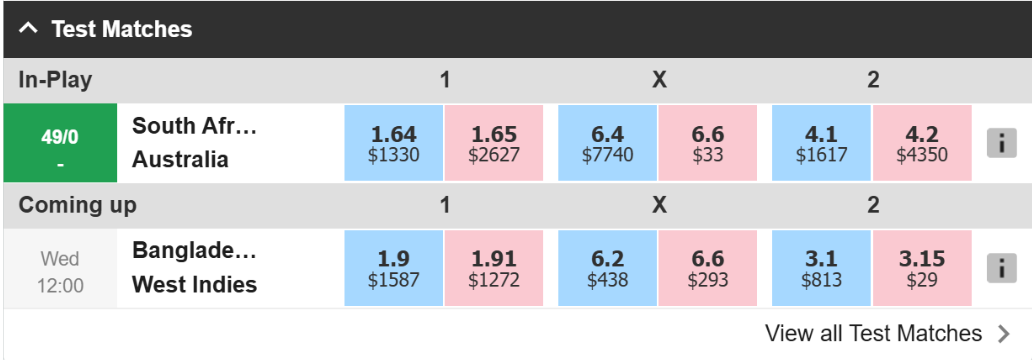
Betting exchanges display odds offered by users who want to back an outcome and users willing to lay it. In the screenshot above, you can see decimal odds in blue and pink boxes.
The blue boxes show the available back odds, while the pink boxes show the available lay odds. The dollar amount beneath each price shows how much money is available to be matched at those odds.
For example, Australia has back odds of 1.64, with A$1,330 available at that price. If you want to back Australia, you can place a bet at 1.64, provided there’s enough money available to match your stake.
If you want to back Australia for A$100, there’s enough money available to match the full amount at those odds. However, if you want to bet A$1,500, only A$1,330 can be matched at 1.64. The remaining A$170 would need to be matched at different odds, or it would stay unmatched until someone accepts your bet.
You don’t have to accept the odds already available, either. You can offer your own price and wait for another user to accept it. For example, you could try backing Australia at 1.70 instead of 1.64, but there’s no guarantee anyone will match your bet.
Odds and available amounts can change as users place bets, cancel their previous offers or react to what’s happening during a match.
Sophie’s Tip: When calculating your profit, you always need to factor in the commission charged by the betting exchange. It’s usually around 4-10%, but it can vary depending on the sport and specific market, even on the same betting exchange platform.
Matching Bets and the Order Book
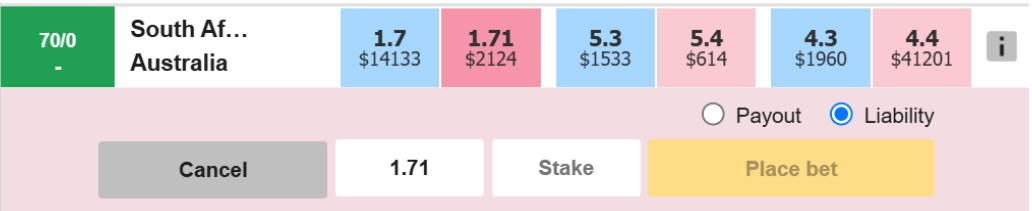
When you place a bet on a betting exchange, it needs to be matched with another user taking the opposite side. If you want to back Australia at odds of 1.70, for example, another user must be willing to lay Australia at those odds for your bet to be matched.
If nobody accepts your price, your bet can remain unmatched. Depending on the exchange’s rules, you can usually leave it there while you wait for someone to accept it, or cancel it if you change your mind.
The ‘order book’ is essentially the part on the platform that shows the available back and lay prices (odds) and how much money is available at each price. At most exchanges, back and lay odds are in different colours, and the order book shows where you can match immediately with another user and where you might need to wait.
Partial Matches & Liquidity
You may also get a partially matched bet. Say you want to back Australia for A$2,200 at 1.70, but only A$2,100 is available to match at that price. Your bet could be matched for A$2,100, leaving the remaining A$100 unmatched until more money becomes available at your odds or you change your price.
There’s also a term called liquidity, which is important when assessing both betting exchanges and individual markets. It refers to how much money is available to be matched for the particular market.
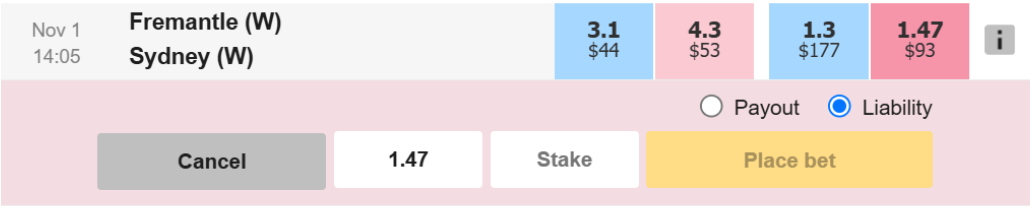
Say you might want to back or lay a particular outcome, but if there aren’t enough users willing to take the other side, which means that you may struggle to get your bet matched at your preferred odds. In that case, we say that the market has low liquidity. A market with plenty of money available and lots of active participants has higher liquidity, which means it’s generally easier to place bets without accepting less favourable odds.
For example, a major cricket match may attract plenty of betting activity, while a smaller domestic fixture like a match between Fremantle (W) vs Sydney (W) may have far less money available. Even on the same exchange, liquidity can vary significantly from one market to another. That’s why it’s worth checking the available prices and amounts before placing your bet.
Backing and Laying Odds
The two most important terms you need to understand when using a betting exchange are backing and laying. They determine which side of a bet you’re taking and how much you stand to win or lose.
Back Odds

Back odds are the prices available if you think an outcome will happen. For example, if Australia are playing South Africa in cricket and the exchange offers Australia at 1.69, you can back Australia at those odds.
Say you stake A$100. If Australia win, your total return would be A$169, including your original stake, giving you a potential profit of A$69 before commission. If Australia don’t win, you lose your A$100 stake, assuming the market settles as a loss.
Lay Odds

Lay odds work the other way. When you lay an outcome, you’re betting that it won’t happen. You’re effectively taking the other side of a backer’s bet, or the ‘bookmaker’s’ side if that’s easier to understand.
Let’s use the same example, with Australia available to lay at 1.70. If you lay Australia for a backer’s A$100 stake, you stand to win A$100 if Australia don’t win, before any applicable commission. However, if Australia do win, you must pay the backer A$70 in winnings.
That A$70 is your liability, which is calculated by multiplying the backer’s stake by the odds minus one:
Liability = Backer’s stake x (Lay odds − 1)
In this example, that’s A$100 x (1.70 − 1) = A$70.
When laying bets, your potential profit is the backer’s stake, but the amount you could lose is determined by the odds and the stake involved.
Sophie Notes: Don’t be surprised if the back and lay odds differ slightly. That’s completely normal on a betting exchange, as users set their own prices. Just compare the available odds before placing your bet and remember that your preferred price might not always get matched.
Are Prediction Markets and Betting Exchanges the Same?
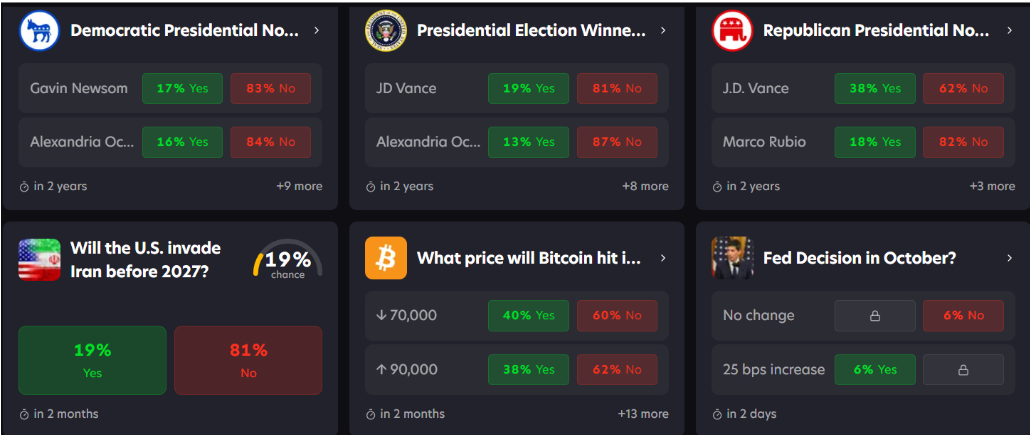
You’ve probably noticed the growing buzz around prediction market platforms such as Polymarket and Kalshi. These platforms let users trade on the outcomes of everything from sports and elections to economic announcements. However, Polymarket is blocked in Australia following regulatory action.
So, are prediction markets and betting exchanges the same thing? Well, not quite, although they share some similarities.
Both allow users to take positions on event outcomes, and you can often trade against other participants rather than betting directly with a bookmaker. The main difference is how they work.
Traditional betting exchanges present back and lay odds, while prediction-market platforms offer tradeable yes/no contracts. Their prices are displayed as market-implied probabilities, rather than the percentage of users supporting each outcome.
Prediction markets also tend to cover a broader range of topics, including politics and financial events, while betting exchanges primarily focus on sports and horse racing. So, while the two models have plenty in common, they’re not interchangeable.
Betting Exchanges vs Traditional Bookmakers
The biggest difference between betting exchanges and traditional bookmakers is who you’re betting against. On an exchange, you’re matched with other users, while a traditional bookmaker accepts your bet and pays out if you win.
Here’s how the two compare:
| Feature | Betting Exchanges | Traditional Bookmakers |
|---|---|---|
| Who you bet against | Other users | The bookmaker |
| Odds | Set by users in the market | Set by the bookmaker |
| Betting options | Back and lay bets | Back bets with fixed odds |
| Fees | Usually charge commission on net winnings | Typically build a margin into the odds |
| Bet acceptance | May remain unmatched if nobody takes the other side | Always accepted at the offered odds |
| Liquidity | Depends on how much money is available in each market | You can bet how much you want |
When it comes to sports betting, neither option has a clear advantage. Both betting exchanges and traditional bookmakers cater to different types of punters, and it comes down to what types of bets you want to make, the available odds, fees, and features you prefer.
Exchanges are also particularly popular among horse racing enthusiasts, who use them to back runners or lay horses they don’t expect to win. If you’re new to horse racing, though, I’d get familiar with the basics before diving into exchange markets, as laying bets and calculating liabilities can get complicated.
5 Tips for Using Betting Exchanges
Betting exchanges can take some getting used to, especially if you’ve only ever placed bets with traditional bookmakers. If you’ve decided that you want to try a different type of sports betting, here’s what I would focus on when approaching betting exchanges:
- Check the Liquidity Before Betting: Always check how much money is available at your preferred odds. If there’s not enough money on the other side, your bet may only be partially matched or remain unmatched.
- Understand Your Liability Before Laying: When you lay a bet, your potential loss can be greater than your potential profit. Check your liability before confirming the bet so you know exactly how much you could lose.
- Factor in Commission: Exchanges typically charge commission on net winnings, which reduces your profit. Check the applicable rate and account for it when comparing odds with traditional bookmakers. Oftentimes, bookies offer better odds when you factor in the commission you need to pay.
- Check Whether Your Bet Has Been Matched: Submitting a bet doesn’t mean the entire stake has been matched. Check whether your bet is fully matched, partially matched or still waiting for another user.
- Start With Simple Back Bets: If you’re new to betting exchanges, start by backing an outcome at available odds before experimenting with lay bets and more advanced strategies. Get comfortable with how odds, matching and commission work first, and only then proceed with laying bets.