

Table of Contents
Written by
 Mike Waters
Edited by
 Matthew Scott
I actually knew about Plinko long before 2012 because it started popping up in online casinos. You’ll usually find it in the instant-win or “Other games” sections of online casino lobbies, and most versions have a good RTP of over 97%.
So, in this guide, I’ll walk you through how Plinko works, whether there are any strategies worth using, and the different Plinko versions available at online casinos today.
What is Plinko?
Plinko is actually a very simple game: you drop a puck at the top of a board filled with pegs and watch it bounce its way down into one of the prize slots at the bottom. In a real-life Plinko game, the “force” that pulls the puck down is gravity, but in RNG-based Plinko games, the algorithm determines where it will land.
Traditional Plinko is played on a tall board with a grid of pegs, and you should climb to the top and drop the disc or puck. The puck bounces off on its way down until it lands in one of the prize multiplier slots at the bottom.
You pick a position at the top of the board, let the puck go, and it goes down through the maze of pegs. Each peg sends the puck slightly left or right, and by the time it reaches the bottom, it takes a random path that makes it impossible to predict where it will land.
On the TV show, each slot at the bottom has a cash value. In casino Plinko, those slots usually have multipliers instead, such as 0.5x, 1x, 2x, 9x, 16x, 100x, or higher, depending on the settings. Your bet is multiplied by whatever slot the puck lands in, so if you wager A$10 and the puck lands in a x10 slot, you win A$100.
Fun fact from Australian Gamblers: Plinko was actually invented by The Price Is Right’s executive producer Frank Wayne. When thinking about how to name the game, he heard the sounds that the puck made on the board (plin, plink, plink), so he named it Plinko. The Price Is Right fans widely consider Plinko to be the most famous game of the show.
Although casino Plinko is based on the The Price Is Right game, it’s a bit different. The TV version didn’t have a house edge because… well… It’s not a casino game. The casino Plinko indeed has a house edge.
Instead of “cash values” at the bottom, casino Plinko games have multipliers that are tied to your wager. You choose a bet size, click to drop the puck (or watch the host/presenter do it in live casino Plinko), and you wait for the result. There are usually no extra rules or side bets, so depending on where the puck will land, you get paid out based on your wager.
The house edge is integrated into how the multipliers are balanced against the probability of hitting them, and I’ll explain later how it works and why some casino Plinko games have better RTP than others. So even though the board looks very similar, the TV and casino Plinko are two different games.
Plinko Basics: Game Layout and Settings

The layout in Plinko is always built around the same idea: there’s a tall board filled with pegs, a drop point at the top, and multiplier slots at the bottom. The look can change depending on the provider, but the fundamentals stay the same in all Plinko games that I’ve tested.
When you load any Plinko game, the screen usually shows three main things:
- The board with pegs (usually between 8 and 16 rows)
- The multiplier values at the bottom
- A small panel where you adjust your bet amount, risk level, and number of rows
I’ll now explain the settings you’ll come across in most Plinko games and what they mean.
The Plinko Board and Number of Lines (Rows)
In most Plinko games, you’ll see the triangular pegboard, and this is where the puck (or ball, or disc, or another round-looking item) bounces down. Just next to it, there’s usually a menu labelled Lines where you can choose how many rows the board will have. Usually, you can adjust the board from 8 to 16 lines, but I’ve seen Plinko games with up to 24 lines.
The more lines you choose, the longer the puck travels, and the more spread-out the results are. So, in theory, the number of rows determines the game’s volatility, because the highest multipliers are usually placed on these edges.
Let’s take BGaming’s Plinko game as an example. When playing with 8 rows in High risk level, the multiplier ranges from x0.2 to x29.
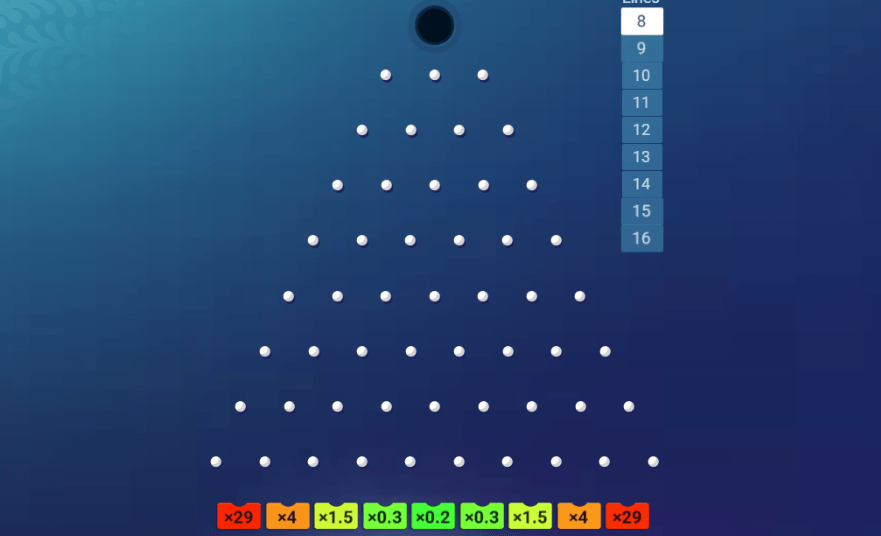
However, if we adjust the number of rows to 16, the lowest multiplier remains x0.2, but the highest multiplier jumps to x1000 (which is the highest possible win in the game). This means that while the max multiplier is higher, the likelihood of getting just x0.2 is higher too, so it’s a much riskier way to play the game.

This happens because Plinko follows a natural probability curve where the centre slots are hit far more often than the edges. So, when you extend the board, you actually lower the chance of reaching the sides, which is why the game offers the highest multipliers on those positions.
In other words, you’re much more likely to hit some of the low-paying centre slots, and the further you move from the centre, the lower the chance of the puck going into that slot.
Risk Levels in Plinko
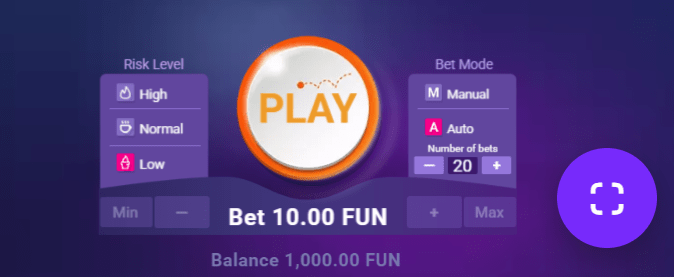
Most Plinko games will let you adjust the risk level, and there are usually three options:
- Low Risk
- Normal Risk
- High Risk
With the Risk Level, you adjust how big (or small) the multipliers at the bottom of the board will be. The layout of the board stays the same, but the risk level changes the values of each slot, depending on the risk level you choose.
Low Risk Mode
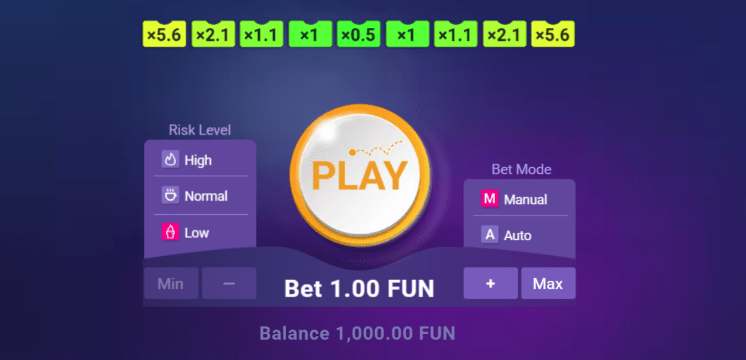
In Low Risk mode, the multipliers are more evenly spread out. With an 8-row pegboard, the only slot that doesn’t cover the bet is the middle one (x0.5 multiplier), which means that it rarely appears in this mode. However, the highest multiplier is x5.6, so while the risk of not getting your wager back is low, so is the chance of hitting a bigger win.
Normal Risk Mode

The Normal Risk level works as medium-volatility pokies. The centre slot begins to drop slightly, but you start to see higher payouts near the edges. This is probably the most commonly played mode in Plinko, and the mode I usually choose when playing Plinko. The low-risk mode is just too slow, while the high-risk mode is too volatile, so the normal risk mode is the most balanced one.
High Risk Mode
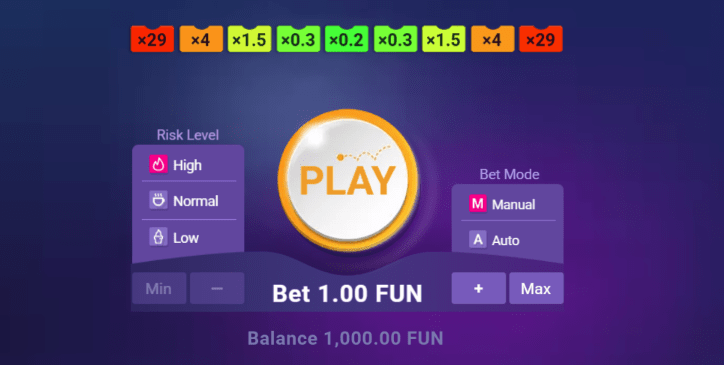
The High Risk mode, as the name suggests, is the most volatile version of this game, so when you combine the three risk levels and the pegboard adjustments, you can set your Plinko to be a rather risky game.
I have noticed that the game becomes much more risky in High Risk mode when compared to Normal Risk, and the far edge “jackpots” are much higher than any other slot, so the game is not as balanced as with different modes. For example, with the 8-row pegboard, the centre 3 slots don’t even cover your bet, and none of the rewards are actually that good except for the far edge x29 slots.
Bet Amount and Bet Mode

Just below the Play button, you can adjust how much you want to bet per drop. Every Plinko casino game has this option, and the betting range usually starts at A$0.10 or A$0.20 up to A$100.
You can also switch between Manual and Auto mode. Manual mode is exactly what it sounds like: you press Play for each drop, while Auto mode lets you run multiple drops automatically.
Note from Australian Gamblers: The Auto mode also allows you to have multiple pucks on the board at the same time. Obviously, this is a massive change from the TV Plinko, and while this option speeds up the game and brings it closer to pokies, it also makes the gameplay feel much more volatile. The pucks start dropping a lot faster than you might expect, so it’s definitely a feature to use with a bit of caution.
How to Play Plinko
Plinko is honestly one of the easiest games you can play at an online casino. Once you understand how the rows and risk levels work (which is not exactly rocket science), the rest is as straightforward as it gets. If you’ve ever played instant-win games or crash-style games, Plinko will feel very similar.
Here’s how to play Plinko step-by-step:
1
Choose your bet size:
This is the amount you’re risking per puck. Most Australian casinos let you bet from around A$0.10 or A$0.20 up to A$100, and the maximum win is usually 1,000x the bet, but it’s incredibly hard to hit.
2
Select the number of rows (lines):
This is where you decide how “tall” the board will be. Fewer rows mean that the results will be more predictable, while more rows open up bigger multipliers, but it also means that there will be more “losing” slots. As I explained earlier, more rows = more volatility.
3
Choose your risk level:
You’ll usually see three options: Low, Normal, and High risk, with the risk level directly affecting the game’s volatility.
4
Pick Manual or Auto mode:
In Manual mode, you’ll have to press Play for each drop. In Auto mode, you can enable multiple puck drops, but note that they drop more frequently than if you were to drop them manually, so Auto mode is much faster.
5
Click to drop the puck:
Once everything is set, all you need to do is click the Play button and watch the puck go down the board. Once it drops in a slot, you’ll get paid out immediately according to the multiplier in the slot.
Note that different Plinko variants can add bonuses like Multiplier Balls or other features like Dead Zones. The concept largely remains the same, and the added features don’t really change the gameplay. In my experience, all these extra features usually lower the game’s RTP.
Plinko RTP (Return to Player)
One thing I like about Plinko compared to a lot of pokies is that the RTP is usually quite high. Most Plinko games sit somewhere between 97% and 99%, which is better than the majority of online pokies and even many table games like European and American roulette. It doesn’t mean you’ll win, of course, but with a lower house edge, your balance generally lasts longer than it would on a 95% pokie.
Unlike games where the RTP changes randomly and is based on how the developer has structured the game and the RNG, Plinko’s RTP comes directly from how the multipliers are arranged at the bottom of the board.
Each slot has a fixed probability of being hit, and the provider balances the payouts based on those probabilities. So if a game advertises 98% RTP, the multipliers are calculated in a way where, over a massive sample of drops, the game returns 98% of the total wagered amount.
For example, if the game offers 1000x as the top multiplier on the far edge, the probability of hitting that slot is extremely low. To balance this, the centre slots (which you hit far more often) usually have a x0.2 multiplier, so this combination of extremely rare big hits and frequent small hits creates the final RTP figure.
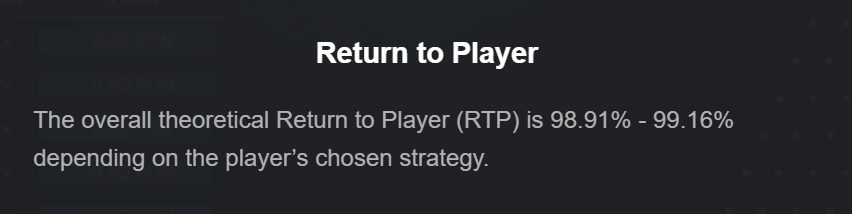
Now, many developers state that your “chosen strategy” affects the RTP (although ever so slightly), but this is a bit misleading. What they really mean is that the different game settings might have different RTP presets. For example, playing the game at Low Risk and 8 rows might have an RTP of 98.91%, while playing it with 12 rows and Normal Risk has an RTP of 99.16%.
They call these “strategies” because you are choosing a setup, but there’s no real strategy as in blackjack, poker, or even roulette.
Different Plinko Versions
For a game as basic as Plinko, you wouldn’t expect too many variations. However, game developers are incredibly creative when it comes to developing new game variants on existing games, and Plinko has had its fair share of “bonusification” and “featurisation”.
When I say Plinko “variants”, I mean a version of Plinko where the developers have modified one or more of the following:
- Number of rows/lines on the board
- Risk/volatility settings (like low/medium/high)
- Multiplier layout at the bottom
- Additional features like bonus multipliers, jackpots, or “special pucks”
- Visual style or theme
Here are three popular Plinko variants you’ll see at online casinos:

This is what most people think of when they picture “online Plinko.” It’s the classic version of the game and adds only the “basic” features I explained above, like adjustable rows (usually 8-16), three risk levels, and the standard multiplier slots at the bottom.
Everything stays pretty close to the original TV-style Plinko, and it’s as straightforward as it gets. The RTP is around 99% depending on the “strategy” you choose, and the betting range is from A$0.10 to A$100 per puck.

Plinko Blitz shakes things up a bit. This version is still very similar to the classic Plinko, but besides the three standard risk levels, there’s a special “Blitz” mode. In this mode, you can only choose between 8 and 16 rows, and besides the standard multiplier slots, there are so-called “Dead Zones” that don’t award any multiplier.
However, there are also special yellow Multiplier Balls that carry multipliers from x2 to x20, on top of the standard slot multiplier. So, if an x2 ball drops in an x4.5 slot, you’ll win x9 your wager. The betting range in Plinko Blitz is from A$0.10 to A$50.

Evoplay’s PlingoBall takes the idea of Plinko and adds a more exotic beach theme. The game is available only in portrait mode and is primarily designed for mobile play. The board is set on the beach, and the two girls drop the pearls (the puck here is a pearl) from seashells.
In addition to the standard Plinko features, PlingoBall adds a Bonus Feature. It’s activated when you drop 100 pucks, and when the Bonus Round is active, some pegs get an x11 multiplier. If the ball touches one of those pegs, you get an x11 multiplier and the regular slot multiplier.
Note from Australian Gamblers: As a general rule of thumb, the classic Plinko variants have a higher RTP of around 99%, while variants like Plinko Blitz and PlingoBall usually have a lower RTP of 96%-98% despite the added features and multipliers.
My 200-Round Plinko Test
To demonstrate how to play Plinko in practice, I played and recorded a 200-round test of Plinko. I chose Blitz Plinko by Dragon Gaming for my test to check how the added features feel, and whether I’ll have any luck with the big multipliers.
I started with a bet of A$10, and I set the risk level to Blitz with 16 lines. In other words, I chose the riskiest mode in this game, and despite some wins, most of the pucks ended up in the Dead Zone. So, after the first 50 rounds, I was down A$239.

I decided to give the Blitz mode another go, but this time with just 8 rows on the board. This time, I had more luck and actually ended the 100th round with some minor profit. Now, for my next 50 rounds, I set the risk level to Medium and 12 lines. However, despite the lower volatility (compared to Blitz mode), I ended up losing around A$50.

Finally, I decided to try the lowest volatility setting with just 8 rows, and, unsurprisingly, the bankroll remained largely the same after the 50 rounds in this volatility mode.
Much to my surprise, I had the best luck with the highest volatility level in Blitz mode and 8 rows, and it was the only mode in which I actually won something. Sure, Plinko is a game of luck, but this test really showed me how the different risk levels completely change it.
It’s one of the rare casino games where you can genuinely feel the full spectrum of volatility, from extremely low-risk, low-reward mode to the incredibly high-risk modes.
Personally, I found the lowest risk mode a bit boring, so I would stick with the normal or high risk modes.
Before You Start Playing Plinko
Plinko is one of the easiest casino games to understand, and the most distinctive part about it is the volatility. You can set it from extremely low to extremely high, and the risk level and lines (rows) on the board you choose really change the game.
I didn’t provide any Plinko strategies because there really aren’t any special tips or strategies about it. It’s a pure luck game, which means that you can’t influence the path of the puck, and you can’t make smarter decisions like you would in blackjack. Your entire approach comes down to two things: your bet size and the volatility setting you choose.
So, if you don’t want to risk it much, play with the lowest volatility setting. If you want to go for a higher possible payout, you’ll have to go for the higher volatility settings.
And realistically, if you’re playing Plinko at an online casino, you’re probably doing it because you want those higher volatility options. With an RTP that can reach around 99%, Plinko is actually one of the better games to use if you’re going to chase those higher wins.
Latest Articles


Disclaimer: Gambling in Australia is strictly for individuals aged 18+. Our editorial team adheres to a strict policy to ensure that our reviews, recommendations, and content remain objective and free from external influence. We strongly encourage responsible gambling at all times. If you or someone you know is struggling with gambling addiction, visit the following gambling resources:
- https://responsiblewagering.com.au/
- https://www.gamblinghelponline.org.au/
- https://gamblershelp.com.au/get-help/