




The good news is that the strategy itself is not nearly as complicated as real poker. You don’t need to bluff, read opponents, or think about position. However, the strategy here is much more mathematical, and you need to stay fully focused at all times while playing.
I’ve prepared this guide to help you learn the Ultimate Texas Hold’em strategy, including when to make the 4x raise, when to check, and when to fold.
How to Play Ultimate Texas Hold’em?
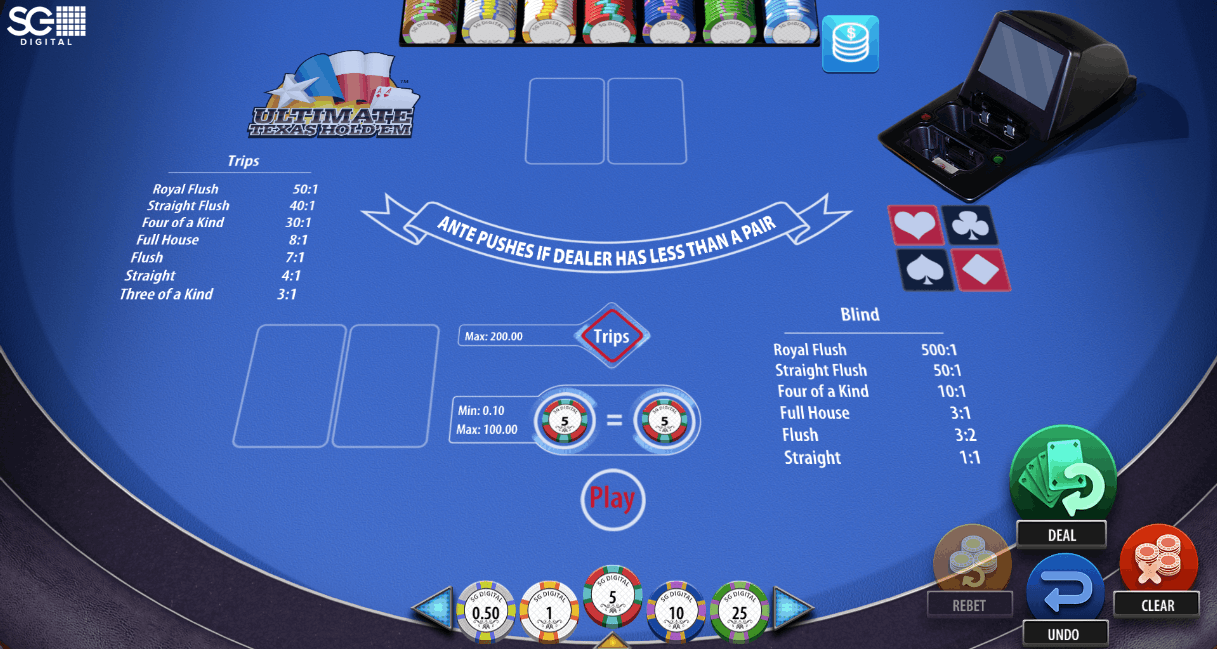
I’ll keep this section brief because I’ve already prepared a full guide on how to play Ultimate Texas Hold’em, but you still need to understand the basics before getting into the strategy.
Ultimate Texas Hold’em is a poker-based casino game where you play directly against the dealer instead of other players. Both you and the dealer receive two cards, five community cards are dealt on the table, and the goal is to make the best possible five-card poker hand.
The game starts with mandatory Ante and Blind bets, after which you decide whether to check or raise.
Depending on the strength of your hand and the community cards, you can raise 4x or 3x pre-flop, 2x after the flop, or 1x on the river. You can also fold and give up your Ante and Blind.
Compared to games like online pokies or other video poker variants like Jacks or Better and Three Card Poker, Ultimate Texas Hold’em is definitely more complex. The decisions you make during the hand directly affect the RTP, and you need to be aware of all the possibilities at all times – which is why strategy matters so much in this game.
Note from Mike Waters: Even if you’re an experienced poker player, I don’t recommend you immediately hop on Ultimate Texas Hold’em for real money without learning the rules and the basic strategy first. This is NOT a game that should be played based on instinct or gut feeling unless you want to give the casino free money.
The Optimal Ultimate Texas Hold’em Strategy
I won’t lie to you, the Ultimate Texas Hold’em strategy is not the simplest one out there. In fact, out of all poker-based casino games, this is probably one of the most mathematical ones, especially when you get to the river decision, so pay attention to my advice about dealer outs.
In reality, most casual players don’t get the advertised 99.47% RTP, but even with a few mistakes, I calculated the house edge to be around 2%.
Based on the calculations I made over 1,000 hands of Ultimate Texas Hold’em, these are my main findings about the optimal strategy:
- You should check pre-flop almost ⅔ of the hands (~62%).
- You should raise 4x pre-flop on more than ⅓ of the hands (~38%)
- The 3x pre-flop raise is never the optimal play
- Players actually have a mathematical edge over the house pre-flop on ~35% of hands
Since the game is actually split into three stages, I’ll split the strategy itself into three main stages: pre-flop, flop, and turn/river.
Pre-Flop Strategy
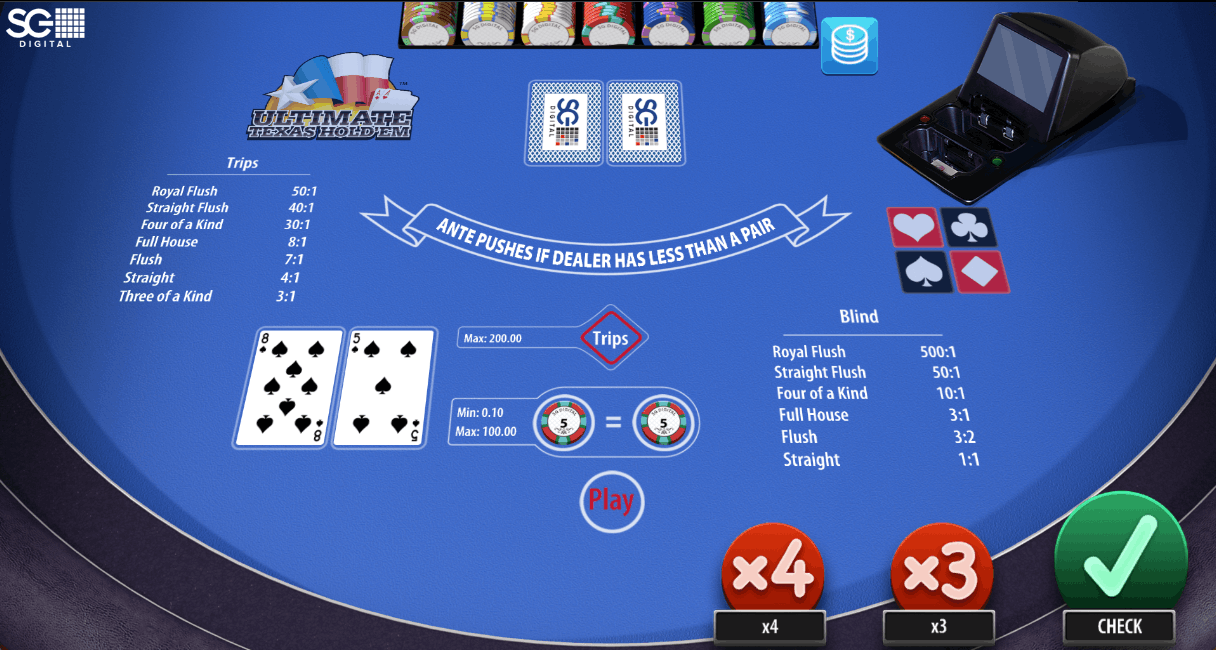
I’d argue that this is the most important decision point in Ultimate Texas Hold’em because it’s the only moment where you can make the maximum 4x Play raise. Naturally, this is also where you can win the biggest hands, but also the riskiest raise.
The basic idea behind the pre-flop strategy is simple: if your starting hand is statistically strong enough against the dealer’s random holding, you should raise x4 immediately and get as much money into the pot as possible. If not, you check and wait for more information from the flop.
One thing to remember here is NEVER to use the 3x raise option. Yes, the game allows it, but mathematically speaking, it’s never the optimal play.
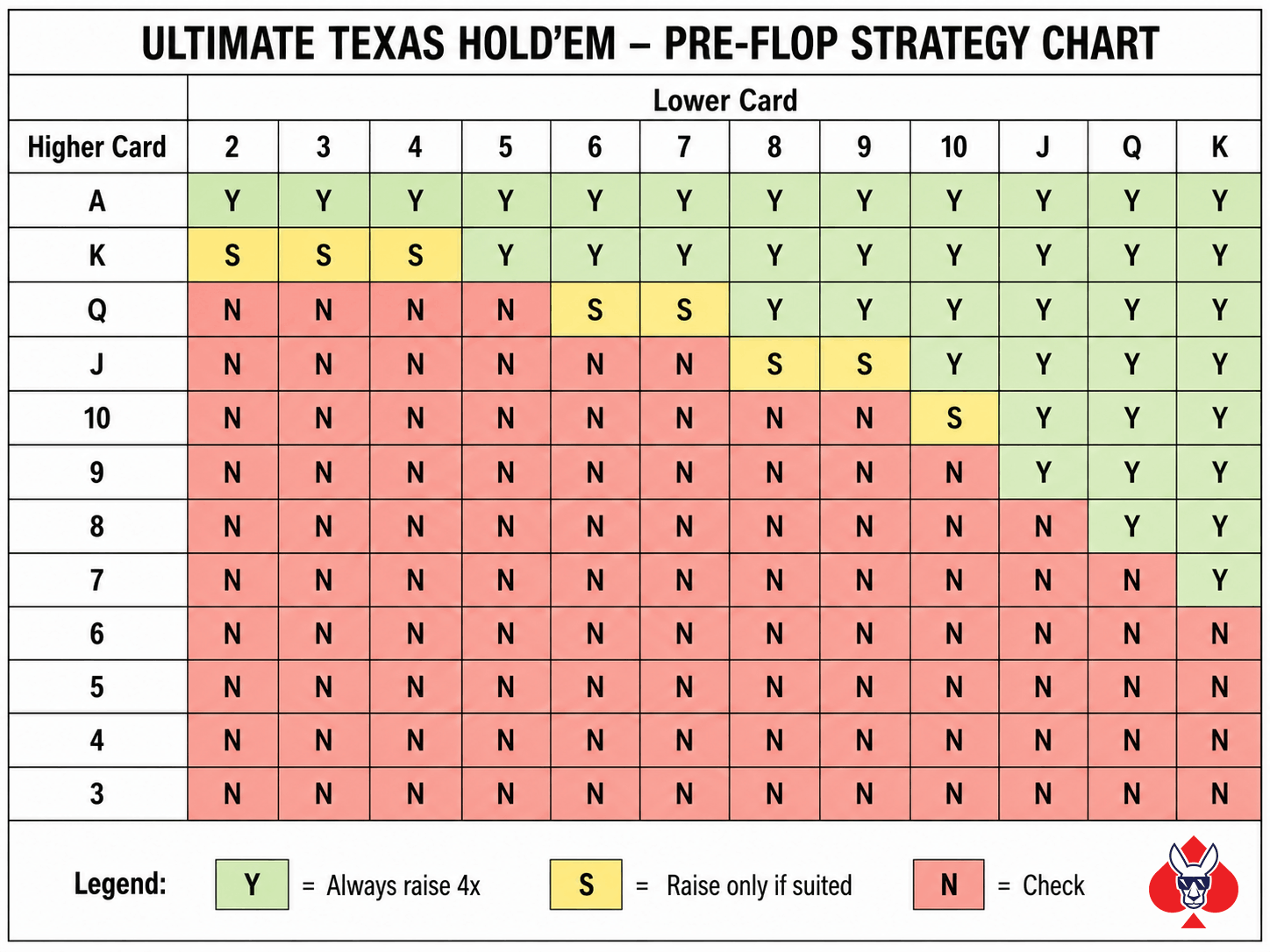
In practice, these are the situations you should raise pre-flop:
- Any pair of 3s or higher
- Any Ace (A2+)
- K5 or higher
- Q8 or higher
- J10
- Suited K2, K3, K4
- Suited Q6, Q7
- Suited J8, J9
The strongest hands are obvious, like A-K, pocket pairs, or strong Broadway combinations, but the optimal strategy also suggests raising with some weaker suited hands, too.
To simplify things, I’ve prepared an Ultimate Texas Hold’em strategy chart for pre-flop bets:
Flop Strategy
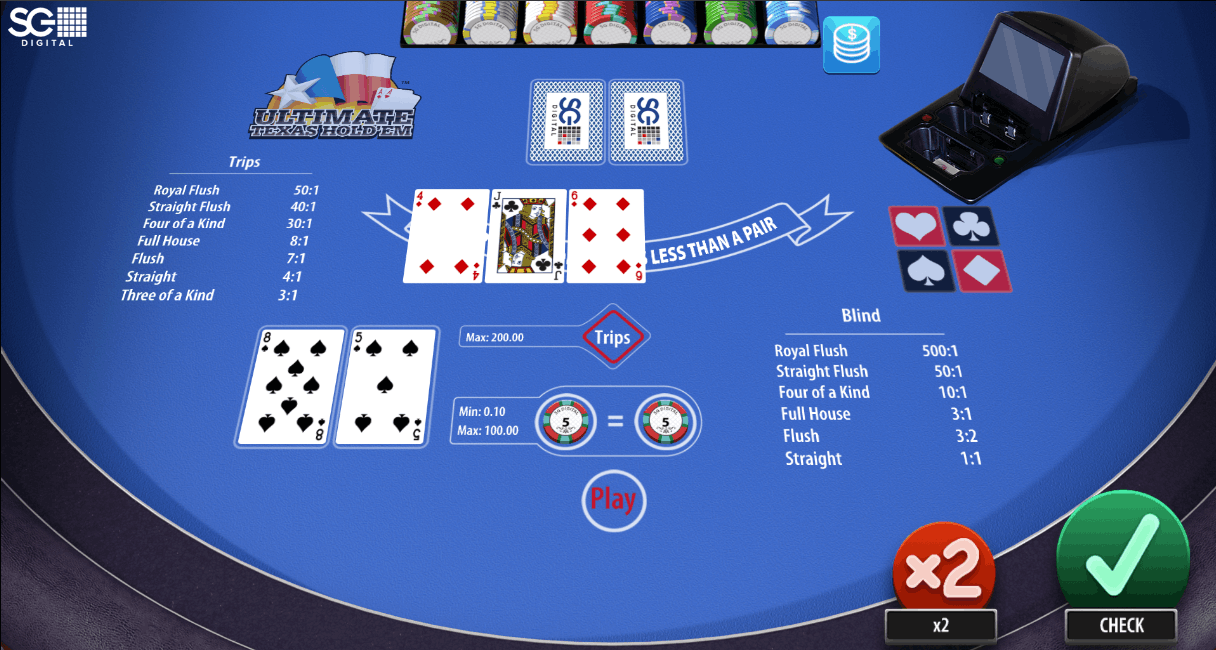
If you checked pre-flop, the flop becomes your next decision point.
At this stage, you now have five visible cards in play, so you need to evaluate not just the current strength of your hand, but also your draws, blockers, kicker strength, and the possible hands the dealer can still make.
If you follow the pre-flop strategy, there are 100 hand combinations where you check pre-flop, and when you calculate the remaining 3 cards on the flop, that’s 19,600 combinations to consider.
Obviously, if you’re not Will Hunting, you won’t remember all these combinations, which is why we’ll use Shackleford’s simplified Ultimate Texas Hold’em strategy, which says you should raise 2x on the flop with:
- Two pair or better
- Any hidden pair (except 2s)
- Four cards to a flush with a Ten or higher kicker
In every other situation, you should check.
Now, what exactly is a hidden pair?
A hidden pair is when one of your hole cards pairs with the board, but the board itself does not already contain a pair. For example, if you hold King of Hearts and 7 of Clubs, and the flop comes King of Spades, 10 of Diamonds, 4 of Clubs, you’ve made a hidden pair of Kings. It’s called “hidden” because the dealer cannot see from the board alone that you’ve paired your card.
As for the simplified strategy itself, it’s not mathematically perfect, as there are still edge-case situations where raising is technically the higher-EV play even though the simplified chart says to check, but the “lost” RTP is very small, often less than half a percent.
For example, certain weak flush draws, straight draws, and backdoor combinations can slightly favour a x2 bet because of the combined probability of improving by the river. However, in practice, it’s much more realistic to use the simplified strategy, especially when you only have around 8 seconds to make a decision.
Turn and River Strategy
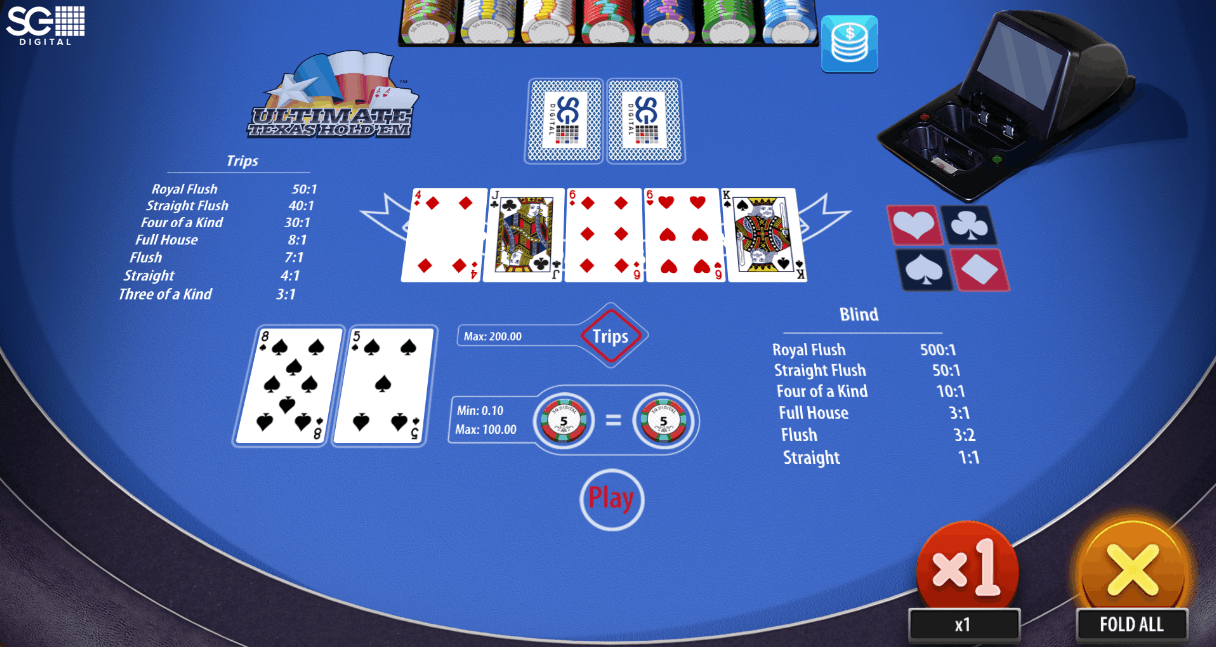
The final decision happens after all five community cards are revealed. At this point, you must either:
- Fold and lose your Ante and Blind bets, or
- Make the final 1x Play bet and go to showdown
This is easily the hardest part of the Ultimate Texas Hold’em strategy because you now need to think about dealer outs, possible hand improvements, and how often your current hand actually wins by showdown.
The simplified strategy to use here is:
- Play 1x with any hidden pair
- Play 1x when the dealer has fewer than 21 outs that can beat your hand
- Fold everything else
So, what does “fewer than 21 outs” mean? Well, an out is simply any card or card combination that gives the dealer a better hand than yours. The reason you need to play when the dealer has fewer than 21 outs is the expected value calculations.
When you fold, you automatically lose both the Ante and Blind, which equals a loss of 2 units. If you continue with the 1x raise, you risk one more unit, but you also give yourself a chance to win the hand.
Examples of Dealer Outs
After running the maths across billions of possible hand combinations on a simulation setup that I built specifically for Ultimate Texas Hold’em strategy testing, the conclusion was that continuing becomes profitable whenever the dealer has 20 or fewer realistic outs to beat you.
Of course, this is much easier said than done in a real game, especially in a limited timeframe of just ~10 seconds. Counting exact outs in Ultimate Texas Hold’em can get complicated very quickly, especially when straights, flushes, board pairs, and kicker situations all start overlapping, which is why I suggest using simplified patterns rather than trying to solve the maths of thousands of combinations.
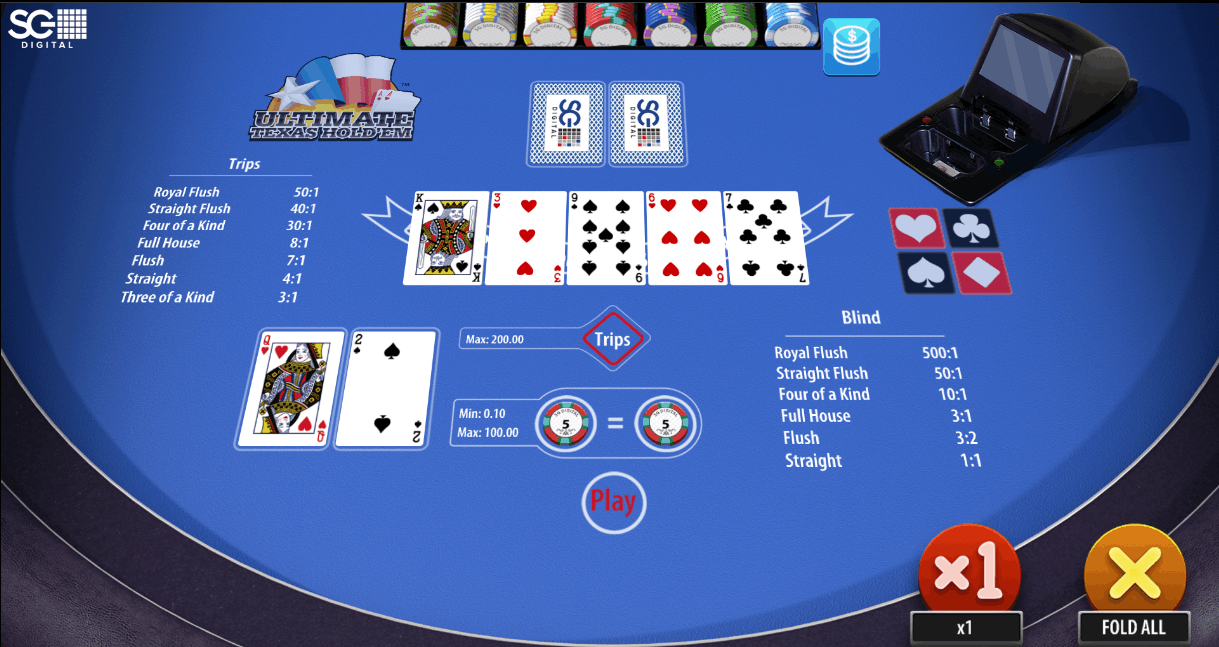
For example, if the board shows something like 10, Jack, Queen, King, then any Ace becomes a straight out for the dealer. Or, if there are already four cards of the same suit on the table, then any remaining card of that suit can complete a flush. Even paired boards can create extra outs because the dealer can easily improve to a set, two pair, or a full house.
Also, the number of outs depends on your hand. For example, if your hand is a high-card 10, the number of outs is all the pairs plus all the Js, Qs, Ks, and As as a high card, so you’ve got too many losing combinations against you.
Note from Mike Waters: Don’t stress too much about calculating every single one out perfectly. After some time playing the game, you’ll naturally start recognising which hands are strong enough to continue with and which ones are obvious folds.
Strategy Deviations and Edge Cases
Now, just like blackjack basic strategy, there are also deviations and edge cases in Ultimate Texas Hold’em.
Some hands that technically qualify as checks under the simplified strategy are actually tiny positive-EV raises when you analyse every possible dealer combination. The same goes for certain river spots where folding might look correct at first glance, but mathematically, the 1x raise performs slightly better over the long run.
The problem is that many of these situations are extremely close in value. We’re often talking about differences smaller than 0.5% EV, and trying to memorise every single exception would make the strategy almost impossible to use in practice.
Many advanced players actually stick to the simplified strategy instead of trying to play the “computer-perfect” Ultimate Texas Hold’em, and I suggest you do that too.
Tips for Playing Ultimate Texas Hold’em
Since Ultimate Texas Hold’em requires a bit of strategy and decision-making, I’ve prepared several practical tips that should help you avoid the most common mistakes:
This is very important because in Ultimate Texas Hold’em, you’re not just placing one bet. You need to cover the Ante and Blind at the start, and if you want to reach the showdown, you’ll always need to place at least one more Play bet too.
So if you’re playing at A$5 stakes, you’re realistically at least A$15 per hand. That’s why you should stick to the 1% here, meaning that your bet size should be 1% of your total bankroll.
I’m serious about this one. Ultimate Texas Hold’em requires actual concentration and decision-making because you constantly need to think about hand strength, dealer outs, possible draws, and whether continuing is mathematically profitable.
This is definitely not the type of game I’d recommend playing after a few drinks.
Even experienced poker players can struggle with Ultimate Texas Hold’em at first because the betting structure is very different from regular live poker. And since most poker sites in Australia allow you to play in demo mode, it’s a good idea to take your time learning how to act across all phases of the game.
You can’t memorise billions of combinations, so you’re better off with the simplified strategy.
Even many advanced players use the simplified strategy because the EV difference between “perfect” play and the simplified version is actually very small. If you follow the optimal strategy I suggested here, you’ll get an RTP of 98-99%.
Summary: Should You Use the Ultimate Texas Hold’em Strategy?
Absolutely! Ultimate Texas Hold’em is a type of casino game where your decisions directly affect the RTP, and even small mistakes can increase the house edge dramatically.
The good news is that you don’t need to memorise billions of combinations or always play the perfect Ultimate Texas Hold’em strategy to get that good return-to-player ratio.
The simplified strategy that I shared in this guide will get you very close to it, and if you’re after high-RTP player-vs-dealer poker games, Ultimate Texas Hold’em is definitely one of the better options out there.


Disclaimer: Gambling in Australia is strictly for individuals aged 18+. Our editorial team adheres to a strict policy to ensure that our reviews, recommendations, and content remain objective and free from external influence. We strongly encourage responsible gambling at all times. If you or someone you know is struggling with gambling addiction, visit the following gambling resources:
- https://responsiblewagering.com.au/
- https://www.gamblinghelponline.org.au/
- https://gamblershelp.com.au/get-help/