



What Is the Martingale Betting System?
The Martingale betting system is one of the oldest and most famous betting strategies in the world. It originated in 18th-century France and was originally designed for games with close to 50/50 outcomes, such as coin flips and roulette’s Red/Black bets. The idea behind Martingale is very simple: every time you lose, you double your next bet. Here’s an example:
| Bet Number | Stake | Result |
|---|---|---|
| 1 | A$1 | Lose |
| 2 | A$2 | Lose |
| 3 | A$4 | Lose |
| 4 | A$8 | Win |
At first glance, this looks brilliant. You’ve lost A$1 + A$2 + A$4 = A$7, but when the A$8 bet wins, you receive A$16 back, covering all previous losses and leaving you with a A$1 profit. This is the core idea behind Martingale: no matter how many bets you lose in a row, the next winning bet should recover all previous losses and generate a profit equal to your original stake.
Unfortunately, there are some very obvious problems with this logic that I’ll discuss below, but that’s how the Martingale works in a nutshell: you set your own unit size, choose a type of bet, and just keep doubling until you win.
How Does the Martingale Strategy Work?
The idea behind the Martingale is actually very simple (and sort of genius, if table limits didn’t exist): every time you lose a bet, you double the size of the next one. The moment you win, you recover all previous losses and make a profit equal to your original stake.
Let’s use European roulette and A$1 starting bets as an example:
- We bet A$1 on Black. The ball lands on 27 Red. We lose, so we double our bet to A$2.
- We bet A$2 on Black. The ball lands on 14 Red. Another loss, so we doubled our bet to A$4.
- We bet A$4 on Black. The ball lands on 32 Red. We lose again, so we increase our stake to A$8.
- We bet A$8 on Black. This time, the ball lands on 9 Red. We lose yet again.
- We bet A$16 on Black. This time, the ball lands on 28 Black. We finally win.
At this point, we’ve lost A$1 + A$2 + A$4 + A$8 = A$15.
However, the winning A$16 bet pays A$16 in profit, meaning we’ve recovered all previous losses and finished the sequence with a A$1 profit.
It sounds rather attractive, and as long as you eventually win, the system appears to guarantee a profit. The question is: what happens when the losing streak keeps going?
1,000-Round Martingale Simulation
To test whether the Martingale system actually works, I ran a 1,000-round simulation using European roulette odds, which means an RTP of 97.30% and a chance of winning a Red/Black bet of 48.60%, which is as close you’ll realistically get to a 50-50 bet in any Australian online casino.
The starting bankroll was A$2,000, and the initial bet was A$1, so our unit is A$1. As the strategy requires, the bet doubled after every loss and returned to A$1 after every win.
At first, the results looked very encouraging. The strategy was working as it was supposed to, and despite some long-ish losing streaks of 4 or 5 losses in a row, the system recovered, and the bankroll steadily increased.
For most of the early part of the simulation, the Martingale system appeared to be doing exactly what its supporters claim: recovering losses and generating small profits of A$1 after each win.
The problem appeared around the 189th spin, when the simulation went on a 12-spin losing streak. At that point, the next wager required by the Martingale system would have been A$4,096. Not only did this exceed the remaining bankroll, but it would also have exceeded the table limits in many online casinos.
So, if this were a real-life scenario, it means that we’ll have to stop with our progression and leave the table, or, if the table allows it, place a bet that’s higher than our initial bankroll. Both of these scenarios are awful, and even if we place this A$4,096 bet, there are no guarantees that the next (or the bet after that, or the bet after that) will be a winning one.
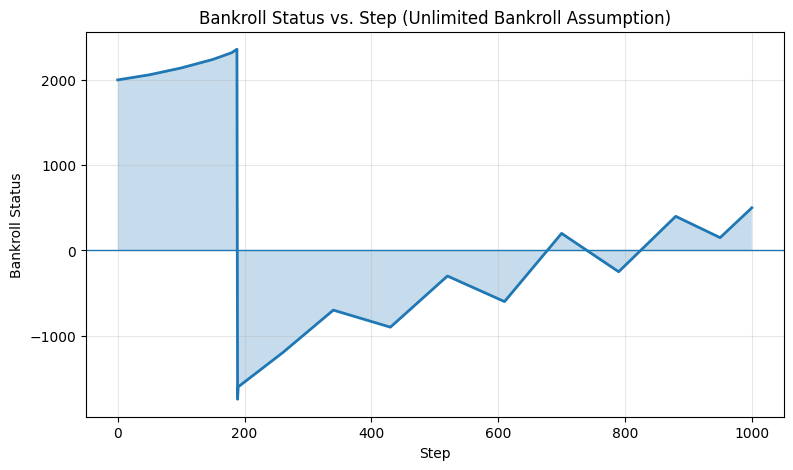
For the purpose of our test, I decided to let the simulation run until the 1000th round with an unlimited bankroll and no betting limits.
However, my simulation encountered several long losing streaks during the 1000-round test, which only shows one thing: the Martingale strategy doesn’t eliminate risk, but it simply postpones it.
Drawbacks of the Martingale Betting System
At this point, you might be thinking: if Martingale has so many problems, why do people still use it? The answer is simple: most of the time, it actually works.
The Martingale strategy wins lots of small bets and recovers from losing streaks often, and that’s why it’s so dangerous. It creates an illusion that you’ve found a loophole in the casino’s mathematics when you’re simply exchanging many small wins for one big loss. And yes, the big loss is inevitable at some point.
These are the biggest problems with this betting system:
Exponential Bet Growth
The Martingale doubles the bet size after each loss, and this doesn’t sound too bad at first. But let’s check out the numbers with a mere A$1 unit size:
- After 5 losses, your next bet is A$32
- After 10 losses, it’s A$1,024
- After 15 losses, it’s A$32,768
You might be thinking: But Mike, the probability of losing 10 Red/Black bets in a row must be tiny, right? Well, in European roulette, the probability of losing 10 Red/Black bets in a row is 0.1275%, while the probability in American roulette is 0.1631%.
And yes, these percentages do look tiny, but if you’re playing hundreds or thousands of rounds, a long losing streak will happen.
In my own 1000-round simulation, we encountered a losing streak that would have required a A$4,096 bet to continue the progression, and that’s the problem with Martingale: the longer you play, the more likely you are to encounter a streak that your bankroll simply can’t survive.
Table Limits
Let’s pretend for a moment that you have an unlimited bankroll. Great! Problem solved, right? Not quite.
Even if you somehow had enough money to keep doubling your bets forever, the casino won’t let you. Almost every roulette table has a maximum betting limit, and once you reach it, you can’t place a bet high enough to cover what the strategy asks for.
Let’s use our A$1 starting bet again. After 10 consecutive losses, your next wager would need to be A$1,024. After 12 losses, it jumped to A$4,096. Many online roulette tables won’t even allow bets that high, especially if you’re playing at lower-stakes tables.
This means that even if you still have money left in your bankroll, you may be unable to place the next required bet. Once that happens, the entire logic behind the Martingale system falls apart because you can no longer recover all previous losses with a single winning spin.
In other words, Martingale doesn’t just depend on having a large bankroll. It also depends on finding a table that allows you to keep doubling indefinitely, and such tables simply don’t exist. There are better strategies out there, and I’ve discussed most of them in my roulette strategies guide.
Should You Use the Martingale Strategy?
My answer is simple: no, you shouldn’t. Not only does it not work, but I also consider the Martingale strategy dangerous. It relies on assumptions that don’t exist in the real world: an unlimited bankroll and no table limits.
As my simulation showed, the strategy works right up until it doesn’t, and that’s the dangerous part. You might win dozens or even hundreds of small bets in a row, but eventually you’ll encounter a losing streak that requires a wager your bankroll or the casino simply can’t support.
A word of advice: don’t fall for the trap of gambling fallacies when using Martingale. Many players convince themselves that after several Reds in a row, Black is “due” to appear next. The reality is that casino games have no ‘memory’, and each round is independent from the previous one.
Martingale doesn’t change the odds, improve your chances of winning, or give you an edge over the casino. Admittedly, you do get a structure to your bets, but in my opinion, it’s in the most dangerous way possible.
Latest Articles


Disclaimer: Gambling in Australia is strictly for individuals aged 18+. Our editorial team adheres to a strict policy to ensure that our reviews, recommendations, and content remain objective and free from external influence. We strongly encourage responsible gambling at all times. If you or someone you know is struggling with gambling addiction, visit the following gambling resources:
- https://responsiblewagering.com.au/
- https://www.gamblinghelponline.org.au/
- https://gamblershelp.com.au/get-help/