




What's Oscar's Grind?
Oscar’s Grind is a betting progression dating back to the 1960s, first mentioned in Allan Wilson’s book “The Casino Gambler’s Guide”. All we know is that it was popularised by a gambler known as Oscar, and the idea here, unlike in most other betting systems (including the popular Martingale and D’Alembert), is not to recover losses as quickly as possible. Instead, you ‘grind’ out a profit of one unit at a time.
Yes, Oscar’s Grind is a slow strategy that requires patience. The goal is to finish each betting cycle with a profit of one unit.
You start with a base unit, and keep betting the same amount until you win. It’s considered one of the best strategies for bankroll management because you increase your bet by one unit after you win, but only if doing so won’t push your profit more than 1 unit for the current cycle. Once you’ve earned that profit of 1 unit, the cycle ends, and the strategy starts all over.
Oscar’s Grind Strategy Example
| Bet Number | Stake | Result |
|---|---|---|
| 1 | A$1 | Lose |
| 2 | A$1 | Lose |
| 3 | A$1 | Win |
| 4 | A$2 | Win |
| 5 | A$1 | Win (Cycle Complete) |
In this example, we start with a A$1 unit. After the first two losses, the bet remains at A$1 because Oscar’s Grind doesn’t increase the stake after a loss. When we finally win on the third bet, we increase the next wager to A$2. Another win follows, bringing us back into profit for the cycle. Since our goal of winning one unit has been achieved, the cycle ends, and we return to our starting stake of A$1.
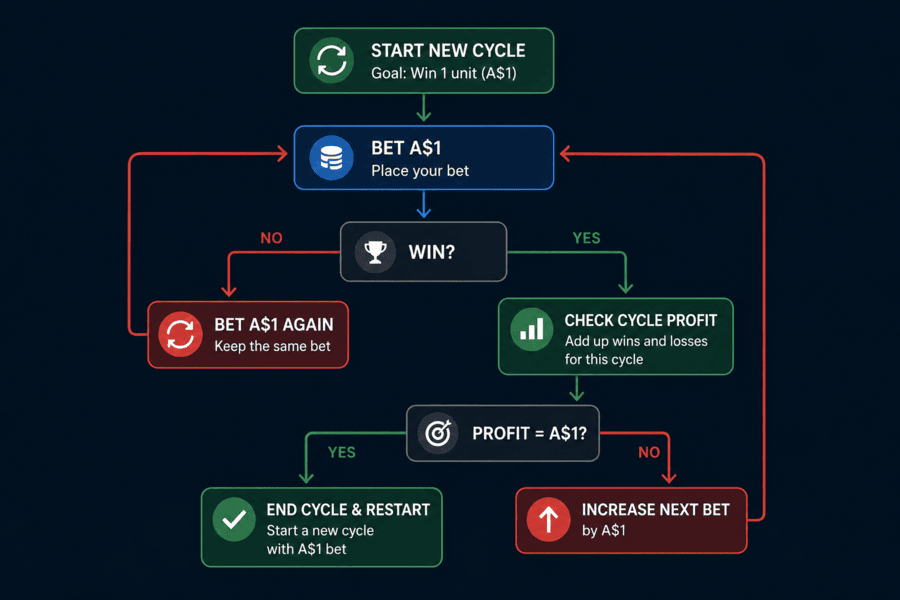
In other words, Oscar’s Grind doesn’t chase losses but aims to recover losses gradually while keeping the bet sizes relatively low. As with every other progression-based system, the bet size largely depends on the bet size you choose, so I suggest you start very low (something like A$1 per bet) until you learn how it works.
Tip from Mike Waters: Oscar’s Grind was originally designed for even-money bets, which is why you’ll often see it recommended for Red/Black, Odd/Even, or High/Low bets in roulette. However, I’ve used it in plenty of other games too, particularly the Player and Banker bets in baccarat, as well as the Pass Line and Don’t Pass bets in craps. As long as you’re betting on outcomes that pay 1:1, the system works the same way.
How Does Oscar’s Grind Strategy Work?
Oscar’s Grind is a little unusual because, unlike most betting systems, you don’t increase your bet after a loss. Instead, you keep betting the same amount until you win. Only then do you start increasing your stake, and even then, the goal is simply to finish the cycle with a profit of one unit.
It works with most roulette types, but we’ll use European roulette here and A$1 starting bets as an example:
- We bet A$1 on Black. The ball lands on 12 Red. We lose, so we keep our next bet at A$1.
- We bet A$1 on Black. The ball lands on 36 Red. Another loss, so we keep our next bet at A$1.
- We bet A$1 on Black. The ball lands on 15 Black. We win, so we increase our next bet to A$2.
- We bet A$2 on Black. The ball lands on 7 Red. We lose. Since Oscar’s Grind doesn’t increase bets after a loss, we keep our next bet at A$2.
- We bet A$2 on Black. The ball lands on 20 Black. We win. At this point, we’re back to -$1 for the cycle, so we keep our next bet at A$2.
- We bet A$2 on Black. The ball lands on 31 Black. We win again. This puts us at a profit of A$1 for the cycle.
- Since our target profit of A$1 has been achieved, the cycle ends. We can now begin a new cycle or leave the table.
As you can see, the key is that you’re trying to win one unit per cycle, and not recover every loss immediately. If A$1 sounds too low, you can gradually increase the bet size as long as you feel comfortable, but as you’ll see later, even Oscar’s Grind can get costly – especially if you run into a long losing streak before the first win arrives, or later down the road when the bets have increased.
Tip from Mike Waters: The most common mistake people make with Oscar’s Grind happens at Step 4. After losing the A$2 bet, many players either drop back to A$1 or increase their stake even further. Both are wrong. Oscar’s Grind requires you to keep the same bet after a loss and only adjust it after a win. That’s also why this strategy isn’t quite as simple as the Reverse Martingale or Fibonacci. You need to keep track of your current cycle profit all the time and do some basic maths along the way.
My 1,000-Round Test of Oscar’s Grind Betting System
To test out Oscar’s Grind, I decided to run a 1,000-round simulation on European roulette. I could use other roulette types too, but European offers the best odds, and it’s widely available at all the best Australian roulette sites.
I first ran a simulation with a unit size of A$1, but the graph barely moved, so I had to either increase the bet size or increase the number of rounds to see how the strategy performs in the long run.
Don’t get me wrong, 1,000 rounds is plenty enough, but since Oscar’s Grind is so slow, the A$1 bet barely moved the A$1,000 bankroll. So, I decided to run another simulation, but this time, I increased the unit size to A$5.
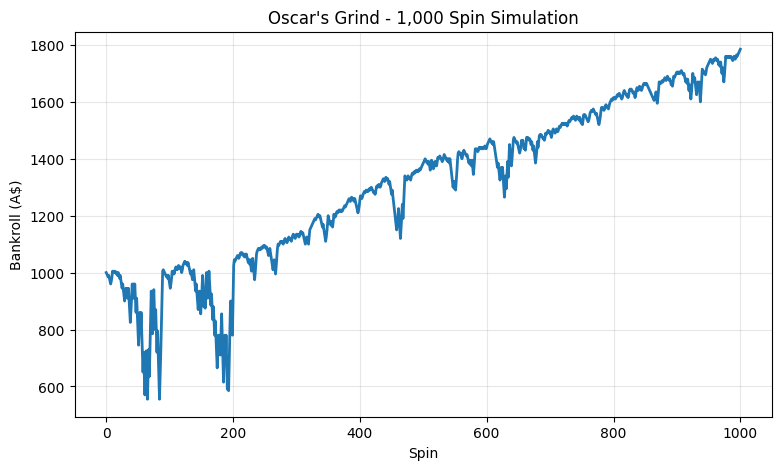
As you can see, early in the simulation we ran into some problems, and our bankroll dropped to ~A$500, but by the ~200th spin it recovered. The longest losing streak was 12 losses in a row, but despite this, the bankroll never dropped below A$555.
It eventually climbed to A$1,785 by the end of the simulation, and the largest bet required was A$125, which is relatively modest compared to other progression systems, like the Fibonacci and D’Alembert.
The results of the first simulation were almost suspiciously good, so I ran more simulations to get the real picture.
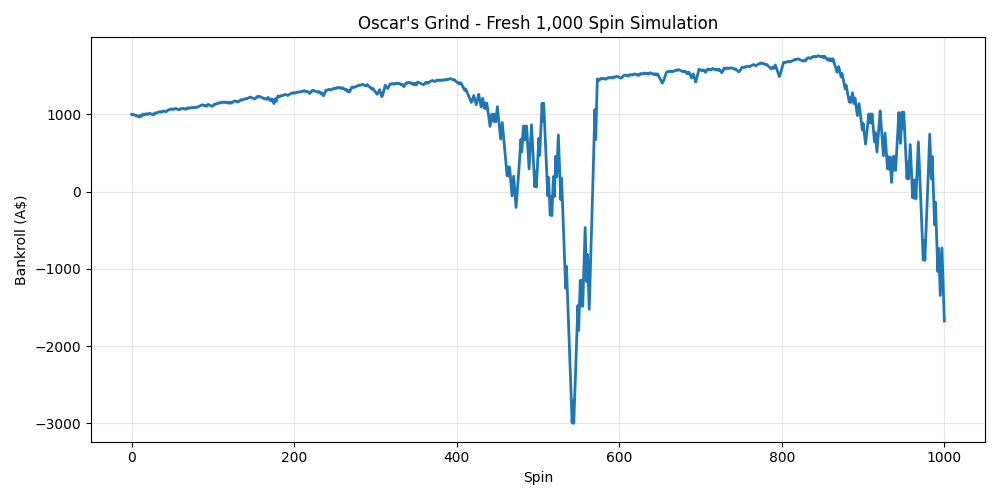
Although some of them ended positively, there were some notable falls. For example, in one of the simulations, we had 10 losses in a row, but the bet size was already large, so our bankroll dropped to almost A$3,000. Surprisingly, we managed to recover, only to dip below 0 again later on.
These runs show that although Oscar’s Grind has potential, it’s not without its drawbacks.
Drawbacks of Oscar's Grind
Oscar’s Grind is still my favourite betting system, but it’s not perfect. Like every progression strategy, it has some weaknesses that you should understand before using it.
Long Losing Streaks Can Still Be Costly
One of the biggest selling points of Oscar’s Grind is that it doesn’t increase the bet after a loss. As explained in my guides on gambler’s fallacies and beginner mistakes, chasing losses is the worst, but long losing streaks can cause serious damage to your bankroll.
As my simulations showed, even a strategy as conservative as Oscar’s Grind can struggle when several losing cycles occur back-to-back. The losses may accumulate slowly, but they still accumulate.
It Doesn't Eliminate the House Edge
This is the most important drawback and one that applies to every betting system. Oscar’s Grind changes how much you bet, but it doesn’t change the odds of the game. European roulette still has a house edge of 2.70%, and over the long run, that edge remains in the casino’s favour.
Recovery Can Take a Long Time
The strategy is called a grind for a reason. Unlike Martingale, which tries to recover losses immediately, Oscar’s Grind aims to recover losses gradually, meaning a long losing session can take a very long time to recover from.
It Requires Constant Attention
Most betting systems are easy to follow, and while Oscar’s Grind isn’t difficult, you do need to keep track of your current cycle profit and know when to increase, maintain, or reset your stake.
Should You Use Oscar's Grind Betting System?
Yes, I think Oscar’s Grind is worth trying, but you should approach it with realistic expectations.
Out of all the betting systems I’ve tested over the years, this is the one I’ve enjoyed using the most, and I genuinely think that it’s the best approach to games that pay out 1:1. You don’t have to stick to roulette; you can use it in games like blackjack, baccarat, and craps (with small adjustments).
The progression is slow, and since you’re not chasing losses, chances are that your bets won’t become so huge that you’ll reach the table limits at most Australian casinos.
That said, Oscar’s Grind is not a guarantee that you’ll beat the casino. It doesn’t remove the house edge, and as my simulations showed, some runs can end in profit, while others can produce significant drawdowns.
My advice is to start small and take the time to learn the progression properly. A unit size of A$1 or A$2 is more than enough while you’re learning this strategy. Once you understand how the betting cycles work, you can decide whether increasing the stake makes sense for your bankroll.
Latest Articles


Disclaimer: Gambling in Australia is strictly for individuals aged 18+. Our editorial team adheres to a strict policy to ensure that our reviews, recommendations, and content remain objective and free from external influence. We strongly encourage responsible gambling at all times. If you or someone you know is struggling with gambling addiction, visit the following gambling resources:
- https://responsiblewagering.com.au/
- https://www.gamblinghelponline.org.au/
- https://gamblershelp.com.au/get-help/