




What's the Paroli Betting Strategy?
The Paroli betting strategy, also known as the Anti-Martingale system, is believed to have originated as a response to the traditional Martingale. In the standard Martingale, you double your wager after each loss until you win.
I’ve already discussed the problems with this theory in detail in my Martingale strategy guide, but the two main issues are that you’ll reach the table limits, and you’ll likely run out of money.
Well, the Paroli betting system tries to combat these issues by doing the opposite. Here, you double your bet after each win, and you revert to the original bet size after each loss. So, the longer a winning streak lasts, the more money you’ll win.
For example, if we start with a bet of A$1 and we win, for our next round, we double our bet to A$2. If we win again, we double that to A$4, and so on until we lose and go back to A$1.
And while this is true regardless of your strategy, the Paroli system is based on the idea that winning streaks should be exploited as long as they last. Of course, this approach relies on the assumption that winning streaks occur often enough to make a difference, which we’ll test later in this guide.
Note from Mike Waters: As I’ve explained in my guide on hot and cold streaks, you shouldn’t rely too much on that. It’s another gambler’s fallacy, and like all gambler’s fallacies, it’s based on the idea that previous results somehow influence future outcomes. In reality, every spin of the roulette wheel, hand of baccarat, or any other casino game is independent of the one before it. Yes, winning streaks do happen, but there’s no way to predict when they’ll start or how long they’ll last.
How Does the Paroli System Work?
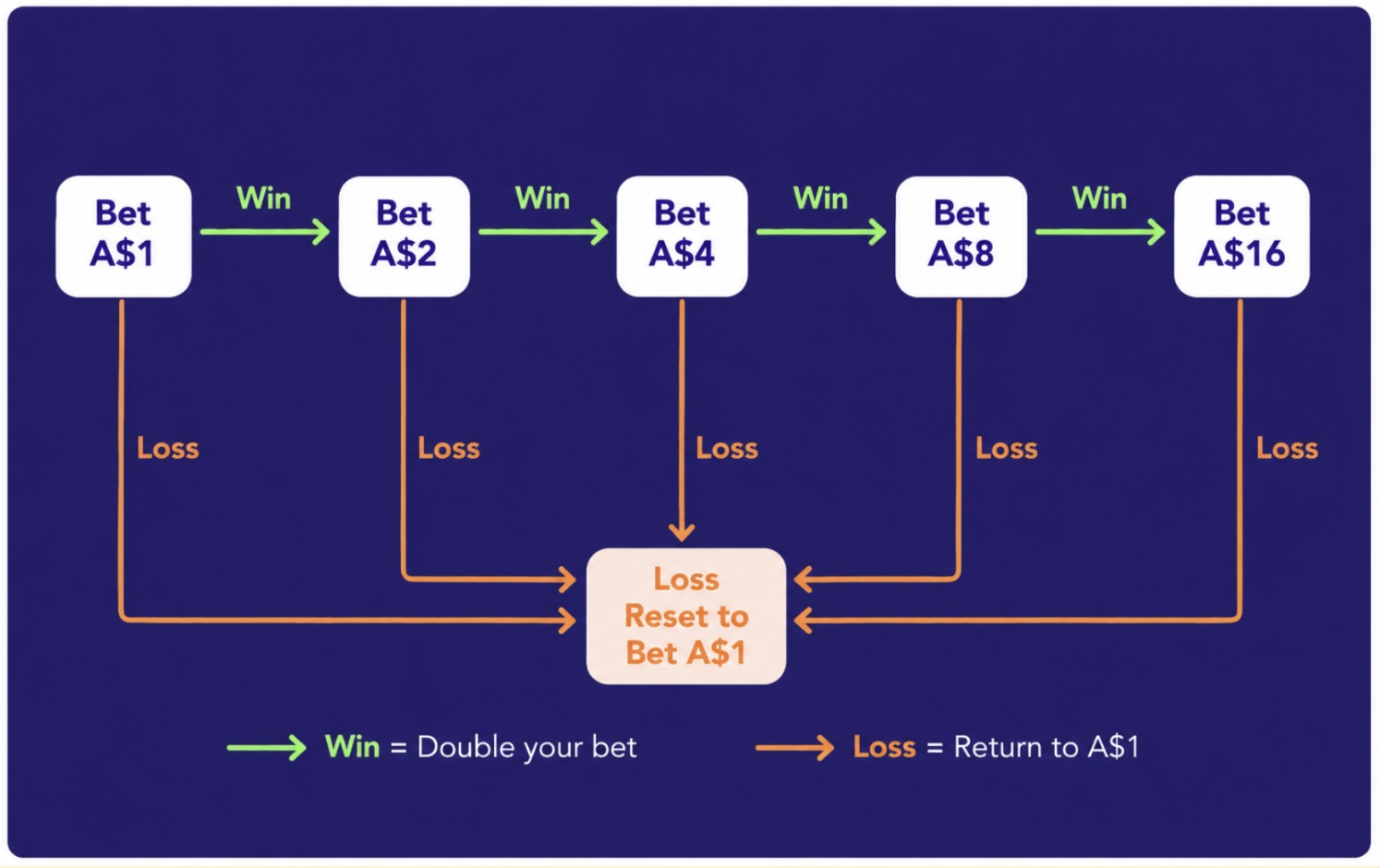
The Paroli system is actually very straightforward. Instead of increasing your bet after a loss, you double it after a win. If you lose, you return to your original stake and start over. It doesn’t say when to stop betting, which means that you can effectively end a cycle whenever you want to.
So, how does the Paroli system work in practice? Well, for this example, I decided to use European roulette and keep placing all our bets on Black. Since Black/Red pays 1:1, it’s a perfect fit for the Paroli system, but the same strategy can also be applied to other games with even-money payouts, such as baccarat’s Player/Banker bets or most blackjack situations.
Here’s how a sequence might play out:
- We bet A$1 on Black. The ball lands on 17 Black. We win, so we double our next bet to A$2.
- We bet A$2 on Black. The ball lands on 31 Black. Another win, so we double our next bet to A$4.
- We bet A$4 on Black. The ball lands on 9 Red. We lose, so we reset our next bet back to A$1.
- We bet A$1 on Black. The ball lands on 22 Red. We lose again, but since we’re already at our base stake, we simply keep the next bet at A$1.
- We bet A$1 on Black. The ball lands on 4 Black. We win, so we increase our next bet to A$2.
- We bet A$2 on Black. The ball lands on 35 Red. We lose and return to our original stake of A$1.
The result of these six rounds is -A$3. This means that we’ve actually lost A$3 despite hitting three wins and three losses.
This shows one of the biggest quirks of the Paroli system: the strategy is only effective if you stop a cycle while on a winning streak. I know it sounds counterintuitive and even paradoxical, but the only way to end up in profit is not to let a winning streak run for too long.
Tip from Mike Waters: This is the most important advice you’ll receive about the Paroli system: set a predetermined target! For example, if you set a wager of A$10, set a very realistic target of A$20 or A$40 as profit per cycle. Once you reach it, stop the cycle and start all over. If you keep increasing the bet size, you’ll eventually lose, and all that progress will be for nothing.
1,000-Round Paroli Simulation
I went on to test the Paroli strategy and see how it fares in the long run. Now, full clarification: the original strategy doesn’t set a target, but testing it with no target would have been pointless because it would most likely end in a huge loss.
So, I ran a simulation with a starting bankroll of A$1,000, a starting bet size of A$1, and a target of 3 wins per cycle. This means that once three wins in a row are achieved, a cycle ends and a new one begins.

The session started well, and the bankroll reached almost A$1,500 at one point, before dropping to A$972 by the end of the 1,000th round. Still, this is a good run in comparison to other strategies like the Martingale or even D’Alembert.
The starting bet of A$1 is rather low for this strategy, so I tested the Paroli for another run, but this time with a bet size of A$10.

I was surprised to see that the results weren’t much different from the first run. Yes, the final bankroll is lower when compared to the run with the A$1 bet size, but we did reach ~A$500 in profit at some point before the bankroll slowly started declining before the end of the run.
Drawbacks of the Paroli Strategy
At this point, you’re probably wondering: if Paroli avoids the biggest Martingale problems, is it actually a good strategy? Well, yes and no.
Unlike Martingale, you won’t blow through your bankroll and reach the table limits after one long losing streak. But the Paroli has its own flaws, and as you could see from my simulation runs, it’s still not great in the long run.
Winning Streaks Are Unpredictable
The entire Paroli system is built around the idea of exploiting winning streaks. The problem is that you never know when those streaks will happen or how long they’ll last. You might hit three wins in a row within your first ten spins, or you might go hundreds of rounds without seeing a streak of a few connected wins.
In other words, Paroli relies on luck and timing, both of which are completely unpredictable.
One Loss Can Erase Several Wins
The irony of the Paroli strategy is that it encourages you to increase your bets precisely when you have the most to lose. Let’s say you’ve won A$10, then A$20, and then A$40. Yes, it feels like you’re playing with “house money,” but the moment the streak ends, you’ll lose it all with one losing bet.
That’s why setting a profit target is so important. If you keep increasing your bet indefinitely, you are guaranteed to lose because your winning streak can’t last forever.
It Still Doesn't Beat the House Edge
This is a drawback that applies to every betting system, including this one. While the Paroli system changes the size of your bets, it doesn’t change the odds of the game. The house edge in different roulette types starts from 1.35% for French up to 5.26% for American roulette, so you’ll always be better off choosing a variant with a higher RTP.
That’s one of the reasons why I always recommend sticking to the top casinos in Australia that tend to offer better roulette variants, including European and French roulette, along with more reasonable table limits.
Should You Use the Paroli Betting System?
Out of all the progression systems I’ve tested, the Paroli is one of the more sensible ones. Unlike Martingale, it doesn’t force you to chase losses with increasingly larger bets, and even during my simulations, the bankroll swings weren’t huge.
That said, I still wouldn’t call it a strategy that gives you an advantage over the casino. The Paroli system relies on winning streaks and, more importantly, knowing when to walk away. If you let your greed take over and keep doubling indefinitely, a losing bet will happen, and it will wipe out all the winnings you’ve obtained until that point.
If you’re determined to try a progression system, I’d suggest doing so at the best Australian casinos, where you’ll generally find better roulette variants, and I’d much rather see you experiment with Paroli (or Oscar’s Grind) than Martingale. Just keep your expectations realistic, use a small base unit, and set a per-cycle profit target before you start playing.
It won’t magically turn the odds in your favour, but at least you’ll be giving yourself the best possible chance to stretch your bankroll and enjoy a longer session.
Latest Articles


Disclaimer: Gambling in Australia is strictly for individuals aged 18+. Our editorial team adheres to a strict policy to ensure that our reviews, recommendations, and content remain objective and free from external influence. We strongly encourage responsible gambling at all times. If you or someone you know is struggling with gambling addiction, visit the following gambling resources:
- https://responsiblewagering.com.au/
- https://www.gamblinghelponline.org.au/
- https://gamblershelp.com.au/get-help/