




The bad news is that you’re still chasing losses, and, like any other system, the D’Alembert strategy doesn’t change the odds, remove the house edge, or guarantee that you’ll win. What it does do is manage your bet sizing differently, and that’s worth examining.
In this guide, I’ll explain exactly how the D’Alembert betting system works, put it through a simulation, and find out whether it has any real potential or if it’s simply another betting strategy that sounds better than it performs.
What’s the D’Alembert Betting System?
The D’Alembert betting system is another classic betting strategy that dates back to 18th-century France. It is named after French mathematician Jean le Rond d’Alembert, who believed that after a series of losses, a win becomes more likely.
I’m sorry, Mr. d’Alembert, but as we know today, that’s not how casino games work. Games like roulette, baccarat, or any other casino game really don’t care what happened on previous rounds. Still, the betting system itself has survived because it’s much less aggressive than Martingale, and this is the idea behind it:
- After every loss, increase your bet by 1 unit
- After every win, decrease your bet by 1 unit
- Once you return to your original betting unit, the progression effectively resets
Let’s say your unit size is A$1:
- Bet 1: A$1 > Lose
- Bet 2: A$2 > Lose
- Bet 3: A$3 > Win
- Bet 4: A$2 > Win
- Bet 5: A$1 > Win
At this point, you’ve returned to your starting bet size, you have won A$1, so the cycle starts again.
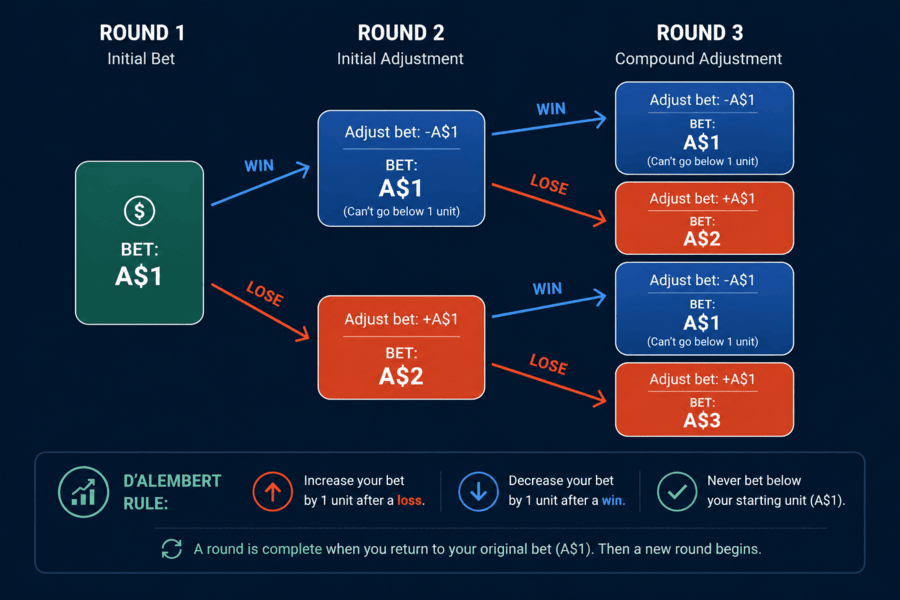
Unlike the Martingale betting strategy, the D’Alembert system doesn’t cause your wagers to explode after a few losses. The trade-off is that recovering losses takes much longer, and just like Martingale, the entire system still relies on chasing losses and hoping that wins arrive often enough to balance things out.
How Does the D'Alembert Strategy Work?
The D’Alembert strategy follows the same basic principle as Martingale: you increase your bet after a loss and reduce it after a win. The difference is that instead of doubling your stake, you only adjust it by one unit at a time.
It can be used with different types of roulette, and A$1 starting bets as an example:
- We bet A$1 on Black. The ball lands on 7 Red. We lose, so we increase our bet to A$2.
- We bet A$2 on Black. The ball lands on 31 Red. Another loss, so we increase our bet to A$3.
- We bet A$3 on Black. The ball lands on 22 Black. We win, so we decrease our next bet to A$2.
- We bet A$2 on Black. The ball lands on 4 Red. We lose, so we increase our next bet to A$3.
- We bet A$3 on Black. The ball lands on 15 Black. We win, so we decrease our next bet to A$2.
- We bet A$2 on Black. The ball lands on 35 Black. We win, so we decrease our next bet to A$1.
At this point, we’ve returned to our starting unit size, which effectively completes the progression.
The biggest advantage of D’Alembert is that your bets grow much more slowly than they do with Martingale. After two losses, you’re betting A$3, and after five losses, you’re betting A$6 instead of A$32. Of course, there’s a trade-off.
Since you’re increasing your bets more slowly, it also takes longer to recover previous losses. If you’ve lost 5 times in a row, it means that you now need to win 4 times in a row to make a profit of 1 unit. That’s why D’Alembert is often described as a better bankroll management strategy than the Martingale.
Tip from Mike Waters: The D’Alembert is a much slower strategy than the Martingale, so a low base unit sometimes doesn’t make sense. If your budget allows it, I would go with a slightly higher base bet here, like A$5 or even A$10, and use it on games like European roulette, which you’ll find at most of the top Australian roulette sites. Otherwise, you might end up playing for hours just to end up with virtually the same bankroll.
1000-Round D’Alembert Betting System Simulation
To test the D’Alembert betting system, I ran a 1,000-spin simulation on a European roulette wheel. The simulation only used Red/Black bets and followed the D’Alembert strategy to the dot, so let’s see what happened.
The starting bankroll was A$1,000, the betting unit was A$5, and every wager was placed on Black. The results were surprising, to say the least.
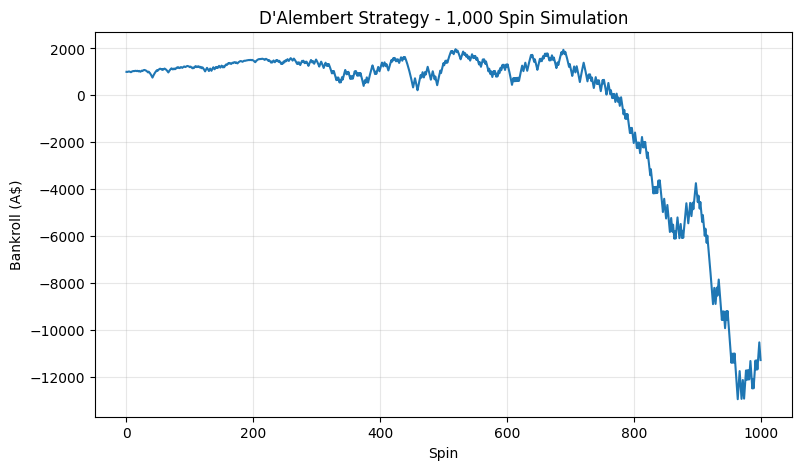
At one point, the bankroll climbed to A$1,965, almost doubling the starting balance. The progression was going as intended, but I guess the luck ran out by spin 700.
As the session progressed, several losing streaks forced the bet size to keep rising. The longest losing streak in the simulation was 13 consecutive losses, which pushed the active wager all the way to A$405 per spin. That’s a huge jump from the original A$5 betting unit, and the problem with the D’Alembert is that from that point onwards, the bankroll never recovered.
The wins were simply not large enough (or frequent enough) to offset the losses, and by round 780, the balance moved into negative territory. In a real-life scenario, this means that you’re out of money, so you need to leave the table, but I let the simulation run until the end. Believe it or not, by the end of the 1,000 spins, the bankroll stood at -A$11,295, while the lowest point of the simulation reached -A$12,965 at one point.
Obviously, it doesn’t mean that every simulation will go like this, but it shows the biggest weakness of this strategy: losing streaks will increase the bet size, and when that happens, you’ll need all the luck in the world to recover.
Disadvantages of the D'Alembert Betting System
The d’Alembert system is more conservative than many other betting progressions, but it still has some significant weaknesses. The biggest one is that you still need to increase the bet after each loss, which means that you’re chasing losses – and as I explained in my guides on beginner mistakes and hot and cold streaks, that’s inherently a bad strategy by itself. But let’s check out all the pitfalls of the D’Alembert strategy before we determine whether it’s a good pick for Australian players.
You're Still Chasing Losses
Every time you lose, the strategy tells you to increase your bet. The idea is to recover previous losses once the wins start arriving, but there’s no guarantee that they will. Essentially, this means that you will have to place large bets at some point, and there are no guarantees that you’ll ever recover.
Recovering Losses Takes Time
This is probably the biggest flaw of the system. Since you’re only increasing your bet by one unit at a time, a long losing streak can put you in a deep hole. To recover, you don’t just need one win, but you often need several wins in a relatively short period. If the wins and losses continue alternating, the bankroll can struggle to recover, and if this happens after a long losing streak, the bets may get uncomfortably large.
The House Edge Remains
No matter how you adjust your bet size, the odds of casino games stay exactly the same. The d’Alembert system doesn’t eliminate the house edge or improve your chances of winning over the long run, so it’s best to use it on games with high RTP. As I’ve explained before, the French and European versions provide the best long-term RTP.
Long Losing Streaks Hurt the Bankroll
The progression is slower than some other systems, but long losing streaks can still push the bet size to uncomfortable levels. As my simulation showed, a 13-spin losing streak increased the wager from A$5 to A$405 per spin.
Should You Use the d'Alembert Betting System?
Out of all the popular betting progressions, d’Alembert is one of the more sensible options, so my answer would be: yes, you should use it, but with caution. The bet increases are gradual, and the volatility is lower than many competing systems, which means that you’re less likely to find yourself placing absurdly large wagers after a long losing streak.
That said, the strategy still has some obvious flaws. It doesn’t remove the house edge (no strategy does that), and recovering losses often requires several wins in a relatively short period. As we saw in the simulation, a long losing streak can still put serious pressure on your bankroll.
If I were using the d’Alembert system, I’d pick one of the best Australian casinos and set both a profit target and a loss limit before starting. For example, with a A$1,000 bankroll and a A$5 unit size, I might stop once I reach A$1,200. A A$200 profit is a solid result, and there’s no point risking it by continuing to play.
Likewise, I’d decide in advance to set a stop-loss limit to protect you from the temptation to keep increasing your bets in an attempt to recover losses. However, I’d still use another, even slower strategy, like Oscar’s Grind, because I believe it has all the advantages of D’Albemert, but fewer disadvantages.
Latest Articles


Disclaimer: Gambling in Australia is strictly for individuals aged 18+. Our editorial team adheres to a strict policy to ensure that our reviews, recommendations, and content remain objective and free from external influence. We strongly encourage responsible gambling at all times. If you or someone you know is struggling with gambling addiction, visit the following gambling resources:
- https://responsiblewagering.com.au/
- https://www.gamblinghelponline.org.au/
- https://gamblershelp.com.au/get-help/