




It works by writing down a sequence of numbers and then wagering the sum of the first and last numbers in that sequence. If you win, you cross numbers off. If you lose, you add a new number to the end of the list.
I know that probably sounds more complicated than it really is, but don’t worry, I’ll explain exactly how the Labouchere system works, test it in a simulation, and see whether it’s worth your time.
What's the Labouchere Betting System?
The Labouchere betting system is a negative progression strategy that revolves around a predefined profit target. Yes, you predefine your own profit target, and then you work around it.
Unlike the Martingale system, which tells you exactly how much to bet after each loss, Labouchere lets you create your own betting sequence based on how much you want to win. The process starts by writing down a series of numbers. The total of those numbers represents your target profit for the session. For example, if you write down:
1 – 2 – 3 – 4
The total is A$10, which means your goal is to win A$10.
To determine your bet size, you simply add the first and last numbers in the sequence. In this case:
1 + 4 = A$5
If the bet wins, you cross off the first and last numbers. If the bet loses, you add the amount you just lost to the end of the sequence.
The strategy works best in bets like Red/Black, Odd/Even, and High/Low in all types of roulette, but I’ve seen players use it in other games as well, like baccarat and blackjack. The most important part is to have an even-money bet, so it’s best to choose a game like roulette.
As you can probably imagine, winning shortens the list, while losing makes it longer. The objective is to eventually cross off every number in the sequence, at which point you’ve achieved your original profit target.
Contrary to the Martingale, this is actually a cancellation system, and it doesn’t chase losses as aggressively.
How Does the Labouchere Betting System Work?
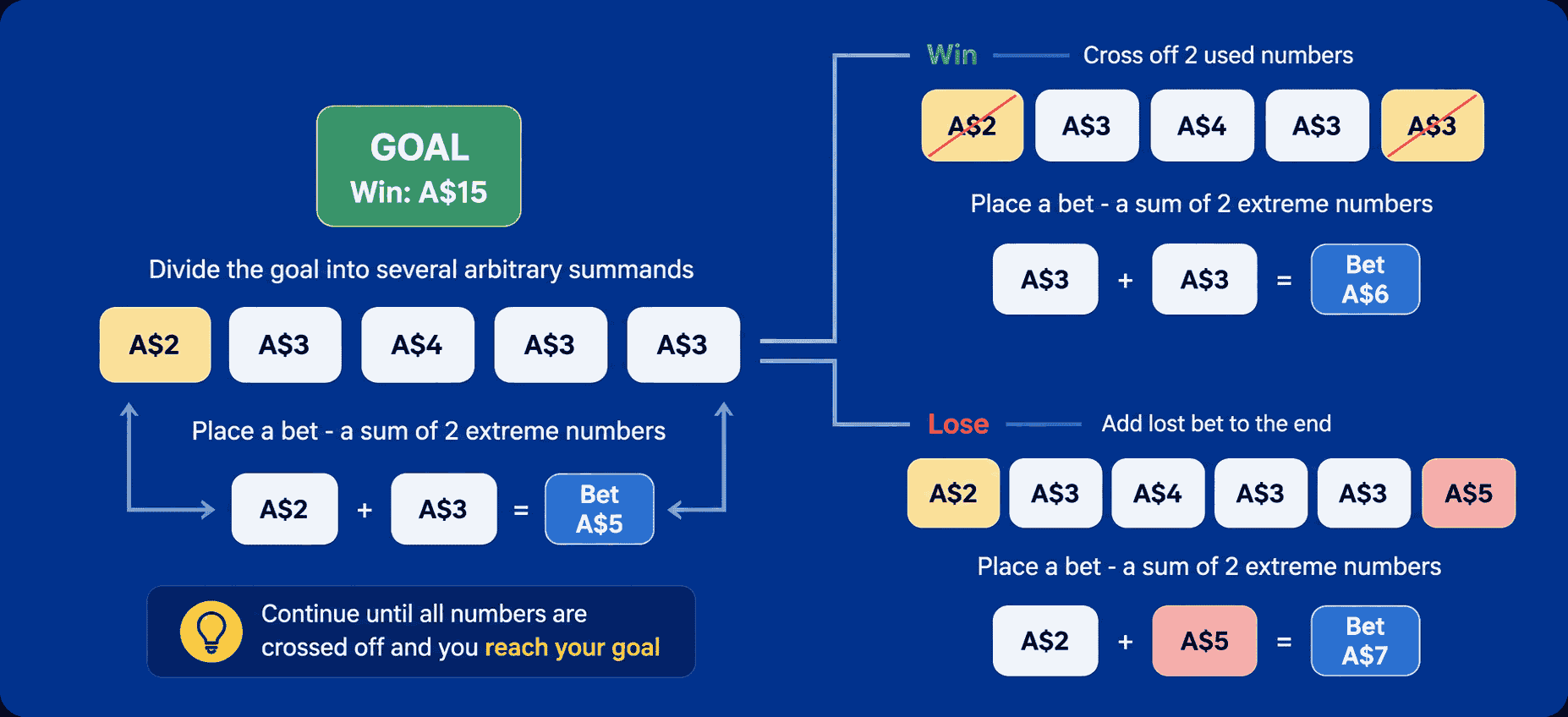
The best way to understand the Labouchere system is to see how it works in action. For this example, I’ll use European roulette and place all bets on Red.
Let’s say I want to win A$20, so I create the following sequence:
1 – 2 – 3 – 4 – 5 – 5
The total of these numbers is A$20, which means the sequence is complete once every number has been crossed off. You can choose any number as your goal, and you can add any numbers in the list, as long as their combined sum is your goal. It also doesn’t matter how many numbers the list has, but the fewer numbers it has, the easier it will be to finish a cycle.
Let’s see how the Labouchere betting system works in practice:
- To determine the first wager, we add the first and last numbers: 1 + 5 = A$6. We bet A$6 on Red. The ball lands on 28 Black. We lose, so we add the lost bet to the end of the sequence: 6. Now, our list looks like this: 1 – 2 – 3 – 4 – 5 – 5 – 6
- For our second bet, we add the first and last numbers again: 1 + 6 = A$7. We bet A$7 on Red, and the ball lands on 32 Red. We win, so we cross off the first and last numbers: 1 and 6.
- For our third bet, we add the first and last numbers of our updates list, so: 2 + 5 = A$7. We bet A$7 on Red. The ball lands on 7 Red. Another win, so we cross off the first and last numbers. The list is now 3 – 4 – 5.
- For our next bet, we add the first and last numbers again: 3 + 5 = A$8. We bet A$8 on Red, but the ball lands on 22 Black. We lose, so we add the lost stake to the end of the sequence.
- For our next bet, we add the first and last numbers again. Since our last number is now 8, we add: 3 + 8 = A$11. We bet A$11 on Red. The ball lands on 3 Red. We win, so we cross off the first and last numbers.
- For our next bet, we add the two remaining numbers: 4 + 5 = A$9. We bet A$9 on Red. The ball lands on 19 Red. We win, so we cross off both numbers and complete the sequence.
Every number has been cancelled by this point, which means that we have achieved our original target profit of A$20.
But what would have happened if we had lost several bets in a row?
Well, we’d simply keep adding the losing wagers to the end of the sequence and continue betting until every number is eventually crossed off. In theory, that’s exactly how the Labouchere system is supposed to work.
The problem is that each loss makes the sequence longer, which means the future bets become larger and larger.
Tip from Mike Waters: Although you can technically set any profit number and add as many numbers as you’d like in your list, I suggest keeping things small and realistic. For example, set a profit target of A$15 and don’t add more than 4 or 5 numbers in your list, because a cycle can get very lengthy if you have a lot of numbers in your Labouchere list.
1,000-Round Labouchere Simulation
To see how it performs in a real-life scenario, I tested the Labouchere strategy over 1,000 rounds of European roulette using a starting bankroll of A$1,000 and a fixed target profit of A$15 per cycle. Every new cycle used the same sequence: 1-2-3-4-5. I went with a simple sequence of 1-2-3-4-5 for simplicity and because I believe it’s a very balanced approach that doesn’t over-complicate things.
Here’s the graph of the run, where you can see how the Labouchere betting strategy performed for 1,000 rounds:
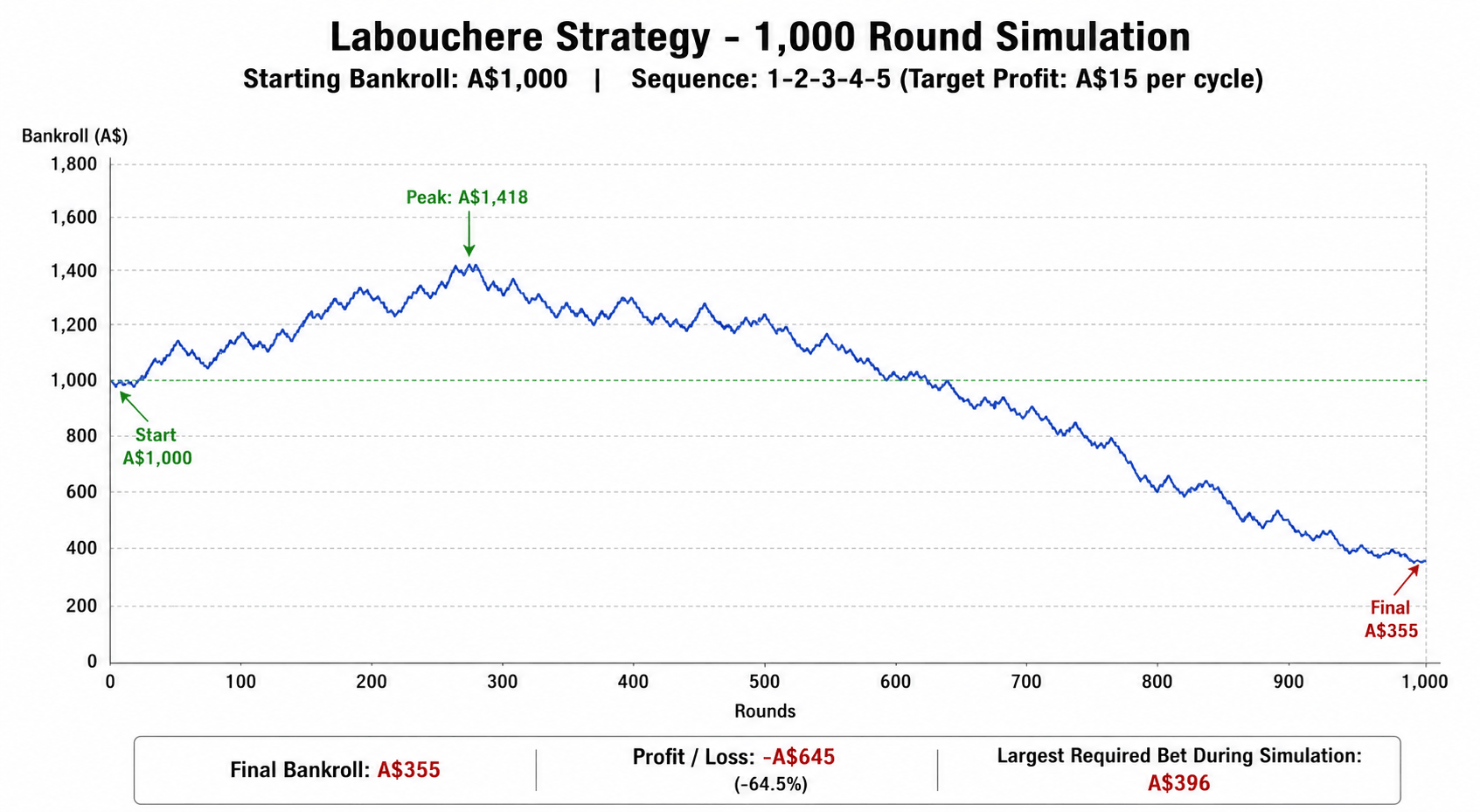
The session started well, and the bankroll climbed to more than A$1,400 at one stage. However, as the session progressed, several losing streaks caused the sequence to grow larger and larger.
By the end of the simulation, the bankroll had fallen to roughly A$355, while the sequence itself had expanded dramatically. The next required bet would have been almost A$400, despite the original target profit being just A$15. Obviously, the bankroll was too low to cover the bet, which essentially means that our player lost their entire starting bankroll.
Our run went as I expected, and it illustrates the biggest flaw of the Labouchere system: it’s still chasing losses (just not as aggressively as the Martingale).
Drawbacks of the Labouchere Betting System
The Labouchere system shares the same drawbacks as other strategies that are based on chasing losses. Admittedly, it is much slower than systems like the Martingale, and I can see why many players like the idea of setting a profit target before they begin. However, it comes with several shortcomings that are important to understand before you give it a try.
Losing Streaks Can Get Expensive
Every loss adds another number to the sequence, which means future bets become larger. A long losing streak can quickly increase your wager size so much that your bankroll won’t be able to cover it.
You're Still Chasing Losses
Labouchere is less aggressive than Martingale, but it’s still a negative progression system. The strategy relies on increasing stakes after losses, which means that you’re essentially chasing losses in an attempt to cover for them with a single big win.
Table Limits Can Stop the Strategy
If the sequence grows large enough, you may eventually reach the table’s maximum bet limit. This is less common at some of the top Australian casinos because many of them offer tables that can reach up to A$40,000 per bet, but it’s still a risk that every Labouchere player should be aware of.
Other Strategies Are Simpler
Labouchere isn’t difficult once you understand it, but it does require more tracking than most betting systems. If you prefer something simpler, consider the Fibonacci betting system, D’Alembert strategy, or Oscar’s Grind.
Should You Use the Labouchere Betting System?
Well, it’s a fun strategy, but I suggest you use it with caution.
Compared to the Martingale or even the Paroli system, the Labouchere system is more controlled and flexible. I like the fact that you can set your own profit target and that the progression doesn’t spiral out of control quite as quickly. However, as my simulation showed, the strategy is still based on chasing losses, and a long losing streak can create some very uncomfortable bet sizes.
Also, the Labouchere doesn’t remove the house edge or change the odds of the game. Don’t fall into the trap and assume that a win is “due” after several losses. Roulette, baccarat, blackjack, and other casino games don’t have a memory, and each round is independent of the previous one.
If you want to experiment with the Labouchere system, keep your profit targets realistic, use small stakes, and use short lists with 4-5 entries.
Latest Articles


Disclaimer: Gambling in Australia is strictly for individuals aged 18+. Our editorial team adheres to a strict policy to ensure that our reviews, recommendations, and content remain objective and free from external influence. We strongly encourage responsible gambling at all times. If you or someone you know is struggling with gambling addiction, visit the following gambling resources:
- https://responsiblewagering.com.au/
- https://www.gamblinghelponline.org.au/
- https://gamblershelp.com.au/get-help/