




So, how did it end up in a casino? Well, gamblers just love to believe in myths and fallacies, and they eventually decided that if the sequence was good enough for mathematics, poetry, and sunflowers, perhaps it could help them beat casino games too.
As much as I respect the beauty of the Fibonacci sequence, casino games don’t care about such patterns. They’re based on maths and probabilities, so can the Fibonacci system help you win? Stick around for this guide where I explain how the Fibonacci strategy works, test it in a simulation, and see if this mathematical celebrity is any good at the casino.
What's the Fibonacci Betting System?
The Fibonacci betting system is a negative progression strategy based on the famous Fibonacci sequence, where each number is the sum of the two numbers before it.
The sequence starts like this:
1, 1, 2, 3, 5, 8, 13, 21, 34, 55…
You’re probably thinking: But Mike, how will this sequence help me with gambling? Well, someone eventually had the idea of using these numbers as betting units.
Here’s how it works: you start with a one-unit bet. Every time you lose, you move one step forward (to the right) in the Fibonacci sequence and increase your wager accordingly. Every time you win, you move two steps back (left) in the sequence. The theory is that by stepping back two positions after a win, you’ll gradually recover previous losses and eventually return to profit.
Let’s use a A$1 unit as a simple example:
| Round | Stake | Result | Next Action |
|---|---|---|---|
| 1 | A$1 | Lose | Move to the next number in the sequence (A$1) |
| 2 | A$1 | Lose | Move to the next number (A$2) |
| 3 | A$2 | Lose | Move to the next number (A$3) |
| 4 | A$3 | Win | Move back two positions in the sequence (A$1) |
| 5 | A$1 | Win | Move back two positions to the start of the sequence |
If that sounds familiar, it’s because the Fibonacci system shares some similarities with Martingale and D’Alembert. Like those strategies, it’s designed to chase losses and help you recover from losing streaks by betting more after each loss. The difference is that instead of doubling your bets after every loss, the increases follow the Fibonacci sequence, which means the progression is slower and, at least in theory, less aggressive.
Of course, “less aggressive” doesn’t mean “safe.” The numbers may grow more slowly than Martingale, but it still has the same problems as the Martingale and every strategy that relies on hot and cold streaks.
How to Use the Fibonacci Betting System?
The Fibonacci strategy is most commonly used on even-money bets where the payouts are predictable, so most players use it on popular roulette bets like Red/Black, High/Low, or Odd/Even.
While you can, technically, use it in other games like baccarat, blackjack, or even crash games, it’s almost exclusively used on roulette. Also, since it doesn’t change the house edge, I strongly suggest sticking to high-RTP roulette types like European and French, and avoiding the American version.
For this example, I used European roulette, so here’s how a Fibonacci cycle might look using a A$1 base unit and all bets on Black:
- Bet A$1 on Black and lose. Move to the next number in the sequence to the right end, which means that we need to stick to A$1.
- Bet A$1 on Black and lose again. Move to the next number, which is 2, so we bet A$2.
- Bet A$2 on Black and lose. Move to the next number, which is 3 (since 2+1 = 3). This means that we need to increase the stake to A$3.
- Bet A$3 on Black and lose. The next number in the sequence is 5, so we bet A$5.
- Bet A$5 on Black and win. Now, we need to move two positions back in the sequence, so for the next wager, we’ll need to wager A$2.
- We wager A$2, and we win. We go two more steps back, which returns us to a A$1 stake.
As you can see, the Fibonacci system doesn’t chase losses quite as aggressively as Martingale, so instead of doubling after every losing spin, the stake increases gradually.
Note from Mike Waters: The Fibonacci system is based on a gambler’s fallacy, so I don’t expect it to be a “guaranteed way to win” because it isn’t. That said, I do appreciate the maths behind it. The progression grows much more gradually than Martingale, which makes it a more sensible bankroll management approach.
1,000-Round Simulation of Fibonacci Betting System
I ran a 1,000-round simulation to test how the Fibonacci betting systems work in practice. I used European roulette, and the starting bankroll was A$1,000 with a base unit of A$1.
The Fibonacci progression followed its traditional rules throughout the session. After every loss, the bet moved one step forward in the sequence (1, 1, 2, 3, 5, 8, 13, and so on). After every win, the bet moved two steps back. Whenever the sequence returned to the beginning, the cycle effectively reset.
I decided not to impose any artificial stop-loss limits, profit targets, or table limits, so, in other words, this was a pure Fibonacci simulation. This is what happened:
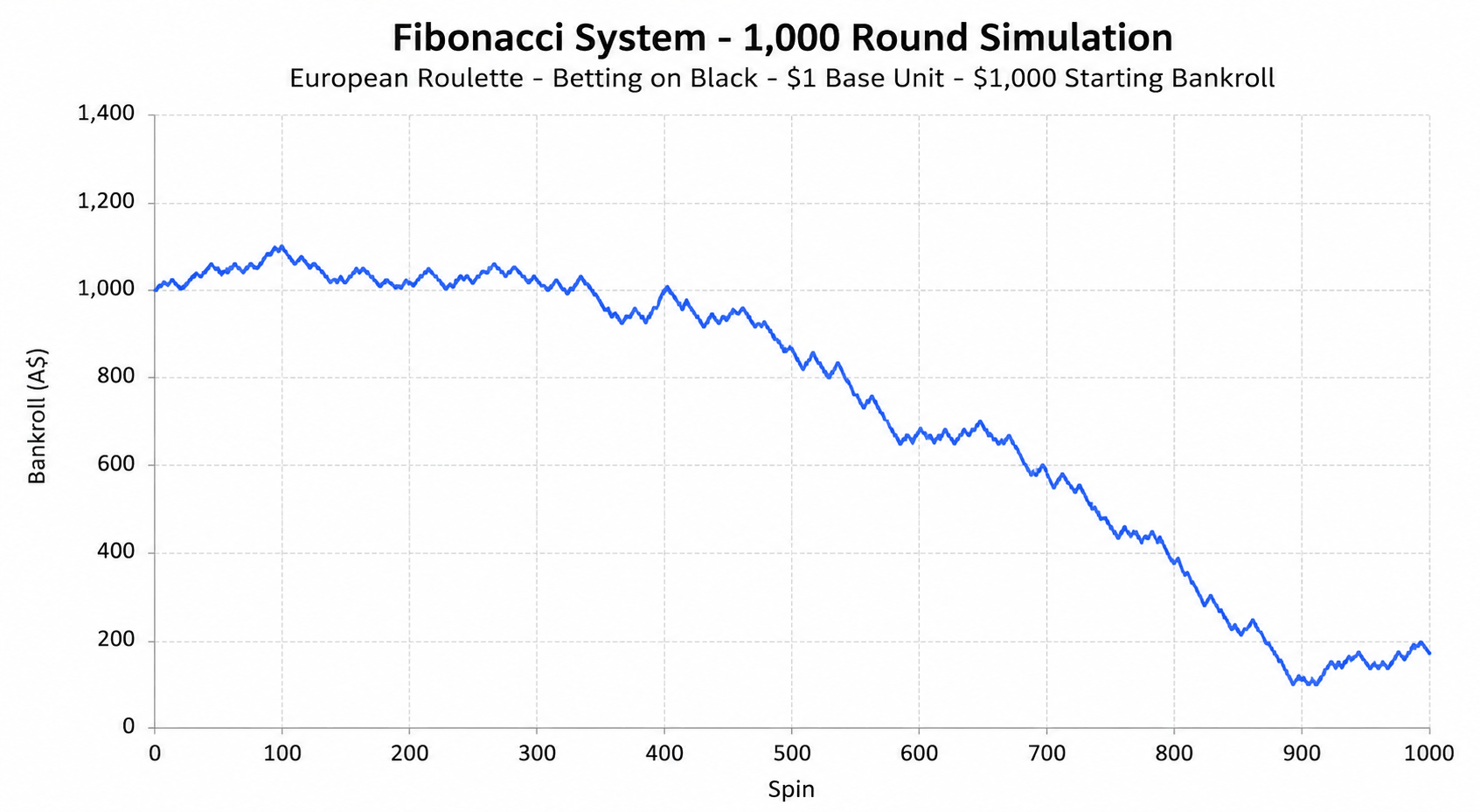
As you can see, my run ended with a loss of around A$800, but there were points when we were actually in profit. The peak was at the ~100th spin, when we were almost A$100 in profit before the line slowly started going down until the end.
Since the Fibonacci is a strategy that chases losses, I can’t say that these results were unexpected. However, I decided to run another simulation, this time with a bet size of A$10.
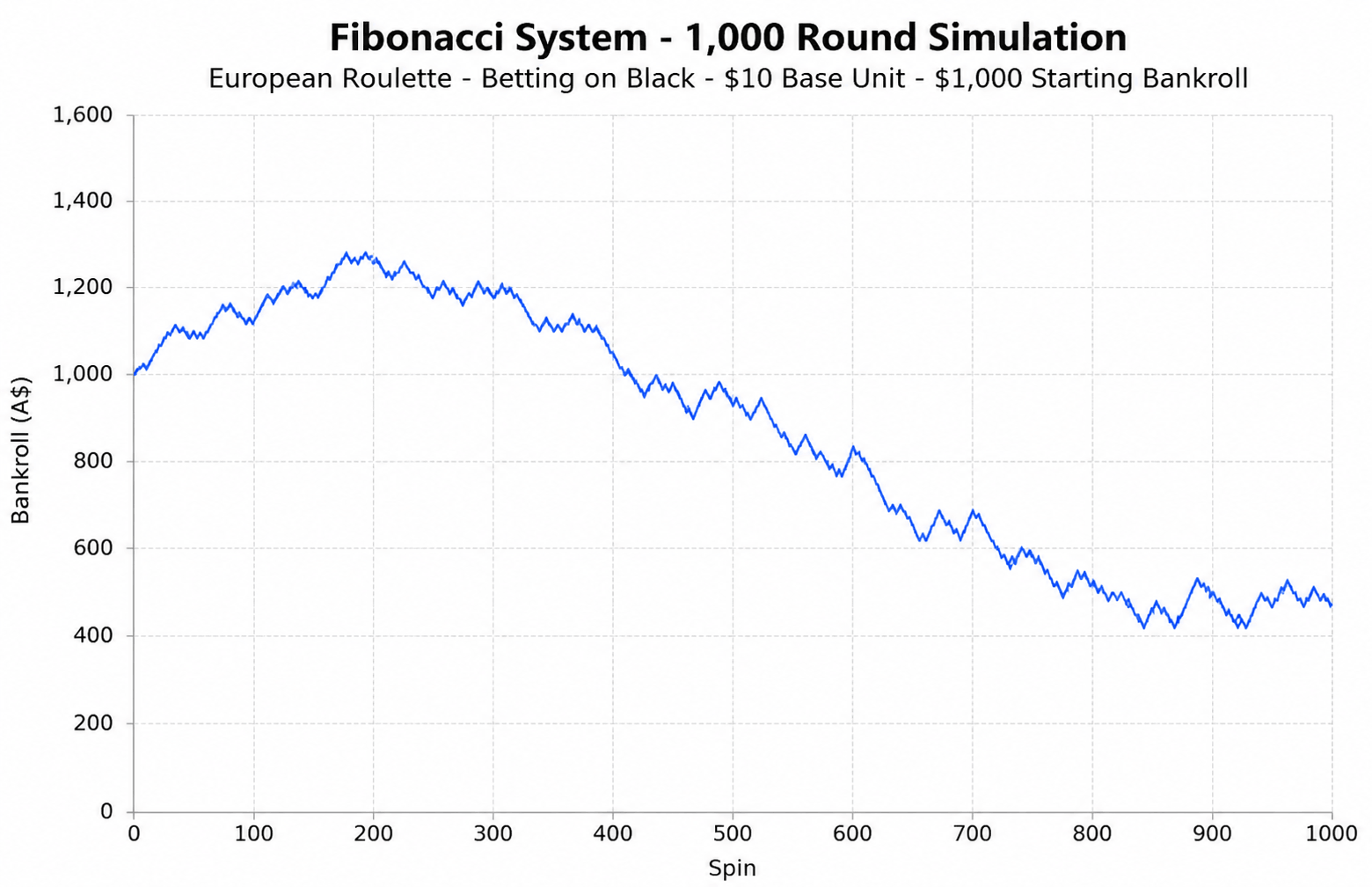
The bankroll initially climbed to around A$1,250 before hitting several losing streaks and ending the 1,000 spins with approximately A$480 in the bankroll and a loss of around A$520.
However, the most interesting takeaway is that Fibonacci really does feel safer than Martingale in the early stages because the bet growth is slower. But once you encounter a long enough losing streak, it deals with the exact same problems as every other betting strategy that’s chasing losses – and that’s one of the biggest beginner mistakes you can make.
Drawbacks of the Fibonacci Betting System
The Fibonacci strategy is often marketed as the “safer Martingale” because the bet progression is slower and less aggressive. And while there’s some truth to that, it still has several drawbacks that you should consider.
Long Losing Streaks Can Drain Your Bankroll
The biggest problem with Fibonacci is that it still relies on the assumption that you’ll eventually hit a win before the sequence gets out of hand. With a A$10 base bet, a losing streak of 10 losses in a row will bring your bet size to A$890.
The slow start creates a false sense of security, but the bet size becomes surprisingly large after a long losing streak, and as my simulations show, even a relatively short unlucky stretch can be costly.
You Can Still Reach the Table Limits
One of the reasons many players prefer Fibonacci over Martingale is that it takes longer to reach the maximum table limits. However, “longer” doesn’t mean “never.”
Many of the top Australian casinos offer roulette tables with maximum bets of several thousand dollars, and some high-limit tables can even reach A$10,000 or more. If you’re starting with a small base unit, you’re less likely to run into those limits.
Still, if the losing streak lasts long enough, the Fibonacci progression will eventually demand a bet that either exceeds the table limit or your bankroll, and that effectively means that you can no longer proceed with the strategy.
It Doesn't Change the House Edge
This is the drawback that applies to every betting system: the Fibonacci strategy changes how much you bet, but it doesn’t change the odds of the game. No matter how much you believe in the Fibonacci sequence, mathematics will eventually catch up.
Should You Use the Fibonacci Betting System?
While I do think that the Fibonacci system is worth trying, you should only approach it with realistic expectations.
Among the positive progression strategies, Fibonacci is one of the more sensible options. The gradual increase in bets makes it far less aggressive than Martingale, and I can see why so many roulette players are drawn to it. It’s also not as slow as strategies like Oscar’s Grind, and it’s actually fun to follow a pre-determined sequence of numbers for your bets.
My advice is: if you want to experiment with Fibonacci, start small. A base unit of A$1 or A$2 is more than enough while you’re learning how the progression works. Once you become comfortable with the sequence, you can decide whether increasing the stake makes sense for your bankroll.
The Fibonacci is definitely not a shortcut to beating the casino, but it will give your betting a bit more discipline and structure, which is never a bad thing.
Latest Articles


Disclaimer: Gambling in Australia is strictly for individuals aged 18+. Our editorial team adheres to a strict policy to ensure that our reviews, recommendations, and content remain objective and free from external influence. We strongly encourage responsible gambling at all times. If you or someone you know is struggling with gambling addiction, visit the following gambling resources:
- https://responsiblewagering.com.au/
- https://www.gamblinghelponline.org.au/
- https://gamblershelp.com.au/get-help/